
Synopsis
Following the Third Sobor, Metropolitan PLATON’s leadership position continued to be challenged. On the one hand, Kedrovsky intensified the divisive activities of the schismatic “Living Church,” and on the other hand, conflicting messages were emanating from Moscow. While in 1923 Patriarch TIKHON had confirmed Metropolitan PLATON’s election by the Third Sobor, in 1924 a Patriarchal decree appeared in the press in which Metropolitan PLATON was supposedly relieved of his position for “counter-revolution directed against the Soviet state.” According to the decree itself, it was to have no validity until announced personally to Metropolitan PLATON by the hierarch appointed to succeed him (an inconceivable scenario at that time). The resulting situation was one of chaos and instability. Therefore, the Church turned once again to her conciliar conscience to deal with this challenging crisis.
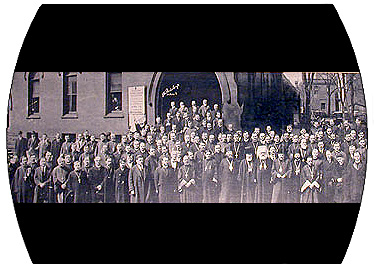
On April 2-4, 1924, the Fourth All-American Sobor was convened in Detroit, MI. Not wishing to sway the council’s decision by his presence, Metropolitan PLATON wisely absented himself from the opening session. Metropolitan PLATON’s election at the previous sobor was resoundingly reconfirmed at this session. Due to great respect for his leadership skills, his primacy was deemed essential for the Church’s survival. Sensing increasing difficulties in communication with the Russian Church as evidenced by the conflicting information being received, the Fourth Sobor decided to declare the North American Church to be “temporarily self-governing” until such time as normal and regular relations could be reestablished with the Mother Church in Russia.
The council also requested Metropolitan PLATON to draft a governing statute for the American Church, based on the Statute adopted by the Moscow Council of 1917-18. Although this statute would take thirty years to complete, the groundwork was laid by this council for the administrative structure by which the Orthodox Church in America is still governed today through her Statute, which is a somewhat revised version of the document which was initially broached at the Fourth Sobor. Additionally, the sobor issued a strong statement against Kedrovsky and the “Living Church” with particular attention to safeguarding the canonical Church’s property rights against spurious claims by schismatics in civil courts. In its proclamation of “temporary self-government,” the Fourth Sobor can be perceived as a major stride in the maturation process of the American Church and a stepping-stone towards the autocephaly envisioned by Saint TIKHON in a 1905 report in preparation for an eventual All-Russian Church Council.
Written by Alexis Liberovsky
Former OCA Archivist, Director of the Department of History and Archives.