In the Church’s annual liturgical cycle, Pentecost is “the last and great day.” It is the celebration by the Church of the coming of the Holy Spirit as the end—the achievement and fulfillment—of the entire history of salvation. For the same reason, however, it is also the celebration of the beginning: it is the “birthday” of the Church as the presence among us of the Holy Spirit, of the new life in Christ, of grace, knowledge, adoption to God and holiness.
This double meaning and double joy is revealed to us, first of all, in the very name of the feast. Pentecost in Greek means fifty, and in the sacred biblical symbolism of numbers, the number fifty symbolizes both the fulness of time and that which is beyond time: the Kingdom of God itself. It symbolizes the fulness of time by its first component: 49, which is the fulness of seven (7 x 7): the number of time. And, it symbolizes that which is beyond time by its second component: 49 + 1, this one being the new day, the “day without evening” of God’s eternal Kingdom. With the descent of the Holy Spirit upon Christ’s disciples, the time of salvation, the Divine work of redemption has been completed, the fulness revealed, all gifts bestowed: it belongs to us now to “appropriate” these gifts, to be that which we have become in Christ: participants and citizens of His Kingdom.
THE VIGIL OF PENTECOST
The all-night Vigil service begins with a solemn invitation:
“Let us celebrate Pentecost, the coming of the Holy Spirit, The appointed day of promise, and the fulfillment of hope, The mystery which is as great as it is precious.”
In the coming of the Spirit, the very essence of the Church is revealed:
“The Holy Spirit provides all, Overflows with prophecy, fulfills the priesthood, Has taught wisdom to illiterates, has revealed fishermen as theologians, He brings together the whole council of the Church.”
In the three readings of the Old Testament (Numbers 11:16-17, 24-29; Joel 2:23-32; Ezekiel 36:24-28) we hear the prophecies concerning the Holy Spirit. We are taught that the entire history of mankind was directed towards the day on which God “would pour out His Spirit upon all flesh.” This day has come! All hope, all promises, all expectations have been fulfilled. At the end of the Aposticha hymns, for the first time since Easter, we sing the hymn: “O Heavenly King, the Comforter, the Spirit of Truth...,” the one with which we inaugurate all our services, all prayers, which is, as it were, the life-breath of the Church, and whose coming to us, whose “descent” upon us in this festal Vigil, is indeed the very experience of the Holy Spirit “coming and abiding in us.”
Having reached its climax, the Vigil continues as an explosion of joy and light for “verily the light of the Comforter has come and illumined the world.” In the Gospel reading (John 20:19-23) the feast is interpreted to us as the feast of the Church, of her divine nature, power and authority. The Lord sends His disciples into the world, as He Himself was sent by His Father. Later, in the antiphons of the Liturgy, we proclaim the universality of the apostles’ preaching, the cosmical significance of the feast, the sanctification of the whole world, the true manifestation of God’s Kingdom.
THE VESPERS OF PENTECOST
The liturgical peculiarity of Pentecost is a very special Vespers of the day itself. Usually this service follows immediately the Divine Liturgy, is “added” to it as its own fulfillment. The service begins as a solemn “summing up” of the entire celebration, as its liturgical synthesis. We hold flowers in our hands symbolizing the joy of the eternal spring, inaugurated by the coming of the Holy Spirit. After the festal Entrance, this joy reaches its climax in the singing of the Great Prokeimenon:
“Who is so great a God as our God?”
Then, having reached this climax, we are invited to kneel. This is our first kneeling since Easter. It signifies that after these fifty days of Paschal joy and fulness, of experiencing the Kingdom of God, the Church now is about to begin her pilgrimage through time and history. It is evening again, and the night approaches, during which temptations and failures await us, when, more than anything else, we need Divine help, that presence and power of the Holy Spirit, who has already revealed to us the joyful End, who now will help us in our effort towards fulfillment and salvation.
All this is revealed in the three prayers which the celebrant reads now as we all kneel and listen to him. In the first prayer, we bring to God our repentance, our increased appeal for forgiveness of sins, the first condition for entering into the Kingdom of God.
In the second prayer, we ask the Holy Spirit to help us, to teach us to pray and to follow the true path in the dark and difficult night of our earthly existence. Finally, in the third prayer, we remember all those who have achieved their earthly journey, but who are united with us in the eternal God of Love.
The joy of Easter has been completed and we again have to wait for the dawn of the Eternal Day. Yet, knowing our weakness, humbling ourselves by kneeling, we also know the joy and the power of the Holy Spirit who has come. We know that God is with us, that in Him is our victory.
Thus is completed the feast of Pentecost and we enter “the ordinary time” of the year. Yet, every Sunday now will be called “after Pentecost”—and this means that it is from the power and light of these fifty days that we shall receive our own power, the Divine help in our daily struggle. At Pentecost we decorate our churches with flowers and green branches—for the Church “never grows old, but is always young.” It is an evergreen, ever-living Tree of grace and life, of joy and comfort. For the Holy Spirit—“the Treasury of Blessings and Giver of Life—comes and abides in us, and cleanses us from all impurity,” and fills our life with meaning, love, faith and hope.
Father Alexander Schmemann (1974)
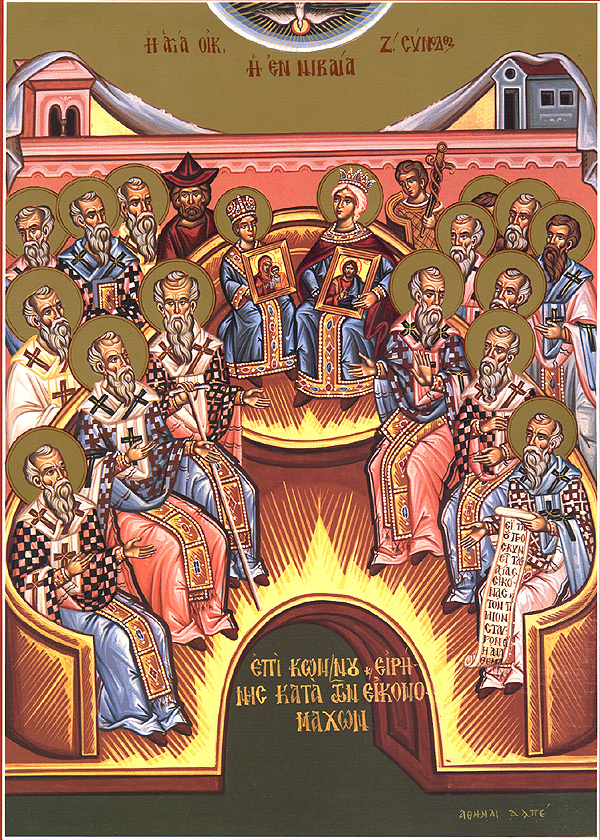
Commemoration of the Holy Fathers of the Seventh Ecumenical Council
Today the Church remembers the 350 holy Fathers of the Seventh Ecumenical Council under the holy Patriarch Tarasius (February 25).
The Synod of 787, the second to meet at Nicea, refuted the Iconoclast heresy during the reign of Empress Irene and her son Constantine VI.
The Council decreed that the veneration of icons was not idolatry (Exodus 20:4-5), because the honor shown to them is not directed to the wood or paint, but passes to the prototype (the person depicted). It also upheld the possibility of depicting Christ, Who became man and took flesh at His Incarnation. The Father, on the other hand, cannot be represented in His eternal nature, because “no man has seen God at any time” (John 1:18).
In Greek practice, the holy God-bearing Fathers of the Seventh Ecumenical Council are commemorated on October 11 (if it is a Sunday), or on the Sunday which follows October 11. According to the Slavic menaion, however, if the eleventh falls on Monday, Tuesday, or Wednesday, the service is moved to the preceding Sunday.
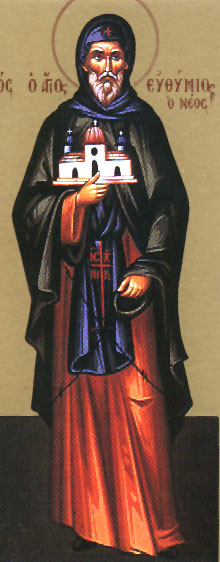
Venerable Euthymius the New of Thessalonica, and Monk of Mount Athos
Saint Euthymius the New of Thessalonica and Mt Athos, in the world was named Nicetas, and he was a native of the city of Ancyra in Galatia. His parents, Epiphanius and Anna, led virtuous Christian lives, and from childhood their son was meek, pious and obedient. At age seven he was left fatherless and he soon became the sole support of his mother in all matters. Having entered military service, Nicetas married, on the insistence of his mother. After the birth of a daughter, he secretly left home in order to enter a monastery. For fifteen years the venerable Euthymius lived the ascetic life on Mount Olympus, where he learned monastic deeds from the Elders.
The monk went to resettle on Mount Athos. On the way he learned that his mother and wife were in good health. He informed them that he had become a monk, and he sent them a cross, calling on them to follow his example. On Mt Athos he was tonsured into the Great Schema and lived for three years in a cave in total silence, struggling with temptations. Saint Euthymius also lived for a long time as a stylite, not far from Thessalonica, instructing those coming to him for advice and healing the sick.
The monk cleansed his mind and heart to such an extent that he was granted divine visions and revelations. At the command of the Lord, Saint Euthymius founded two monasteries in 863 on Mount Peristeros, not far from Thessalonica, which he guided for 14 years, with the rank of deacon. In one of these his wife and mother received monastic tonsure. Before his death he settled on Hiera, an island of Mt Athos, where he reposed in 898. His relics were transferred to Thessalonica. Saint Euthymius is called “the New” to distinguish him from Saint Euthymius the Great (January 20).
Martyr Lucian the Presbyter of Antioch
The Hieromartyr Lucian, Presbyter of Antioch, was born in the Syrian city of Samosata. At twelve years of age he was left orphaned. Lucian distributed his possessions to the poor, and went to the city of Edessa to the confessor Macarius, under the guidance of whom he diligently read Holy Scripture and learned the ascetic life. For his pious and zealous spreading of Christianity among the Jews and pagans, Lucian was made a presbyter.
In Antioch Saint Lucian opened a school where many students gathered. He taught them how to understand the Holy Scriptures, and how to live a virtuous life. Saint Lucian occupied himself with teaching, and he corrected the Greek text of the Septuagint, which had been corrupted in many places by copyists and by heretics who deliberately distorted it in order to support their false teachings. The entire Greek text of the Bible which he corrected was hidden in a wall at the time of his confession of Christ, and it was found during the lifetime of Saint Constantine the Great.
During the persecution of Diocletian, Saint Lucian was arrested and was sent to prison in Nicomedia, where for nine years he encouraged other Christians with him to remain steadfast in their confession of Christ, urging them not to fear tortures or death.
Saint Lucian died in prison from many terrible tortures and from hunger. Before his death, he wished to partake of the Holy Mysteries of Christ on the Feast of Theophany. Certain Christians who visited him brought bread and wine for the Eucharist. The hieromartyr, bound by chains and lying on a bed of sharp potsherds, was compelled to offer the Bloodless Sacrifice upon his chest, and all the Christians there in prison received Communion. The next day the emperor sent people to see if the saint was still alive. Saint Lucian said three times, “I am a Christian,” then surrendered his soul to God. The body of the holy martyr was thrown into the sea, but after thirty days dolphins brought it to shore. Believers reverently buried the body of the much-suffering Saint Lucian.
Saint Lucian was originally commemorated on January 7, the day of his death. Later, when the celebration of the Synaxis of Saint John the Baptist was appointed for this day, the feast of Saint Lucian was transferred to October 15.
The October date may be associated with the dedication of a church which was built in Antioch by Saint Helen (May 21) over Saint Lucian’s holy relics.
Although he was only a priest, sometimes Saint Lucian is depicted in the vestments of a bishop. The Stroganov Guide for Iconographers was published in Russia in 1869, based on a 1606 manuscript. There Saint Lucian is depicted wearing a phelonion and holding a Gospel. He does not wear the omophorion of a bishop, however. Another handbook, the Litsevoy Podlinnik, states that Saint Lucian is to be depicted with the omophorion.
It may be that the Russians thought of Saint Lucian as a bishop because of his importance to the Church, and so that is how they depicted him. Similarly, Saint Charalampus (February 10) is depicted as a priest in Greek icons, and as a bishop in Russian icons.
Saint John, Bishop of Suzdal
Saint John, Bishop of Suzdal, entered one of the monasteries of Suzdal while a youth. For his virtuous and humble life, the saint was made the first Bishop of Suzdal and Nizhegorod in 1350. Bishop John merited a great mercy of God: Prince Boris of Suzdal saw how an angel of God attended the saint during the Divine Liturgy.
Saint John was known for his love towards the destitute and the sick; he interceded for the poor before the princes to lower their taxes. He also built poor houses and hospices for the sick. The saint was very concerned about enlightening the pagan Mordvians with the Christian Faith. After the annexation of Suzdal to the Moscow Diocese, Saint John took the monastic schema and withdrew to the Bogoliub monastery. He lived there in seclusion and died in peace. Numerous miracles took place at his grave.
Hieromartyr Lucian the Presbyter of the Kiev Caves
Saint Lucian the Presbyter lived in the XIII century, and suffered martyrdom under Batu around 1243. Nothing else is known about him.
Saint Lucian's relics are in the Far Caves of Saint Theodosios, and his Feast Day is on October 15, because of his Patron Saint, Hieromartyr Lucian, the Presbyter of Antioch. He is also commemorated on August 28 (Synaxis of the Saints of the Kiev Caves, whose relics repose in the Far Caves of Saint Theodosios); and again on the second Sunday of Great Lent (Synaxis of all the Venerable Fathers of the Kiev Caves Monastery).
Martyrs Sarbelius and Bebaia of Edessa
The Holy Martyrs Sarbelus and Bebaia (Barbea) of Edessa were brother and sister, suffering in the second century under the emperor Trajan for confessing Christianity. Saint Sarbelus was a priest of the idols at Edessa, but was converted to Christ by a certain bishop, then he and his sister were baptized. Pagans tortured the saints for a long while, and then beheaded them.
These saints are also commemorated on January 29. Saint Sarbelus may be the same one who is commemorated on September 5.
Saint Sabinus, Bishop of Catania
Saint Sabinus, Bishop of Catania in Sicily, fervently desiring to serve the Lord, withdrew into the wilderness. Here he led a strict ascetic life and received from the Lord gifts of wonderworking and discernment.
“Multiplier of Wheat” Icon of the Mother of God
The Icon of the Mother of God, the “Multiplier of Wheat”, was painted at the blessing of the Elder Ambrose (October 10) of the Visitation Optina wilderness monastery. Saint Ambrose, a great Russian ascetic of the nineteenth century, was ardent with a childlike faith towards the Mother of God. In particular, he revered all the Feastdays of the Mother of God, and on these days he redoubled his prayer. With the icon, “Multiplier of Wheat,” Saint Ambrose blessed the Shamordino women’s monastery established in honor of the Kazan Icon of the Mother of God, which he had founded not far from the Optina monastery.
On this icon, the Mother of God is depicted sitting upon the clouds, and Her hands are extended in blessing. Beneath her is a compressed field, and on it amidst the grass and flowers stand and lay sheaves of rye. Elder Ambrose himself decreed the day of celebration, October 15, and called the icon “Multiplier of Wheat”, indicating by this, that the Most Holy Theotokos “is a Helper for people in their labors for the acquiring of their daily bread.”
Before his blessed repose, Saint Ambrose ordered many copies of this icon and sent them to his spiritual children. For the Akathist to this icon, the Elder composed a particular response, “Hail, Full of Grace, the Lord is with You! Grant unto us unworthy ones the dew of Your grace and the showing forth of Your mercy!”
Saint Ambrose’s burial took place on October 15, the Feastday of the icon. The first miracle from the holy icon was witnessed in 1891, when throughout Russia there was a famine because of crop failure. In the Kaluga district and on the fields of the Shamordino monastery, however, grain was produced. In 1892, already after the death of Saint Ambrose, his attendant John Cherepanov sent a copy of the icon to the Pyatnitsa women’s monastery in Voronezh district. In this locale there was a threat of drought and famine, but soon after a Molieben was celebrated before the icon “The Multiplier of Wheat”, rain fell and ended the drought.