
“Surety of Sinners” Icon of the Mother of God of Korets
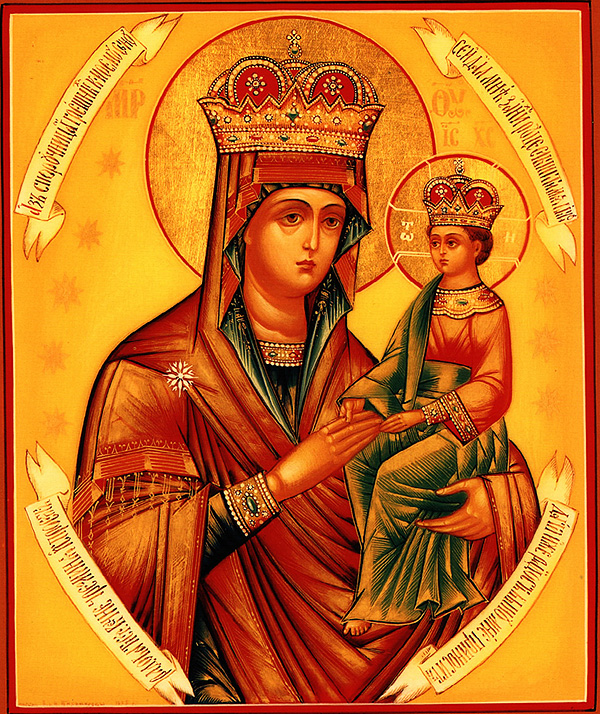
This ancient icon of the Mother of God "Surety of Sinners" of Korets was kept in the castle of the Korets Princes for a long time, and it was called "blessed."
After the death of Samuel, the last of the Orthodox Princes of Korets, his brother John offered to let his sister, Igoumeness Seraphima take the Icon from the Prince's chapel to Holy Resurrection Korets Maidens' Monastery. The solemn transfer of the Icon took place in 1622, on the Thursday after Pentecost. On that day, a Feast Day was established in honor of the "Surety of Sinners" Icon of Korets.
From 1752 to 1795, the fate of the Korets Icon was closely associated with the history of Korets Monastery, which was under the control of the Uniates. According to some reports, the Icon was moved several times during this period, and the "Surety of Sinners" Icon of Korets remained in the possession of the Catholics, who also revered it miraculous.
In 1795, by decree of Empress Catherine II, part of the Monastery was given to Orthodox nuns. The "Surety of Sinners" Icon of Korets was also returned to the Orthodox Monastery. On August 19, 1797 there was a fire in the Monastery. Some of the buildings were destroyed, but the wonderworking Icon was saved.
After the Monastery's restoration, the "Surety of Sinners" Icon was placed in the High Place1 in the new church of the Dormition, rebuilt with materials from the former trapeza. At this time a gilded silver oklad (with enamels) was made for the Icon.
After reconstruction and repairs in 1880, the consecration of Holy Trinity Monastery took place. The nuns of Holy Resurrection Monastery moved, and the Korets Holy Trinity Stavropegial Convent was formed. Its main shrine is the wonderworking "Surety of Sinners" Icon of Korets.
On August 17, 1998, Igoumeness Natalia (Ilchuk) of Korets Holy Trinity Monastery, sent a petition to Patriarch Alelxei II of Moscow and All Russia to include the Korets Icon of the Mother of God in its list of wonderworking icons of the Mother of God in the Patriarchal Church Calendar.
With the Patriarch's blessing, the celebration of the Korets Icon was approved. In November 2001, there was an attempt to steal the Icon, but the thieves managed to take only her precious oklad. Through public donations a new riza was made, which is a copy of the lost one.
More than once the wonderworking Icon revealed its grace-filled help for the suffering – in 1923, on the Feast of the Holy Trinity, a young man who was possessed by an unclean spirit was healed before the Icon. The following year, from the Feast of the Ascension until the Thursday after Pentecost, there were incessant showers in Volhynia. Miraculously, after a Cross Procession around the church with the Icon, the rain subsided.
Many of the faithful who turned to the Queen of Heaven for her help and intercession in case of any disorders, family problems, and particularly "afflictions of the soul," indicated that after praying before the Icon they received spiritual relief and peace, for she is truly the "Surety of Sinners."
The "Surety of Sinners" Icon of the Mother of God belongs to the Hodegetria (Hodēgḗtria) type. It is a half-length image of the Most Holy Theotokos with the Divine Infant on her left hand, Who holds her right hand with both hands.
The word "surety" means one who acts as a guarantor for us before God. The Most Holy Theotokos prays for all of us, good and evil, sinners and righteous, forgiving all, accepting all with equal love.
The inscription on the Icon reads: “I am the Surety of Sinners for my Son Who has entrusted me to hear them, and those who bring me the joy of hearing them shall receive everlasting joy through me.”
The "Surety of Sinners" Icon of Korets is painted on a wooden board measuring 102 x 76 centimeters. In contrast to the "Surety of Sinners" Icon of the Mother of God at Saint Nicholas Monastery in Odrino (March 7 and May 29), the Korets Icon shows the Mother of God and the Divine Infant inclined toward each other with their cheeks touching.
The Icon is located in Holy Trinity Convent at Korets.
1 That is, the area behind the altar.


