5th Sunday of Great Lent: St Mary of Egypt
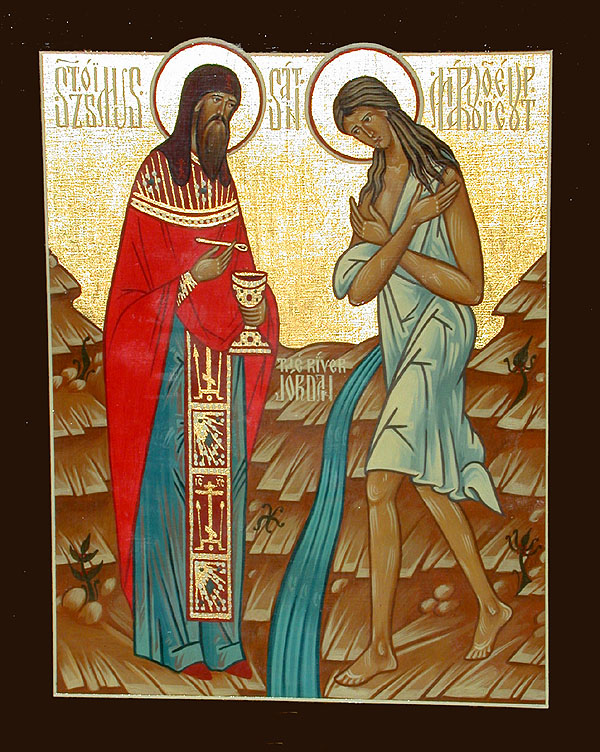
Saint Zosimas (April 4) was a monk at a certain Palestinian monastery on the outskirts of Caesarea. Having dwelt at the monastery since his childhood, he lived there in asceticism until he reached the age of fifty-three. Then he was disturbed by the thought that he had attained perfection, and needed no one to instruct him. “Is there a monk anywhere who can show me some form of asceticism that I have not attained? Is there anyone who has surpassed me in spiritual sobriety and deeds?”
Suddenly, an angel of the Lord appeared to him and said, “Zosimas, you have struggled valiantly, as far as this is in the power of man. However, there is no one who is righteous (Rom 3:10). So that you may know how many other ways lead to salvation, leave your native land, like Abraham from the house of his father (Gen 12:1), and go to the monastery by the Jordan.”
Abba Zosimas immediately left the monastery, and following the angel, he went to the Jordan monastery and settled in it.
Here he met Elders who were adept in contemplation, and also in their struggles. Never did anyone utter an idle word. Instead, they sang constantly, and prayed all night long. Abba Zosimas began to imitate the spiritual activity of the holy monks.
Thus much time passed, and the holy Forty Day Fast approached. There was a certain custom at the monastery, which was why God had led Saint Zosimas there. On the First Sunday of Great Lent the igumen served the Divine Liturgy, everyone received the All-Pure Body and Blood of Christ. Afterwards, they went to the trapeza for a small repast, and then assembled once more in church.
The monks prayed and made prostrations, asking forgiveness one of another. Then they made a prostration before the igumen and asked his blessing for the struggle that lay before them. During the Psalm “The Lord is my Light and my Savior, whom shall I fear? The Lord is defender of my life, of whom shall I be afraid?” (Ps 26/27:1), they opened the monastery gate and went off into the wilderness.
Each took with him as much food as he needed, and went into the desert. When their food ran out, they ate roots and desert plants. The monks crossed the Jordan and scattered in various directions, so that no one might see how another fasted or how they spent their time.
The monks returned to the monastery on Palm Sunday, each having his own conscience as a witness of his ascetic struggles. It was a rule of the monastery that no one asked how anyone else had toiled in the desert.
Abba Zosimas, according to the custom of the monastery, went deep into the desert hoping to find someone living there who could benefit him.
He walked into the wilderness for twenty days and then, when he sang the Psalms of the Sixth Hour and made the usual prayers. Suddenly, to the right of the hill where he stood, he saw a human form. He was afraid, thinking that it might be a demonic apparition. Then he guarded himself with the Sign of the Cross, which removed his fear. He turned to the right and saw a form walking southward. The body was black from the blazing sunlight, and the faded short hair was white like a sheep’s fleece. Abba Zosimas rejoiced, since he had not seen any living thing for many days.
The desert-dweller saw Zosimas approaching, and attempted to flee from him. Abba Zosimas, forgetting his age and fatigue, quickened his pace. When he was close enough to be heard, he called out, “Why do you flee from me, a sinful old man? Wait for me, for the love of God.”
The stranger said to him, “Forgive me, Abba Zosimas, but I cannot turn and show my face to you. I am a woman, and as you see, I am naked. If you would grant the request of a sinful woman, throw me your cloak so I might cover my body, and then I can ask for your blessing.”
Then Abba Zosimas was terrified, realizing that she could not have called him by name unless she possessed spiritual insight.
Covered by the cloak, the ascetic turned to Zosimas: “Why do you want to speak with me, a sinful woman? What did you wish to learn from me, you who have not shrunk from such great labors?”
Abba Zosimas fell to the ground and asked for her blessing. She also bowed down before him, and for a long time they remained on the ground each asking the other to bless. Finally, the woman ascetic said: “Abba Zosimas, you must bless and pray, since you are honored with the grace of the priesthood. For many years you have stood before the holy altar, offering the Holy Gifts to the Lord.”
These words frightened Saint Zosimas even more. With tears he said to her, “O Mother! It is clear that you live with God and are dead to this world. You have called me by name and recognized me as a priest, though you have never seen me before. The grace granted you is apparent, therefore bless me, for the Lord’s sake.”
Yielding finally to his entreaties, she said, “Blessed is God, Who cares for the salvation of men.” Abba Zosimas replied, “Amen.” Then they rose to their feet. The woman ascetic again said to the Elder, “Why have you come, Father, to me who am a sinner, bereft of every virtue? Apparently, the grace of the Holy Spirit has brought you to do me a service. But tell me first, Abba, how do the Christians live, how is the Church guided?”
Abba Zosimas answered her, “By your holy prayers God has granted the Church and us all a lasting peace. But fulfill my unworthy request, Mother, and pray for the whole world and for me a sinner, that my wanderings in the desert may not be useless.”
The holy ascetic replied, “You, Abba Zosimas, as a priest, ought to pray for me and for all, for you are called to do this. However, since we must be obedient, I will do as you ask.
The saint turned toward the East, and raising her eyes to heaven and stretching out her hands, she began to pray in a whisper. She prayed so softly that Abba Zosimas could not hear her words. After a long time, the Elder looked up and saw her standing in the air more than a foot above the ground. Seeing this, Zosimas threw himself down on the ground, weeping and repeating, “Lord, have mercy!”
Then he was tempted by a thought. He wondered if she might not be a spirit, and if her prayer could be insincere. At that moment she turned around, lifted him from the ground and said, “Why do your thoughts confuse you, Abba Zosimas? I am not an apparition. I am a sinful and unworthy woman, though I am guarded by holy Baptism.”
Then she made the Sign of the Cross and said, “May God protect us from the Evil One and his schemes, for fierce is his struggle against us.” Seeing and hearing this, the Elder fell at her feet with tears saying, “I beseech you by Christ our God, do not conceal from me who you are and how you came into this desert. Tell me everything, so that the wondrous works of God may be revealed.”
She replied, “It distresses me, Father, to speak to you about my shameless life. When you hear my story, you might flee from me, as if from a poisonous snake. But I shall tell you everything, Father, concealing nothing. However, I exhort you, cease not to pray for me a sinner, that I may find mercy on the Day of Judgment.
“I was born in Egypt and when I was twelve years old, I left my parents and went to Alexandria. There I lost my chastity and gave myself to unrestrained and insatiable sensuality. For more than seventeen years I lived like that and I did it all for free. Do not think that I refused the money because I was rich. I lived in poverty and worked at spinning flax. To me, life consisted in the satisfaction of my fleshly lust.
“One summer I saw a crowd of people from Libya and Egypt heading toward the sea. They were on their way to Jerusalem for the Feast of the Exaltation of the Holy Cross. I also wanted to sail with them. Since I had no food or money, I offered my body in payment for my passage. And so I embarked on the ship.
“Now, Father, believe me, I am very amazed, that the sea tolerated my wantonness and fornication, that the earth did not open up its mouth and take me down alive into hell, because I had ensnared so many souls. I think that God was seeking my repentance. He did not desire the death of a sinner, but awaited my conversion.
“So I arrived in Jerusalem and spent all the days before the Feast living the same sort of life, and maybe even worse.
“When the holy Feast of the Exaltation of the Venerable Cross of the Lord arrived, I went about as before, looking for young men. At daybreak I saw that everyone was heading to the church, so I went along with the rest. When the hour of the Holy Elevation drew nigh, I was trying to enter into the church with all the people. With great effort I came almost to the doors, and attempted to squeeze inside. Although I stepped up to the threshold, it was as though some force held me back, preventing me from entering. I was brushed aside by the crowd, and found myself standing alone on the porch. I thought that perhaps this happened because of my womanly weakness. I worked my way into the crowd, and again I attempted to elbow people aside. However hard I tried, I could not enter. Just as my feet touched the church threshold, I was stopped. Others entered the church without difficulty, while I alone was not allowed in. This happened three or four times. Finally my strength was exhausted. I went off and stood in a corner of the church portico.
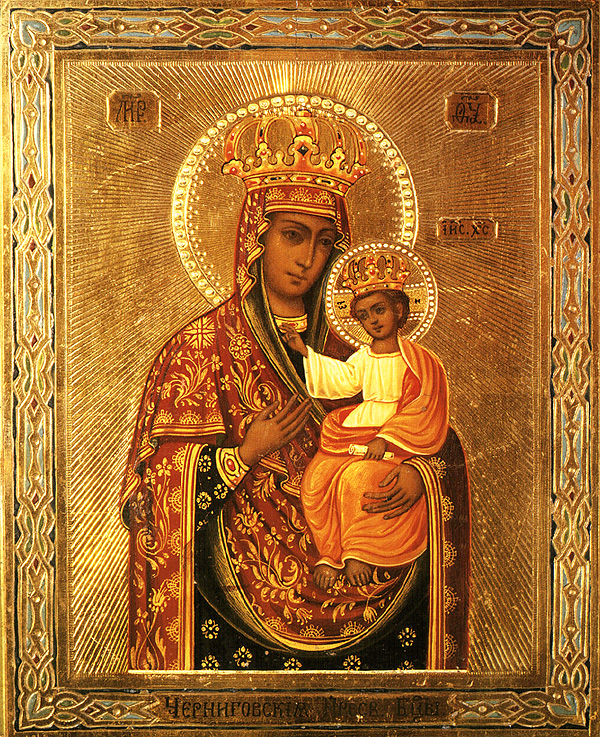
“Then I realized that it was my sins that prevented me from seeing the Life-Creating Wood. The grace of the Lord then touched my heart. I wept and lamented, and I began to beat my breast. Sighing from the depths of my heart, I saw above me an icon of the Most Holy Theotokos. Turning to Her, I prayed: “O Lady Virgin, who gave birth in the flesh to God the Word! I know that I am unworthy to look upon your icon. I rightly inspire hatred and disgust before your purity, but I know also that God became Man in order to call sinners to repentance. Help me, O All-Pure One. Let me enter the church. Allow me to behold the Wood upon which the Lord was crucified in the flesh, shedding His Blood for the redemption of sinners, and also for me. Be my witness before Your Son that I will never defile my body again with the impurity of fornication. As soon as I have seen the Cross of your Son, I will renounce the world, and go wherever you lead me.”
“After I had spoken, I felt confidence in the compassion of the Mother of God, and left the spot where I had been praying. I joined those entering the church, and no one pushed me back or prevented me from entering. I went on in fear and trembling, and entered the holy place.
“Thus I also saw the Mysteries of God, and how God accepts the penitant. I fell to the holy ground and kissed it. Then I hastened again to stand before the icon of the Mother of God, where I had given my vow. Bending my knees before the Virgin Theotokos, I prayed:
“‘O Lady, you have not rejected my prayer as unworthy. Glory be to God, Who accepts the repentance of sinners. It is time for me to fulfill my vow, which you witnessed. Therefore, O Lady, guide me on the path of repentance.’”
“Then I heard a voice from on high: ‘If you cross the Jordan, you will find glorious rest.’
“I immediately believed that this voice was meant for me, and I cried out to the Mother of God: ‘O Lady, do not forsake me!’
“Then I left the church portico and started on my journey. A certain man gave me three coins as I was leaving the church. With them I bought three loaves of bread, and asked the bread merchant the way to the Jordan.
“It was nine o’clock when I saw the Cross. At sunset I reached the church of Saint John the Baptist on the banks of the Jordan. After praying in the church, I went down to the Jordan and washed my face and hands in its water. Then in this same temple of Saint John the Forerunner I received the Life-Creating Mysteries of Christ. Then I ate half of one of my loaves of bread, drank water from the holy Jordan, and slept there that night on the ground. In the morning I found a small boat and crossed the river to the opposite shore. Again I prayed that the Mother of God would lead me where She wished. Then I found myself in this desert.”
Abba Zosimas asked her, “How many years have passed since you began to live in the desert?”
“‘I think,” she replied, “it is forty-seven years since I came from the Holy City.”
Abba Zosimas again asked, “What food do you find here, Mother?”
And she said, “I had with me two and a half loaves of bread when I crossed the Jordan. Soon they dried out and hardened Eating a little at a time, I finished them after a few years.”
Again Abba Zosimas asked, “Is it possible you have survived for so many years without sickness, and without suffering in any way from such a complete change?”
“Believe me, Abba Zosimas,” the woman said, “I spent seventeen years in this wilderness (after she had spent seventeen years in immorality), fighting wild beasts: mad desires and passions. When I began to eat bread, I thought of the meat and fish which I had in abundance in Egypt. I also missed the wine that I loved so much when I was in the world, while here I did not even have water. I suffered from thirst and hunger. I also had a mad desire for lewd songs. I seemed to hear them, disturbing my heart and my hearing. Weeping and striking myself on the breast, I remembered the vow I had made. At last I beheld a radiant Light shining on me from everywhere. After a violent tempest, a lasting calm ensued.
“Abba, how shall I tell you of the thoughts that urged me on to fornication? A fire seemed to burn within me, awakening in me the desire for embraces. Then I would throw myself to the ground and water it with my tears. I seemed to see the Most Holy Virgin before me, and She seemed to threaten me for not keeping my vow. I lay face downward day and night upon the ground, and would not get up until that blessed Light encircled me, dispelling the evil thoughts that troubled me.
“Thus I lived in this wilderness for the first seventeen years. Darkness after darkness, misery after misery stood about me, a sinner. But from that time until now the Mother of God helps me in everything.”
Abba Zosimas again inquired, “How is it that you require neither food, nor clothing?”
She answered, “After finishing my bread, I lived on herbs and the things one finds in the desert. The clothes I had when I crossed over the Jordan became torn and fell apart. I suffered both from the summer heat, when the blazing heat fell upon me, and from the winter cold, when I shivered from the frost. Many times I fell down upon the earth, as though dead. I struggled with various afflictions and temptations. But from that time until the present day, the power of God has guarded my sinful soul and humble body. I was fed and clothed by the all-powerful word of God, since man does not live by bread alone, but by every word proceeding from the mouth of God (Dt 8:3, Mt.4:4, Luke 4:4), and those who have put off the old man (Col 3:9) have no refuge, hiding themselves in the clefts of the rocks (Job 24:8, Heb 11:38). When I remember from what evil and from what sins the Lord delivered me, I have imperishible food for salvation.”
When Abba Zosimas heard that the holy ascetic quoted the Holy Scripture from memory, from the Books of Moses and Job and from the Psalms of David, he then asked the woman, “Mother, have you read the Psalms and other books?”
She smiled at hearing this question, and answered, “Believe me, I have seen no human face but yours from the time that I crossed over the Jordan. I never learned from books. I have never heard anyone read or sing from them. Perhaps the Word of God, which is alive and acting, teaches man knowledge by itself (Col 3:16, 1 Thess 2:13). This is the end of my story. As I asked when I began, I beg you for the sake of the Incarnate Word of God, holy Abba, pray for me, a sinner.
“Furthermore, I beg you, for the sake of Jesus Christ our Lord and Savior, tell no one what you have heard from me, until God takes me from this earth. Next year, during Great Lent, do not cross the Jordan, as is the custom of your monastery.”
Again Abba Zosimas was amazed, that the practice of his monastery was known to the holy woman ascetic, although he had not said anything to her about this.
“Remain at the monastery,” the woman continued. “Even if you try to leave the monastery, you will not be able to do so. On Great and Holy Thursday, the day of the Lord’s Last Supper, place the Life-Creating Body and Blood of Christ our God in a holy vessel, and bring it to me. Await me on this side of the Jordan, at the edge of the desert, so that I may receive the Holy Mysteries. And say to Abba John, the igumen of your community, ‘Look to yourself and your brothers’ (1 Tim 4:16), for there is much that needs correction. Do not say this to him now, but when the Lord shall indicate.”
Asking for his prayers, the woman turned and vanished into the depths of the desert.
For a whole year Elder Zosimas remained silent, not daring to reveal to anyone what he had seen, and he prayed that the Lord would grant him to see the holy ascetic once more.
When the first week of Great Lent came again, Saint Zosimas was obliged to remain at the monastery because of sickness. Then he remembered the woman’s prophetic words that he would not be able to leave the monastery. After several days went by, Saint Zosimas was healed of his infirmity, but he remained at the monastery until Holy Week.
On Holy Thursday, Abba Zosimas did what he had been ordered to do. He placed some of the Body and Blood of Christ into a chalice, and some food in a small basket. Then he left the monastery and went to the Jordan and waited for the ascetic. The saint seemed tardy, and Abba Zosimas prayed that God would permit him to see the holy woman.
Finally, he saw her standing on the far side of the river. Rejoicing, Saint Zosimas got up and glorified God. Then he wondered how she could cross the Jordan without a boat. She made the Sign of the Cross over the water, then she walked on the water and crossed the Jordan. Abba Zosimas saw her in the moonlight, walking toward him. When the Elder wanted to make prostration before her, she forbade him, crying out, “What are you doing, Abba? You are a priest and you carry the Holy Mysteries of God.”
Reaching the shore, she said to Abba Zosimas, “Bless me, Father.” He answered her with trembling, astonished at what he had seen. “Truly God did not lie when he promised that those who purify themselves will be like Him. Glory to You, O Christ our God, for showing me through your holy servant, how far I am from perfection.”
The woman asked him to recite both the Creed and the “Our Father.” When the prayers were finished, she partook of the Holy Mysteries of Christ. Then she raised her hands to the heavens and said, “Lord, now let Your servant depart in peace, for my eyes have seen Your salvation.”
The saint turned to the Elder and said, “Please, Abba, fulfill another request. Go now to your monastery, and in a year’s time come to the place where we first time spoke.”
He said, “If only it were possible for me to follow you and always see your holy face!”
She replied, “For the Lord’s sake, pray for me and remember my wrechedness.”
Again she made the Sign of the Cross over the Jordan, and walked over the water as before, and disappeared into the desert. Zosimas returned to the monastery with joy and terror, reproaching himself because he had not asked the saint’s name. He hoped to do so the following year.
A year passed, and Abba Zosimas went into the desert. He reached the place where he first saw the holy woman ascetic. She lay dead, with arms folded on her bosom, and her face was turned to the east. Abba Zosimas washed her feet with his tears and kissed them, not daring to touch anything else. For a long while he wept over her and sang the customary Psalms, and said the funeral prayers. He began to wonder whether the saint would want him to bury her or not. Hardly had he thought this, when he saw something written on the ground near her head: “Abba Zosimas, bury on this spot the body of humble Mary. Return to dust what is dust. Pray to the Lord for me. I reposed on the first day of April, on the very night of the saving Passion of Christ, after partaking of the Mystical Supper.”
Reading this note, Abba Zosimas was glad to learn her name. He then realized that Saint Mary, after receiving the Holy Mysteries from his hand, was transported instantaneously to the place where she died, though it had taken him twenty days to travel that distance.
Glorifying God, Abba Zosimas said to himself, “It is time to do what she asks. But how can I dig a grave, with nothing in my hands?” Then he saw a small piece of wood left by some traveler. He picked it up and began to dig. The ground was hard and dry, and he could not dig it. Looking up, Abba Zosimas saw an enormous lion standing by the saint’s body and licking her feet. Fear gripped the Elder, but he guarded himself with the Sign of the Cross, believing that he would remain unharmed through the prayers of the holy woman ascetic. Then the lion came close to the Elder, showing its friendliness with every movement. Abba Zosimas commanded the lion to dig the grave, in order to bury Saint Mary’s body. At his words, the lion dug a hole deep enough to bury the body. Then each went his own way. The lion went into the desert, and Abba Zosimas returned to the monastery, blessing and praising Christ our God.
Arriving at the monastery, Abba Zosimas related to the monks and the igumen, what he had seen and heard from Saint Mary. All were astonished, hearing about the miracles of God. They always remembered Saint Mary with faith and love on the day of her repose.
Abba John, the igumen of the monastery, heeded the words of Saint Mary, and with the help of God corrected the things that were wrong at the monastery. Abba Zosimas lived a God-pleasing life at the monastery, reaching nearly a hundred years of age. There he finished his temporal life, and passed into life eternal.
The monks passed on the life of Saint Mary of Egypt by word of mouth without writing it down.
“I however,” says Saint Sophronius of Jerusalem (March 11), “wrote down the Life of Saint Mary of Egypt as I heard it from the holy Fathers. I have recorded everything, putting the truth above all else.”
“May God, Who works great miracles and bestows gifts on all who turn to Him in faith, reward those who hear or read this account, and those who copy it. May he grant them a blessed portion together with Saint Mary of Egypt and with all the saints who have pleased God by their pious thoughts and works. Let us give glory to God, the Eternal King, that we may find mercy on the Day of Judgment through our Lord Jesus Christ, to Whom is due all glory, honor, majesty and worship together with the Unoriginate Father, and the Most Holy and Life-Creating Spirit, now and ever and unto ages of ages. Amen.”