At the end of Chapter 8 in Gospel of Saint John, the Savior was disputing with the Pharisees in the Temple during the Feast of Tabernacles. He told them, "Your father Abraham was glad that he should see my day; and he saw it and rejoiced" (John 8:56). The Jews said that Jesus was not even fifty years old, so how could He claim to have seen Abraham? The Lord replied, "Before Abraham was, I am." I am, of course, is the name that God revealed to Moses in the Burning Bush. When the Jews picked up stones to throw at Him, He hid Himself and went out of the Temple.
We read in SaInt John's Gospel (9:1-38): "As He passed by, he saw a man who was blind from birth." It might appear that Jesus was on His way to something or someone else, but in his Commentary on the Gospel of Saint John, the ever-memorable Archbishop Dmitri of Dallas, quotes from Homily LVI of Saint John Chrysostom: "that on going out of the Temple, He proceeded intentionally to the work, is clear from this: it was He who saw the blind man, and not the blind man who came to Him...."
Christ's disciples asked Him who had sinned, the blind man or his parents that he had been born blind. Jesus answered, "Neither this man nor his parents sinned, but that the works of God might be manifested in him" (John 9:3). It was thought that a person who had some affliction must have sinned (or his parents did) to deserve such punishment. In the Book of Exodus (20:5), God said that he would visit "the iniquity of the fathers upon the children unto the third and fourth generation." This, however, applied to the sin of idolatry, if the children emulated their parents' behavior.
The blind man was not born blind just so the miracle could be performed, but seeing the man in such a condition, the Lord decided to use him in a way that would manifest God's glory. He Who is the Light of the world healed the blind man and enlightened him. Giving sight to the blind was one of the signs which would identify the Messiah (Matthew 11:4-6).
The Lord made clay when He spat on the ground, and placed it in the man’s empty eye sockets and sent him to the pool of Siloam to wash. Most versions of the Gospels translate the word επεθηκεν as "anointed," but it can also mean "to spread on," or "to smear." Siloam means "sent," and in Saint John's Gospel Christ says about forty times that He Himself had been sent by the Father."
This manner of healing reminds us of the way God created man by fashioning him from the dust of the earth. In the Old Testament God created man from the dust of the earth, now Christ, the same God, fashions eyes from the clay and places them in the blind man’s empty sockets. Here are some quotes from the Pentecostarion:
At the Oikos of Matins: "He receives physical eyes as well as those of the soul."
In the Verses of the Synaxarion: O Bestower of light. Who are Light coming forth from Light; You gave eyes to the man who was blind from birth, O Word."
In the second exapostilarion: "Along the way, the Savior found a man who lacked both sight and eyes."
At Monday Vespers (stikheron of the Feast) we sing, "With his whole soul, and mind, and his tongue, the man who in times not long passed had been blind, confessed Him Who had fashioned eyes for him out of spittle and clay..."
Saint Theophylaktos says in his Commentary that "Jesus our Lord fashioned all the members of the blind man's body except for the eyes, which He omitted. By healing them now, he completes the divine act of creating and demonstrates that He is the Creator."
Jesus tests the faith of the blind man by sending him to the Pool of Siloam (which means “sent”). He respects the man’s freedom, but asks for his voluntary and free participation in the miracle. The blind man, with faith, obeys God’s command. He goes and washes in the pool, and he returns seeing.
The former blind man’s life was not made easier, however. He becomes the object of the Scribes' and Pharisees' evil and hatred, those who believed in God and in the observance of His Law. They themselves were blind, yet they were suspicious of the formerly blind man, imagining that he only pretended to be blind and now was able to see. "They willingly were made blind by the dark letter of the Law, in which Christ, the resplendent Sun shines."1
They questioned the man who was blind, but when they see the miracle before their eyes, instead of believing, they shut the eyes of their souls. Then the man's parents were questioned. They were afraid to confirm the miracle that happened to their son who was born blind, because they did not want to be expelled from the synagogue. They tried to avoid trouble by concealing the truth. Therefore, they said, "He is of age, ask him!"
We who receive benefits from God every day are ashamed or afraid to confess God because of our lack of trust. We put our own interests above God, knowing that He will understand us! He will understand us, but He will also see our faith and what priorities we have in our lives. Christ will see what "gods" we have put in His place, but He will not cease to remind us that He is the light of the world.
The blind man was healed, not only in the eyes of his body but eventually in his soul as well. He recognizes Jesus as God, and does not hesitate to confess it before the religious rulers with courage that many of us would envy. Faith alone is not enough, we also need to confess our faith in order to become genuine children of God. When we confess Christ before men, He will confess us before His Father, as the Lord has promised us: "Everyone who shall confess me before men, I also shall confess him before my Father who is in Heaven; and whoever denies me before men I also will deny him before my Father who is in Heaven" (Matthew 10:32).
In addition to the Sunday of the Blind Man, today the Church also commemorates the Icon of the Mother of God "Of the Passion" (see August 13) in remembrance of the miracles which occurred on this day.
In the Moscow church of the Unburnt Bush in the Khamovniki district, there is an Icon which was once in the Palace. The ancient writing is beautiful. The size of the Icon measures 1 arshin 12 vershkov long, and 1 arshin 7 vershkov wide. This Icon is commemorated twice: on September 4, the Feast Day of the Prophet Moses, and also on the Sixth Sunday After Pascha (the Sunday of the Blind Man), because according to Tradition, the Icon was transferred from the Kremlin to the newly-consecrated Khamovniki church on this day.
At Khamovniki is the Novodevichii Convent (founded in 1524) and the Zachatievsky convent (founded in 1584), the rebuilt cathedral of Christ the Savior, the church of Saint Nicholas the Wonderworker at Khamovniki and others. More than ten Orthodox churches in Khamovniki were destroyed during the Soviet era. Memorial chapels and memorial signs have now been placed on the site of some of the destroyed temples. Khamovniki is also the working residence of the Patriarch of Moscow and All Russia, and the Publishing Council of the Russian Orthodox Church.
1 Sunday of the Blind man, at Vespers, fourth stikheron on "Lord, I Call."
Icon of the Mother of God “of the Passion”
The Icon of the Mother of God “Of the Passion” The icon received its name because on either side of the Mother of God are two angels with the implements of the Lord’s suffering: the Cross, the lance, and the sponge.
There was a certain pious woman, Katherine, who began to suffer seizures and madness after her marriage. She ran off into the forest and attempted suicide more than once.
In a moment of clarity she prayed to the Mother of God and vowed that if she were healed, she would enter a monastery. After recovering her health, she only remembered her vow after a long time. Afraid and mentally afflicted, she took to her bed. Three times the Most Holy Theotokos appeared to her, commanding the sick woman to go to Nizhni-Novgorod and to buy Her icon from the iconographer Gregory.
After she had done this, Katherine received healing. From that time on, miracles have occurred from this icon. The Feast day of this icon is on August 13, commemorating its transfer from the village of Palitsa to Moscow in 1641. A church was built at the place where it was met at the Tver gates, and in 1654, the Strastna monastery was built.
The icon is also commemorated on April 30, and on the sixth Sunday after Pascha (the Sunday of the Blind Man) in memory of the miracles which occurred on this day. Other “Passion” icons of the Mother of God have been glorified in the Moscow church of the Conception of Saint Anna, and also in the village of Enkaeva in Tambov diocese.
Commemoration of the Holy Fathers of the Seventh Ecumenical Council
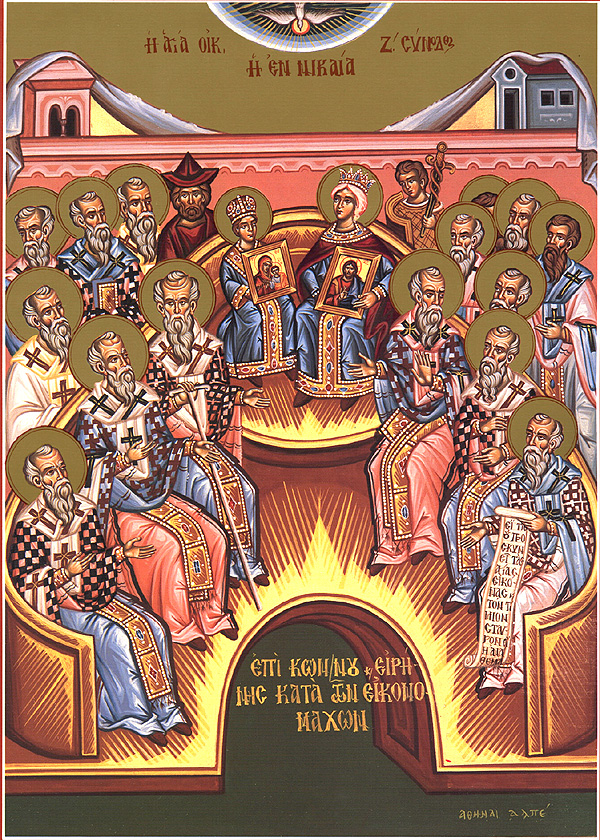
Today the Church remembers the 350 holy Fathers of the Seventh Ecumenical Council under the holy Patriarch Tarasius (February 25).
The Synod of 787, the second to meet at Nicea, refuted the Iconoclast heresy during the reign of Empress Irene and her son Constantine VI.
The Council decreed that the veneration of icons was not idolatry (Exodus 20:4-5), because the honor shown to them is not directed to the wood or paint, but passes to the prototype (the person depicted). It also upheld the possibility of depicting Christ, Who became man and took flesh at His Incarnation. The Father, on the other hand, cannot be represented in His eternal nature, because “no man has seen God at any time” (John 1:18).
In Greek practice, the holy God-bearing Fathers of the Seventh Ecumenical Council are commemorated on October 11 (if it is a Sunday), or on the Sunday which follows October 11. According to the Slavic menaion, however, if the eleventh falls on Monday, Tuesday, or Wednesday, the service is moved to the preceding Sunday.
Martyrs Probus, Tarachus, and Andronicus, at Tarsus in Cilicia
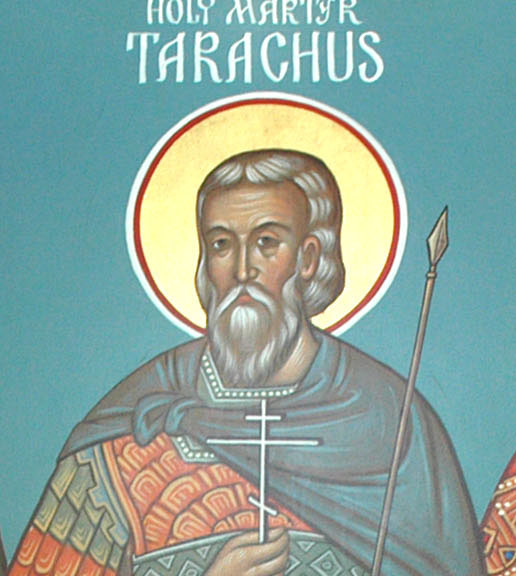
The Martyrs Tarachus, Probus, and Andronicus suffered for Christ in the year 304 at Tarsus in Cilicia. When the pagans ordered him to offer sacrifice to idols, the old soldier Tarachus replied that he would offer a pure heart to the one true God instead of sacrifices of blood. Seeing the firmness of the saint’s confession the true Faith, the proconsul gave them all over to torture.
“When my body suffers,” Saint Probus said to the idol worshippers, “then my soul is healed and invigorated.” The tormentors refined their tortures, such as their rage could invent, and then they tore the bodies of the saints apart. Christians secretly took up the relics of the saints and buried them.
Saint Cosmas the Hymnographer, Bishop of Maiuma
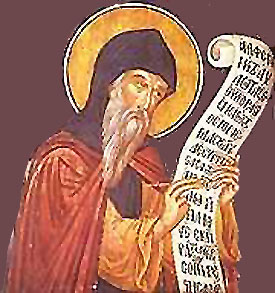
Saint Cosmas the Hymnographer, Bishop of Maiuma, was a native of Jerusalem. He was raised by the parents of Saint John of Damascus (December 4) together with their son, and he received a fine education. When Saint Cosmas came of age, he set out to one of the monasteries of Palestine, where he attained renown for his monastic exploits.
During a time of persecution against holy icons Saint Cosmas, and the venerable John, came forward to defend Orthodoxy. In the year 743 Cosmas was made Bishop of Maiuma. He died in old age, leaving behind many canons for feast days and a Triodion for four days of Holy Week.
In Slavic usage Saint Cosmas the Hymnographer is commemorated on October 12, but on October 14, according to Greek usage.
Venerable Amphilochius, Abbot of Glushetsa
Saint Amphilochius, Abbot of Glushetsa, already a monk of priestly rank, came from Ustiug to Saint Dionysius of Glushetsa (July 1) in the year 1417. Saint Dionysius, learning of the wish of Amphilochius to become an ascetic, told him of the severity and harshness of life in his monastery, but this did not deter the newcomer. Then Saint Dionysius said, “If you wish to dwell here, then we shall make an accord not to be distinct one from another while we dwell upon the earth.” Amphilochius joyfully agreed and vowed to fulfill the rule of the monastery.
The venerable Amphilochius spent twenty years in deeds of fasting, prayer and obedience under the guidance of Saint Dionysius, striving to imitate him in all things and assisting in the work of building up the monastery.
After the death of Saint Dionysius, Saint Amphilochius was the abbot of the Glushetsa monastery for fifteen years. He died peacefully in the year 1452, and was buried alongside his mentor.
Martyr Domnina of Anazarbus
The Martyr Domnina of Anazarbus lived in the region of Cilicia, and suffered for confessing Christianity. She was beaten for a long time, by order of the governor Licius, and they also burned her with fire. After many tortures, Saint Domnina was thrown into prison, where she died in 286.
Saint Martin the Merciful, Bishop of Tours
Saint Martin the Merciful, Bishop of Tours, was born at Sabaria in Pannonia (modern Hungary) in 316. Since his father was a Roman officer, he also was obliged to serve in the army. Martin did so unwillingly, for he considered himself a soldier of Christ, though he was still a catechumen.
At the gates of Amiens, he saw a beggar shivering in the severe winter cold, so he cut his cloak in two and gave half to the beggar. That night, the Lord Jesus Christ appeared to the saint wearing Martin’s cloak. He heard the Savior say to the angels surrounding Him, “Martin is only a catechumen, but he has clothed Me with this garment.” The saint was baptized soon after this, and reluctantly remained in the army.
Two years later, the barbarians invaded Gaul and Martin asked permission to resign his commission for religious reasons. The commander charged him with cowardice. Saint Martin demonstrated his courage by offering to stand unarmed in the front line of battle, trusting in the power of the Cross to protect him. The next day, the barbarians surrendered without a fight, and Martin was allowed to leave the army.
He traveled to various places during the next few years, spending some time as a hermit on an island off Italy. He became friendly with Saint Hilary, Bishop of Poitiers (January 14), who made Martin an exorcist. After several years of the ascetic life, Saint Martin was chosen to be Bishop of Tours in 371. As bishop, Saint Martin did not give up his monastic life, and the place where he settled outside Tours became a monastery. In fact, he is regarded as the founder of monasticism in France. He conversed with angels, and had visions of Saints Peter and Paul (June 29) and of other saints. He is called the Merciful because of his generosity and care for the poor, and he received the grace to work miracles.
After a life of devoted service to Christ and His Church, the saint fell ill at Candes, a village in his diocese, where he died on November 8, 397. He was buried three days later (his present Feast) at Tours. During the Middle Ages, many Western churches were dedicated to Saint Martin, including Saint Martin’s in Canterbury, and Saint Martin-in-the-Fields in London.
In 1008, a cathedral was built at Tours over the relics of Saint Martin. This cathedral was destroyed in 1793 during the French Revolution, together with the relics of Saint Martin and Saint Gregory of Tours (November 17). A new cathedral was built on the site many years later. Some fragments of the relics of Saint Martin were recovered and placed in the cathedral, but nothing remains of Saint Gregory’s relics.
Saint Martin’s name appears on many Greek and Russian calendars. His commemoration on October 12 in the Russian calendar appears to be an error, since ancient sources give the November date.
“Jerusalem” Icon of the Mother of God
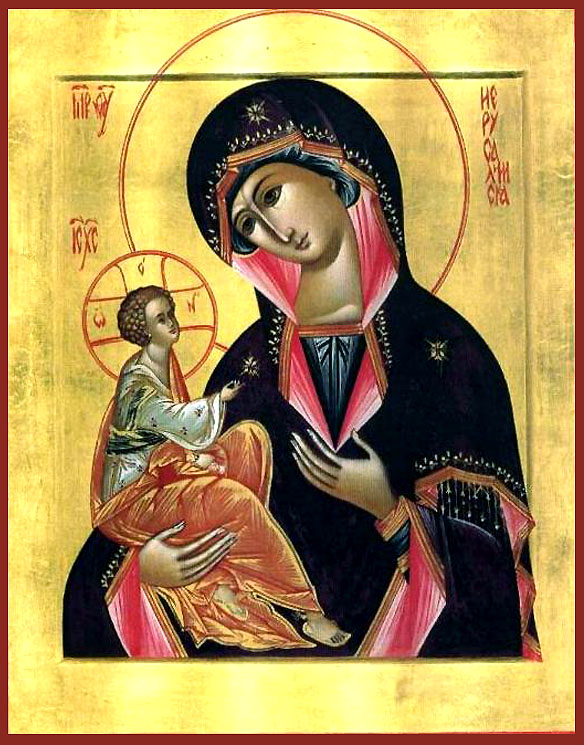
The Jerusalem Icon of the Mother of God, by tradition, was painted by the holy Evangelist Luke fifteen years after the Ascension of the Lord at Gethsemane.
In the year 463, the icon was transferred to Constantinople. The Byzantine army carried the Jerusalem Icon into battle when they turned back an invasion of the Scythians. In 988 the icon was transferred to Korsun and given to the holy Prince Vladimir. When the people of Novgorod accepted Christianity, Saint Vladimir sent them this icon. In 1571, Ivan the Terrible transferred the icon to the Moscow Dormition cathedral. During the Napoleonic invasion of 1812, the original was stolen by the French and brought to Paris. An authenticated copy was placed in the Dormition cathedral.
The Jerusalem Icon is also commemorated on November 13, and on the Fifth Saturday of Great Lent.
Saint Edwin, King and Martyr
Saint Edwin (Eadwine) was the son of Alla, King of Deira, and was born around 584. When his father died, Edwin was cheated out of his kingdom by King Ethelred of Bernicia, who united Bernicia and Deira into a single kingdom of Northumbria.
Edwin fled to East Anglia and took refuge with King Redwald. Redwald, because of the threats and promises he had received, was persuaded to give Edwin up to his enemies. Edwin was warned by a friend of the danger he faced. That night, a stranger promised that his kingdom would be restored to him if Edwin would do as he taught him. Edwin agreed, and the stranger laid his hand on Edwin’s head, telling him to remember the gesture.
In time, Edwin became ruler of the entire north of England and, by force of arms, obliged the other kings to acknowledge him as sovereign. He married Ethelburga, the daughter of Saint Ethelbert (February 25), the first Christian king in England. Ethelburga was also the sister of King Ealbald of Kent.
There was an attempt on Edwin’s life in 626, on the eve of Pascha. That night the queen gave birth to a baby girl, and King Quichelm of the West Saxons sent an assassin named Eumer to kill Edwin with a poisoned dagger. Eumer was admitted to Edwin’s presence and tried to stab him. He would have succeeded if it had not been for Lilla, King Edwin’s faithful minister, who placed himself between the king and the assassin. The blade passed through his body, however, and wounded the king. The assassin was killed, and Lilla saved Edwin’s life at the cost of his own. This event is commemorated by a stone cross which stands on Lilla Howe near Fylingdales Ballistic Missile Early Warning System on the North Yorkshire Moors. Before the Pickering-Whitby road was built in 1759, this cross served as a guide for those who walked across the moors from Robin Hood’s Bay to Saltergate.
Edwin thanked his gods that he had been spared, but he was told by Bishop Paulinus of York (October 10) that he had been saved by the prayers of his queen. The bishop said that he should show his gratitude to the true God by allowing his newborn daughter to be baptized. The child was baptized on Pentecost, and was given the name Eanfleda.
The king, who had been slightly wounded in the attack, promised Bishop Paulinus that he would become a Christian if he were restored to health, and if he would triumph over those who conspired to kill him.
As soon as his wound healed, King Edwin marched against the King of the West Saxons with an army. He vanquished the opposing army, killing or capturing those involved in the plot against him. He no longer followed the pagan religion, but he put off his promise to embrace Christianity, and it was many years before Edwin converted. He would sit alone for hours trying to decide which religion he should follow. Saint Paulinus, informed by a revelation about the stranger’s promise to the king, went to Edwin and laid his hand upon his head. “Do you remember this gesture?” he asked.
The king trembled with astonishment, and would have fallen at the bishop’s feet. Saint Paulinus gently raised him up and said, “You see that God has delivered you from your enemies. Moreover, He offers you His everlasting Kingdom. See that you fulfill your promise to become a Christian and keep the commandments of God.”
King Edwin said that he would seek the counsel of his advisers and urge them to convert with him. He asked them what he should do. Coifi, a pagan priest, said it was readily apparent that their gods had no power. Another person said that this brief life was inconsequential, compared to eternity.
Saint Paulinus addressed the gathering, and when he had finished, Coifi told the king that the altars and temples of their false gods should be burned. The king asked him who should be the first to profane them. Coifi replied that he should be the first, since he had been foremost in leading their worship. The chief priest of the pagans was not permitted to bear arms or to ride a horse. It was customary that he ride a mare. Coifi, however, asked for a horse and for arms. Mounted on the king’s own horse, Coifi threw a spear into their temple, commanding the others to pull it down and set it afire. This place was not far from York, and today it is known as Godmanham.
In 627, the eleventh year of his reign, Saint Edwin was baptized by Saint Paulinus of York in the wooden church of Saint Peter. Saint Edwin began the construction of a new stone church, which was completed by his successor Saint Oswald (August 5).
Saint Edwin ruled his kingdom in peace for six more years, and continued to practice and promote Christianity. He was killed in a battle with Penda of Mercia and Cadwalla of Wales in 633, when he was forty-eight years old, at a place now known as Hatfield.
Saint Edwin’s body was buried at Whitby, but his head was buried at York in the church he had built. Most of the early English calendars list Saint Edwin as a martyr.
After the death of Saint Edwin, his wife Saint Ethelburga (April 5) returned to Kent, where she became the abbess of a monastery which she founded at Lyminge.
Icon of the Mother of God of Rudens
The Rudens Icon of the Mother of God appeared in the year 1687 in the Rudno locale of Mogilevsk diocese. In 1712 the icon was transferred to the Florovsk Ascension monastery in Kiev, where now it is located.
Translation from Malta to Gatchina: of a Particle of the Life Giving Cross, the Filersk Icon of the Mother of God, and the relic of the Right Hand of John the Baptist
The Translation from Malta to Gatchina of a Portion of the Life-Creating Cross of the Lord, together with the Philermos Icon of the Mother of God (from Mount Philermos on the Greek island of Rhodes), and the right hand of Saint John the Baptist took place in the year 1799. These holy things were preserved on the island of Malta by the Knights of the Catholic Order of Saint John of Jerusalem. In 1798, when the French seized the island, the Maltese knights turned to Russia for defense and protection. On October 12, 1799 they offered these ancient holy things to the emperor Paul I, who at this time was at Gatchina. In the autumn of 1799 the holy items were transferred to Saint Petersburg and placed in the Winter Palace within the church dedicated to the Icon of the Savior Not-Made-by-Hands. The Feast for this event was established in 1800.
By ancient tradition, the Philermos Icon of the Mother of God was painted by the holy Evangelist Luke. From Jerusalem it was transferred to Constantinople, where it was situated in the Blachernae church. In the thirteenth century it was taken from there by crusaders, and from that time was kept by the Knights of the Order of Saint John.
New Martyr John, Archbishop of Riga and Latvia
No information available at this time.
Saint Tarasius of Glushetsa
Saint Tarasius of Glushetsa was abbot of a monastery built by Saint Stephen of Perm (April 26), and he zealously spread and affirmed the Orthodox Faith among the Zyryani people.
In 1427, under the successor of Saint Stephen, Bishop Gerasimus (January 29), Saint Tarasius voluntarily gave up leading the monastery and went to the Glushetsa monastery under the guidance of Saint Dionysius (June 1).
Saint Dionysius, seeing Tarasius’ deep humility, accepted him. The former igumen Tarasius toiled alongside the novices as an equal at the monastery and he led a strict ascetic life. He was buried at the Dionysiev monastery in 1440.
Saint Macarius, Abbot of Glushetsa
Saint Macarius, Abbot of Glushetsa (in the world Matthew), was born in Rostov. As a twelve-year-old boy he was given to Saint Dionysius (June 1) to be raised. Growing up under the guidance of the great Elder, the saint was distinguished by a rare purity of soul. Saint Macarius, already a hieromonk, was chosen by the brethren as igumen of the monastery after the death of Saint Amphilochius. Saint Macarius fell asleep in the Lord on May 13 (not earlier than 1462).
Icon of the Mother of God of Yaroslav-Smolensk
The Yaroslav-Smolensk Icon of the Mother of God was the cell icon of the archimandrite of the Trinity-St Sergius Lavra, Anthony. On October 12, 1642 while he was praying, he heard a voice from the Smolensk Hodēgḗtria (Directress) icon saying, “Go, go to the limits of the city of Yaroslavl, to a newly-made monastery in My name.” Archimandrite Anthony sent this icon with the Venerable Gersaim to the indicated monastery, being built in the forest, not far from Yaroslavl. The wonderworking icon was set in the monastery church in the altar area.
Icon of the Mother of God of Kaluga
The Kaluga Icon of the Mother of God appeared in the year 1748 (September 2). In 1812 many Russian and French soldiers beheld the Kaluga icon of the Mother of God, standing in the air. Thus also it was around Kaluga and Maloyaroslavl. During such appearances the Russian armies were always victorious. This vision was also granted to the peasant Paraskevḗ Alekseeva.