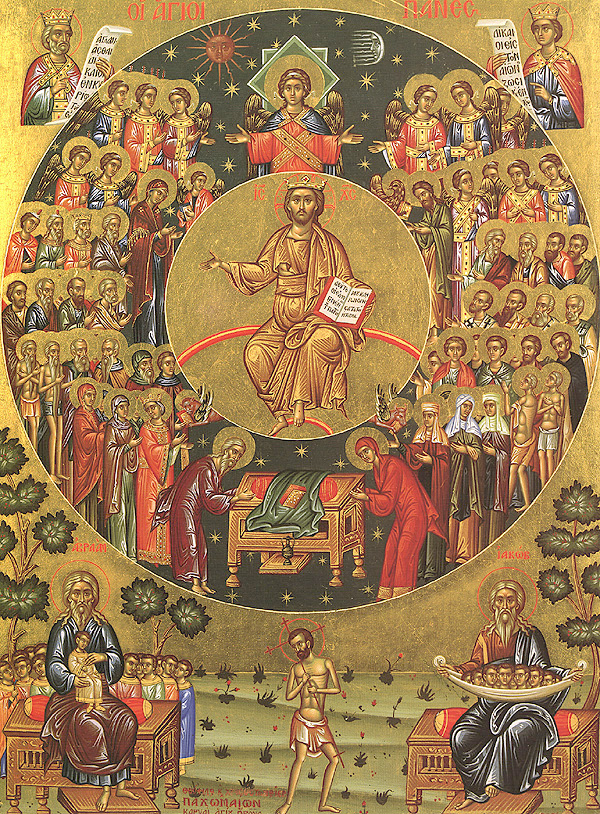
The Sunday following Pentecost is dedicated to All Saints, both those who are known to us, and those who are known only to God. There have been saints at all times, and they have come from every corner of the earth. They were Apostles, Martyrs, Prophets, Hierarchs, Monastics, and Righteous, yet all were perfected by the same Holy Spirit.
The Descent of the Holy Spirit makes it possible for us to rise above our fallen state and to attain sainthood, thereby fulfilling God’s directive to “be holy, for I am holy” (Lev. 11:44, 1 Peter 1:16, etc.). Therefore, it is fitting to commemorate All Saints on the first Sunday after Pentecost.
This feast may have originated at an early date, perhaps as a celebration of all martyrs, then it was broadened to include all men and women who had borne witness to Christ by their virtuous lives, even if they did not shed their blood for Him.
Saint Peter of Damascus, in his “Fourth Stage of Contemplation,” mentions five categories of saints: Apostles, Martyrs, Prophets, Hierarchs, and Monastic Saints (Philokalia [in English] Vol. 3, p.131). He is actually quoting from the Octoechos, Tone 2 for Saturday Matins, kathisma after the first stichology.
Saint Νikόdēmos of the Holy Mountain (July 14) adds the Righteous to Saint Peter’s five categories. The list of Saint Νikόdēmos is found in his book The Fourteen Epistles of Saint Paul (Venice, 1819, p. 384) in his discussion of I Corinthians 12:28.
The hymnology for the feast of All Saints also lists six categories: “Rejoice, assembly of the Apostles, Prophets of the Lord, loyal choirs of the Martyrs, divine Hierarchs, Monastic Fathers, and the Righteous....”
Some of the saints are described as Confessors, a category which does not appear in the above lists. Since they are similar in spirit to the martyrs, they are regarded as belonging to the category of Martyrs. They were not put to death as the Martyrs were, but they boldly confessed Christ and came close to being executed for their faith. Saint Maximus the Confessor (January 21) is such a saint.
The order of these six types of saints seems to be based on their importance to the Church. The Apostles are listed first, because they were the first to spread the Gospel throughout the world.
The Martyrs come next because of their example of courage in professing their faith before the enemies and persecutors of the Church, which encouraged other Christians to remain faithful to Christ even unto death.
Although they come first chronologically, the Prophets are listed after the Apostles and Martyrs. This is because the Old Testament Prophets saw only the shadows of things to come, whereas the Apostles and Martyrs experienced them firsthand. The New Testament also takes precedence over the Old Testament.
The holy Hierarchs comprise the fourth category. They are the leaders of their flocks, teaching them by their word and their example.
The Monastic Saints are those who withdrew from this world to live in monasteries, or in seclusion. They did not do this out of hatred for the world, but in order to devote themselves to unceasing prayer, and to do battle against the power of the demons. Although some people erroneously believe that monks and nuns are useless and unproductive, Saint John Climacus had a high regard for them: “Angels are a light for monks, and the monastic life is a light for all men” (LADDER, Step 26:31).
The last category, the Righteous, are those who attained holiness of life while living “in the world.” Examples include Abraham and his wife Sarah, Job, Saints Joachim and Anna, Saint Joseph the Betrothed, Saint Juliana of Lazarevo, and others.
The feast of All Saints achieved great prominence in the ninth century, in the reign of the Byzantine Emperor Leo VI the Wise (886-911). His wife, the Holy Empress Theophano (December 16) lived in the world, but was not attached to worldly things. She was a great benefactor to the poor, and was generous to the monasteries. She was a true mother to her subjects, caring for widows and orphans, and consoling the sorrowful.
Even before the death of Saint Theophano in 893 or 894, her husband started to build a church, intending to dedicate it to Theophano, but she forbade him to do so. It was this emperor who decreed that the Sunday after Pentecost be dedicated to All Saints. Believing that his wife was one of the righteous, he knew that she would also be honored whenever the Feast of All Saints was celebrated.
Icon of the Mother of God “The Unbreakable Wall”
The “Unbreakable (or “Indestructible”) Wall” Icon of the Most Holy Theotokos is commemorated on the Sunday of All Saints. It is an XI century mosaic icon of the Blachernae type, above the main altar of Kiev's Holy Wisdom Cathedral. The Mother of God is depicted against a golden background, standing with upraised hands on a quadrangular gold platform.
In some Icons of this type [but not in the mosaic Icon], Christ is depicted within a mandorla, an oval or circle, symbolizing the glory of Heaven, or the Divine Light.
The Icon is called the "Unbreakable Wall" because for ten centuries it has remained intact, in spite of the fact that both Kiev's Holy Wisdom Cathedral and the city have been damaged several times. An ancient description of this Icon has been preserved: "A gigantic full-length portrait of the Theotokos.... She stands upon a gold stone, as an unshakable foundation for all who resort to her protection. Her chiton is blue, and she wears a scarlet belt. Hanging from it is an embroidered cloth with which she wipes away so many tears.
There are several possible sources for this Icon's title:
The Prophet-King David wrote "God is in the midst of her (i. e. the city of God); she shall not be moved: God shall help her with his countenance" (Psalm 45/46:5).
"Thus the Lord showed me; and behold, he stood upon a wall of adamant..." (Amos 7:7, LXX).
The Akathist to the Mother of God, Ikos 12. "Rejoice, indestructible wall of kingdoms" - Ikos XII).
According to Kievan tradition, the wall of the church will not perish while the hands of the Mother of God are extended over it.
"Seven Arrows" Icon of the Mother of God
On the Seven Arrows Icon, the Most Holy Theotokos is depicted without the Divine Infant. She inclines her head toward her right shoulder, and her heart is pierced with seven arrows or swords, of which four are on the left side and three on the right. A similar image of the Mother of God is also found on the icons "Softener of Evil Hearts," and "Simeon's Prophecy," on which the swords are placed somewhat differently: three on the right and left, and the seventh at the bottom.
The "Seven Arrows" Icon is at least 600 years old. For a long time, the holy image was at the landing in the bell tower of the church of the Apostle John the Theologian (near Vologda). The Icon, facing downward, was mistaken for an ordinary board on which people walked, until a paralyzed man in the city of Kadnikov had a vision in which it was revealed that he would receive healing after praying before this Icon. A Moleben was served before the Icon, and the man recovered.
The Icon became especially famous in 1830 during an outbreak of cholera in Vologda.
The real, authentic image (the "Seven Arrows" Icon) is now in the church of Saint Lazarus, in Vologda. The Icon has been in that temple since 1945, after the Great Patriotic War.
Muscovites can pray before the wonderworking copies located in the Moscow region. There are two images of the "Seven Arrows" Mother of God. Both exude an amazing myrrh - an oily liquid which inexplicably appeared on them.
The first copy of the "Seven Arrows" Icon is now in the church dedicated to the Holy Archangel Michael, located in Moscow. The second copy is in the village of Bachurino in the Moscow region.
The Feast Day of this Icon is celebrated on August 13, and on the Sunday of All Saints (First Sunday after Pentecost).
The same Troparion and Kontakion are used for the "Seven Arrows" Icon (August 13), and the "Softener of Evil Hearts" Icon (Sunday of All Saints).
Martyrs Acindynus, Pegasius, Aphthonius, Elpidephorus, Anempodistus, and 7,000 with them, of Persia
Saint Acindynus suffered martyrdom in Persia along with Saints Pegasias, Aphthonius, Elpidephorus, Anempodistus, and 7,000 other Christians at the time of King Sapor II (310-381). These saints were Sapor’s courtiers, and were secret Christians. When the king began his persecution against Christians, envious pagans denounced them to him. Summoned to Sapor’s presence for trial, the holy martyrs fearlessly confessed their faith in the Holy Trinity. The king ordered them to be beaten with whips.
Sapor told the people that Saints Acindynus, Pegasias, Anempodistus and Elpidephorus would have their heads cut off, and that he would not permit the Christians to bury their bodies.
A tremendous crowd accompanied these saints as they were led outside the city walls for execution, glorifying Christ. On Sapor’s orders, soldiers massacred all the Christians in the procession (about 7,000), including Saint Elpidephorus.
Acindynus, Pegasias, and Anempodistus were burned on the following day with the mother of the emperor. Christians came secretly by night to the place of execution, found the bodies of the holy martyrs unharmed by the fire, and they buried them with reverence.
Saint Marcian of Cyrrhus
Saint Marcian of Cyrrhus lived during the fourth century. He went into the desert, where he lived for many years in solitude, unceasing prayer, and strict fasting. He built a small cell, and settled in it. The saint never lit candles for reading at night when he fulfilled his Rule of prayer, for the cell was filled with a divine light.
After several years the monk accepted two disciples, settling them beside him, but he continued to live as a hermit. The Patriarch Flavian of Antioch (February 18) and other bishops entreated the monk to abandon his strict solitude for the benefit of Christians, but he would not agree.
However, while not quitting his cell, he taught those coming to him for instruction and he turned many away from heresy and led them to the Orthodox Faith. Before his end, Saint Marcian instructed his disciple Eusebius to bury him secretly far from his cell, in order to shun posthumous glory and avoid contention among those wanting his relics for nearby churches. Saint Marcian died in the year 388.
“Ozerianka” Icon of the Mother of God of Shuiu-Smolensk
The Shuiu-Smolensk Wonderworking Icon of the Mother of God was painted in the years 1654-1655 in the Resurrection parish of the city of Shuiu, where an unrelenting pestilence raged. Trusting in the mercy of God and the intercession of the Mother of God, the parishioners of the Resurrection church commissioned a certain pious monk to paint the icon of the Smolensk Mother of God, an icon long attributed with being a rescuer of the Russian people from enemies and misfortune.
The parishioners spent the whole week in prayer and fasting while the image was being painted. When the icon was finished, the priest and the people took it to the church and set it in a specially built place. From that time the pestilence began to ease, at first in the area of the Resurrection parish, and then also in all the city.
From the Icon of the Mother of God many miracles of healing took place, especially of eye diseases. The icon is also celebrated on July 11, July 28, and Bright Tuesday.