This Sunday was originally dedicated to Saint Polycarp of Smyrna (February 23). After his glorification in 1368, a second commemoration of Saint Gregory Palamas (November 14) was appointed for the Second Sunday of Great Lent as a second “Triumph of Orthodoxy.”
Saint Gregory Palamas, Archbishop of Thessalonica, was born in the year 1296 in Constantinople. Saint Gregory’s father became a prominent dignitiary at the court of Andronicus II Paleologos (1282-1328), but he soon died, and Andronicus himself took part in the raising and education of the fatherless boy. Endowed with fine abilities and great diligence, Gregory mastered all the subjects which then comprised the full course of medieval higher education. The emperor hoped that the youth would devote himself to government work. But Gregory, barely twenty years old, withdrew to Mount Athos in the year 1316 (other sources say 1318) and became a novice in the Vatopedi monastery under the guidance of the monastic Elder Saint Νikόdēmos of Vatopedi (July 11). There he was tonsured and began on the path of asceticism. A year later, the holy Evangelist John the Theologian appeared to him in a vision and promised him his spiritual protection. Gregory’s mother and sisters also became monastics.
After the demise of the Elder Νikόdēmos, Saint Gregory spent eight years of spiritual struggle under the guidance of the Elder Nikēphóros, and after the latter’s death, Gregory transferred to the Lavra of Saint Athanasius (July 5). Here he served in the trapeza, and then became a church singer. But after three years, he resettled in the small skete of Glossia, striving for a greater degree of spiritual perfection. The head of this monastery began to teach the young man the method of unceasing prayer and mental activity, which had been cultivated by monastics, beginning with the great desert ascetics of the fourth century: Evagrius Pontikos and Saint Macarius of Egypt (January 19).
Later on, in the eleventh century Saint Simeon the New Theologian (March 12) provided detailed instruction in mental activity for those praying in an outward manner, and the ascetics of Athos put it into practice. The experienced use of mental prayer (or prayer of the heart), requiring solitude and quiet, is called “Hesychasm” (from the Greek “hesychia” meaning calm, silence), and those practicing it were called “hesychasts.”
During his stay at Glossia the future hierarch Gregory became fully embued with the spirit of hesychasm and adopted it as an essential part of his life. In the year 1326, because of the threat of Turkish invasions, he and the brethren retreated to Thessalonica, where he was then ordained to the holy priesthood.
Saint Gregory combined his priestly duties with the life of a hermit. Five days of the week he spent in silence and prayer, and only on Saturday and Sunday did he come out to his people. He celebrated divine services and preached sermons. For those present in church, his teaching often evoked both tenderness and tears. Sometimes he visited theological gatherings of the city’s educated youth, headed by the future patriarch, Isidore. After he returned from a visit to Constantinople, he found a place suitable for solitary life near Thessalonica the region of Bereia. Soon he gathered here a small community of solitary monks and guided it for five years.
In 1331 the saint withdrew to Mt. Athos and lived in solitude at the skete of Saint Savva, near the Lavra of Saint Athanasius. In 1333 he was appointed Igumen of the Esphigmenou monastery in the northern part of the Holy Mountain. In 1336 the saint returned to the skete of Saint Savva, where he devoted himself to theological works, continuing with this until the end of his life.
In the 1330s events took place in the life of the Eastern Church which put Saint Gregory among the most significant universal apologists of Orthodoxy, and brought him great renown as a teacher of hesychasm.
About the year 1330 the learned monk Barlaam had arrived in Constantinople from Calabria, in Italy. He was the author of treatises on logic and astronomy, a skilled and sharp-witted orator, and he received a university chair in the capital city and began to expound on the works of Saint Dionysius the Areopagite (October 3), whose “apophatic” (“negative”, in contrast to “kataphatic” or “positive”) theology was acclaimed in equal measure in both the Eastern and the Western Churches. Soon Barlaam journeyed to Mt. Athos, where he became acquainted with the spiritual life of the hesychasts. Saying that it was impossible to know the essence of God, he declared mental prayer a heretical error. Journeying from Mount Athos to Thessalonica, and from there to Constantinople, and later again to Thessalonica, Barlaam entered into disputes with the monks and attempted to demonstrate the created, material nature of the light of Tabor (i.e. at the Transfiguration). He ridiculed the teachings of the monks about the methods of prayer and about the uncreated light seen by the hesychasts.
Saint Gregory, at the request of the Athonite monks, replied with verbal admonitions at first. But seeing the futility of such efforts, he put his theological arguments in writing. Thus appeared the “Triads in Defense of the Holy Hesychasts” (1338). Towards the year 1340 the Athonite ascetics, with the assistance of the saint, compiled a general response to the attacks of Barlaam, the so-called “Hagiorite Tome.” At the Constantinople Council of 1341 in the church of Hagia Sophia Saint Gregory Palamas debated with Barlaam, focusing upon the nature of the light of Mount Tabor. On May 27, 1341 the Council accepted the position of Saint Gregory Palamas, that God, unapproachable in His Essence, reveals Himself through His energies, which are directed towards the world and are able to be perceived, like the light of Tabor, but which are neither material nor created. The teachings of Barlaam were condemned as heresy, and he himself was anathemized and fled to Calabria.
But the dispute between the Palamites and the Barlaamites was far from over. To these latter belonged Barlaam’s disciple, the Bulgarian monk Akyndinos, and also Patriarch John XIV Kalekos (1341-1347); the emperor Andronicus III Paleologos (1328-1341) was also inclined toward their opinion. Akyndinos, whose name means “one who inflicts no harm,” actually caused great harm by his heretical teaching. Akyndinos wrote a series of tracts in which he declared Saint Gregory and the Athonite monks guilty of causing church disorders. The saint, in turn, wrote a detailed refutation of Akyndinos’ errors. The patriarch supported Akyndinos and called Saint Gregory the cause of all disorders and disturbances in the Church (1344) and had him locked up in prison for four years. In 1347, when John the XIV was replaced on the patriarchal throne by Isidore (1347-1349), Saint Gregory Palamas was set free and was made Archbishop of Thessalonica.
In 1351 the Council of Blachernae solemnly upheld the Orthodoxy of his teachings. But the people of Thessalonica did not immediately accept Saint Gregory, and he was compelled to live in various places. On one of his travels to Constantinople the Byzantine ship fell into the hands of the Turks. Even in captivity, Saint Gregory preached to Christian prisoners and even to his Moslem captors. The Hagarenes were astonished by the wisdom of his words. Some of the Moslems were unable to endure this, so they beat him and would have killed him if they had not expected to obtain a large ransom for him. A year later, Saint Gregory was ransomed and returned to Thessalonica.
Saint Gregory performed many miracles in the three years before his death, healing those afflicted with illness. On the eve of his repose, Saint John Chrysostom appeared to him in a vision. With the words “To the heights! To the heights!” Saint Gregory Palamas fell asleep in the Lord on November 14, 1359. In 1368 he was canonized at a Constantinople Council under Patriarch Philotheus (1354-1355, 1364-1376), who compiled the Life and Services to the saint.
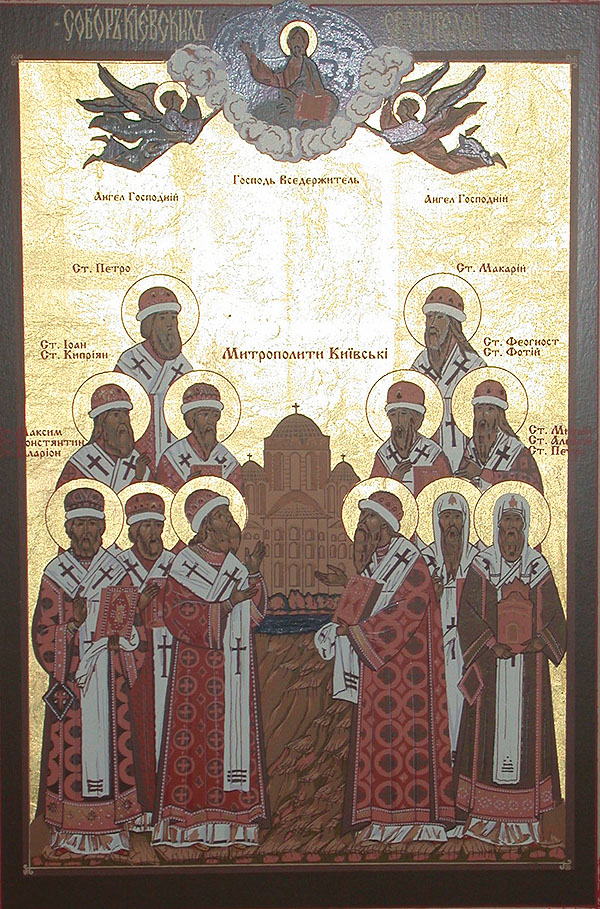
Synaxis of the Venerable Fathers of the Kiev Caves Lavra
On the second Sunday of Great Lent, we commemorate the Synaxis of all the Venerable Fathers of the Kiev Caves Monastery: those who rest in the Near Caves of Saint Anthony (see September 28), as well as those who rest in the Far Caves of Saint Theodosios (see August 28).
The Canon, which was added to the Service for today's Feast, was composed by Hieromonk Meletios during the second half of the XVII century.
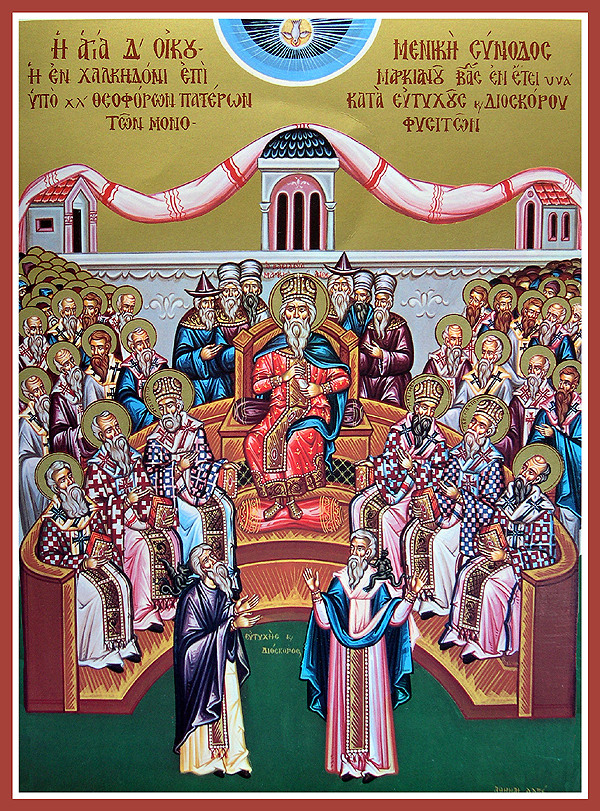
Fathers of the First Six Councils
The Commemoration of the Holy Fathers of the First Six Ecumenical Councils.
In the Ninth Article of the Nicea-Constantinople Symbol of Faith proclaimed by the holy Fathers of the First and Second Ecumenical Councils, we confess our faith in “One, Holy, Catholic, and Apostolic Church.” By virtue of the catholic nature of the Church, an Ecumenical Council is the Church’s supreme authority, and possesses the competence to resolve major questions of church life. An Ecumenical Council is comprised of archpastors and pastors of the Church, and representatives of all the local Churches, from every land of the “oikumene” (i.e. from all the whole inhabited world).
The Orthodox Church acknowledges Seven Holy Ecumenical Councils:
The First Ecumenical Council (Nicea I) (May 29, and also on seventh Sunday after Pascha) was convened in the year 325 against the heresy of Arius, in the city of Nicea in Bithynia under Saint Constantine the Great, Equal of the Apostles.
The Second Ecumenical Council (Constantinople I) (May 22) was convened in the year 381 against the heresy of Macedonias, by the emperor Theodosius the Great.
The Third Ecumenical Council (Ephesus) (September 9) was convened in the year 431 against the heresy of Nestorius, in the city of Ephesus by the emperor Theodosius the Younger.
The Fourth Ecumenical Council (Chalcedon) (July 16) was convened in the year 451, against the Monophysite heresy, in the city of Chalcedon under the emperor Marcian.
The Fifth Ecumenical Council (Constantinople II) (July 25) “Concerning the Three Chapters,” was convened in the year 553, under the emperor Justinian the Great.
The Sixth Ecumenical Council (Constantinople III) (January 23) met during the years 680-681, to fight the Monothelite heresy, under the emperor Constantine Pogonatos.
The fact that the Seventh Ecumenical Council (Nicea II) is not commemorated today testifies to the antiquity of today’s celebration. The Seventh Council, commemorated on the Sunday nearest to October 11, was convened at Nicea in the year 787 against the Iconoclast heresy, under the emperor Constantine and his mother Irene.
The Church venerates the Holy Fathers of the Ecumenical Councils because Christ has established them as “lights upon the earth,” guiding us to the true Faith. “Clad in the garment of truth,” the doctrine of the Fathers, based upon the preaching of the Apostles, has established one faith for the Church. The Ecumenical Councils, are the highest authority in the Church. Such Councils, guided by the grace of the Holy Spirit, and accepted by the Church, are infallible.
The Orthodox Church’s conciliar definitions of dogma have the highest authority, and such definitions always begin with the Apostolic formula: “It seemed good to the Holy Spirit and to us...” (Acts 15: 28).
The Ecumenical Councils were always convened for a specific reason: to combat false opinions and heresies, and to clarify the Orthodox Church’s teaching. But the Holy Spirit has thus seen fit, that the dogmas, the truths of faith, immutable in their content and scope, constantly and consequently are revealed by the conciliar mind of the Church, and are given precision by the holy Fathers within theological concepts and terms in exactly such measure as is needed by the Church itself for its economy of salvation. The Church, in expounding its dogmas, is dealing with the concerns of a given historical moment, “not revealing everything in haste and thoughtlessly, nor indeed, ultimately hiding something” (Saint Gregory the Theologian).
A brief summary of the dogmatic theology of the First Six Ecumenical Councils is formulated and contained in the First Canon of the Council of Trullo (also known as Quinisext), held in the year 692. The 318 Holy Fathers of the First Ecumenical Council are spoken of in this Canon I of Trullo as having: “with unanimity of faith revealed and declared to us the consubstantiality of the three Persons of the Divine nature and, ... instructing the faithful to adore the Father, Son, and Holy Spirit with one worship, they cast down and dispelled the false teaching about different degrees of Divinity.”
The 150 Holy Fathers of the Second Ecumenical Council left their mark on the theology of the Church concerning the Holy Spirit, “repudiating the teaching of Macedonius, as one who wished to divide the inseparable Unity, so that there might be no perfect mystery of our hope.”
The 200 God-bearing Fathers of the Third Ecumenical Council expounded the teaching that “Christ, the Incarnate Son of God is One.” They also confessed that “she who bore Him without seed was the spotless Ever-Virgin, glorifying her as truly the Mother of God.
The 630 Holy Fathers of the Fourth Ecumenical Council decreed that “the One Christ, the Son of God... must be glorified in two natures.”
The 165 God-bearing Holy Fathers of the Fifth Ecumenical Council “in synod anathematized and repudiated Theodore of Mopsuestia (the teacher of Nestorius), and Origen, and Didymus, and Evagrius, renovators of the Hellenic teaching about the transmigration of souls and the transmutation of bodies and the impieties they raised against the resurrection of the dead.”
The 170 Holy Fathers of the Sixth Ecumenical Council “taught that we ought to confess two natural volitions, or two wills [trans. note: one divine, and the other human], and two natural operations (energies) in Him Who was incarnate for our salvation, Jesus Christ, our true God.”
In decisive moments of Church history, the holy Ecumenical Councils promulgated their dogmatic definitions, as trustworthy delimitations in the spiritual battle for the purity of Orthodoxy, which will last until such time, as “all shall come into the unity of faith, and of the knowledge of the Son of God” (Eph. 4: 13). In the struggle with new heresies, the Church does not abandon its former dogmatic concepts nor replace them with some sort of new formulations. The dogmatic formulae of the Holy Ecumenical Councils need never be superseded, they remain always contemporary to the living Tradition of the Church. Therefore the Church proclaims:
“The faith of all in the Church of God hath been glorified by men, which were luminaries in the world, cleaving to the Word of Life, so that it be observed firmly, and that it dwell unshakably until the end of the ages, conjointly with their God-bestown writings and dogmas. We reject and we anathematize all whom they have rejected and anathematized, as being enemies of Truth. And if anyone does not cleave to nor admit the aforementioned pious dogmas, and does not teach or preach accordingly, let him be anathema” (Canon I of the Council of Trullo).
In addition to their dogmatic definitions, the Holy Fathers of the Ecumenical Councils exerted great efforts towards the strengthening of church discipline. Local Councils promulgated their disciplinary canons according to the circumstances of the time and place, frequently differing among themselves in various particulars.
The universal unity of the Orthodox Church required unity also in canonical practice, i.e. a conciliar deliberation and affirmation of the most important canonical norms by the Fathers of the Ecumenical Councils. Thus, according to conciliar judgment, the Church has accepted: 20 Canons from the First, 7 Canons from the Second, 8 Canons from the Third, and 30 Canons from the Fourth Ecumenical Synods. The Fifth and the Sixth Councils concerned themselves only with resolving dogmatic questions, and did not leave behind any disciplinary canons.
The need to establish in codified form the customary practices during the years 451-680, and ultimately to compile a canonical codex for the Orthodox Church, occasioned the convening of a special Council, which was wholly devoted to the general application of churchly rules. This was convened in the year 692. The Council “in the Imperial Palace” or “Under the Arches” (in Greek “en trullo”), came to be called the Council in Trullo. It is also called the “Quinisext” [meaning the “fifth and sixth”], because it is considered to have completed the activities of the Fifth and Sixth Councils, or rather that it was simply a direct continuation of the Sixth Ecumenical Council itself, separated by just a few years.
The Council in Trullo, with its 102 Canons (more than of all the Ecumenical Synods combined), had a tremendous significance in the history of the canonical theology of the Orthodox Church. It might be said that the Fathers of this Council produced a complete compilation of the basic codex from the relevant sources for the Orthodox Church’s canons. Listing through in chronological order, and having been accepted by the Church the Canons of the Holy Apostles, and the Canons of the Holy Ecumenical and the Local Councils and of the holy Fathers, the Trullo Council declared: “Let no one be permitted to alter or to annul the aforementioned canons, nor in place of these put forth, or to accept others, made of spurious inscription” (2nd Canon of the Council in Trullo).
Church canons, sanctified by the authority of the first Six Ecumenical Councils (including the rules of the Seventh Ecumenical Council in 787, and the Constantinople Councils of 861 and 879, which were added later under the holy Patriarch Photius), form the basis of THE RUDDER, or KORMCHAYA KNIGA (a canon law codex known as “Syntagma” or “Nomokanon” in 14 titles). In its repository of grace is expressed a canonical norm, a connection to every era, and a guide for all the local Orthodox Churches in churchly practice.
New historical conditions can lead to the change of some particular external aspect of the life of the Church. This makes creative canonical activity necessary in the conciliar reasoning of the Church, in order to reconcile the external norms of churchly life with historical circumstances. The details of canonical regulation are not fully developed for the various eras of churchly organization all at once. With every push to either forsake the literal meaning of a canon, or to fulfill and develop it, the Church again and again turns for reasoning and guidance to the eternal legacy of the Holy Ecumenical Councils, to the inexhaustable treasury of dogmatic and canonical truths.
Uncovering of the relics of Venerable Seraphim of Sarov
Uncovering of the Relics of Saint Seraphim, Wonderworker of Sarov: The glorification of Saint Seraphim of Sarov (January 2), took place in 1903, seventy years after his repose. On July 3, 1903 Metropolitan Anthony of Saint Petersburg, assisted by Bishop Nazarius of Nizhni-Novgorod and Bishop Innocent of Tambov, transferred the saint’s relics from their original burial place to the church of Saints Zosimus and Sabbatius. Tsar Nicholas II and Tsarina Alexandra provided a new cypress coffin to receive the relics. This cypress coffin was then placed inside an oak coffin and remained in the church until the day of the saint’s glorification.
At noon on July 16, the first day of the festivities, Metropolitan Anthony offered a Memorial Service for the ever-memorable Hieromonk Seraphim in the Dormition Cathedral. Services also took place in the monastery’s other churches.
The next day Metropolitan Anthony and Bishop Nazarius served a Memorial Liturgy in the Dormition Cathedral. At 5:00 that afternoon, the bells of Sarov began to ring, announcing the arrival of Tsar Nicholas and his family. Metropolitan Anthony greeted them and then led them to the Dormition Cathedral for a Service of Thanksgiving.
The royal family attended the early Liturgy on July 18th and received the Holy Mysteries. Later that morning, the final Memorial Service for the repose of Hieromonk Seraphim’s soul was offered in the Cathedral. These would be the last prayers offered for him as a departed servant of God. From that time forward, prayers would be addressed to him as a saint. At 6 P.M. the bells rang for Vigil, the first service with hymns honoring Saint Seraphim, and during which his relics would be exposed for public veneration.
At the time of the Litia during Vespers, the saint’s coffin was carried from the church of Saints Zosimus and Sabbatius and into the Dormition Cathedral. Several people were healed of various illnesses during this procession. During Matins, as “Praise ye the Name of the Lord” was sung, the coffin was opened. After the Gospel, Metropolitan Anthony and the other hierarchs kissed the holy relics. They were followed by the royal family, the officiating clergy, and all the people in the cathedral.
On July 19, the saint’s birthday, the late Liturgy began at 8 o’clock. At the Little Entrance, twelve Archimandrites lifted the coffin from the middle of the church, carried it around the altar, then placed it into a special shrine. The long awaited event was accompanied by numerous miraculous healings of the sick, who had gathered at Sarov in large numbers. More than 200,000 people came to Sarov from all across Russia.
The festivities at Sarov came to an end with the dedication of the first two churches to Saint Seraphim. The first church to be consecrated was over his monastic cell in Sarov. The second church was consecrated on July 22 at the Diveyevo convent.
In 1991, Saint Seraphim’s relics were rediscovered after being hidden in a Soviet anti-religious museum for seventy years. Widely esteemed in his lifetime, Saint Seraphim is one of the most beloved saints of the Orthodox Church.
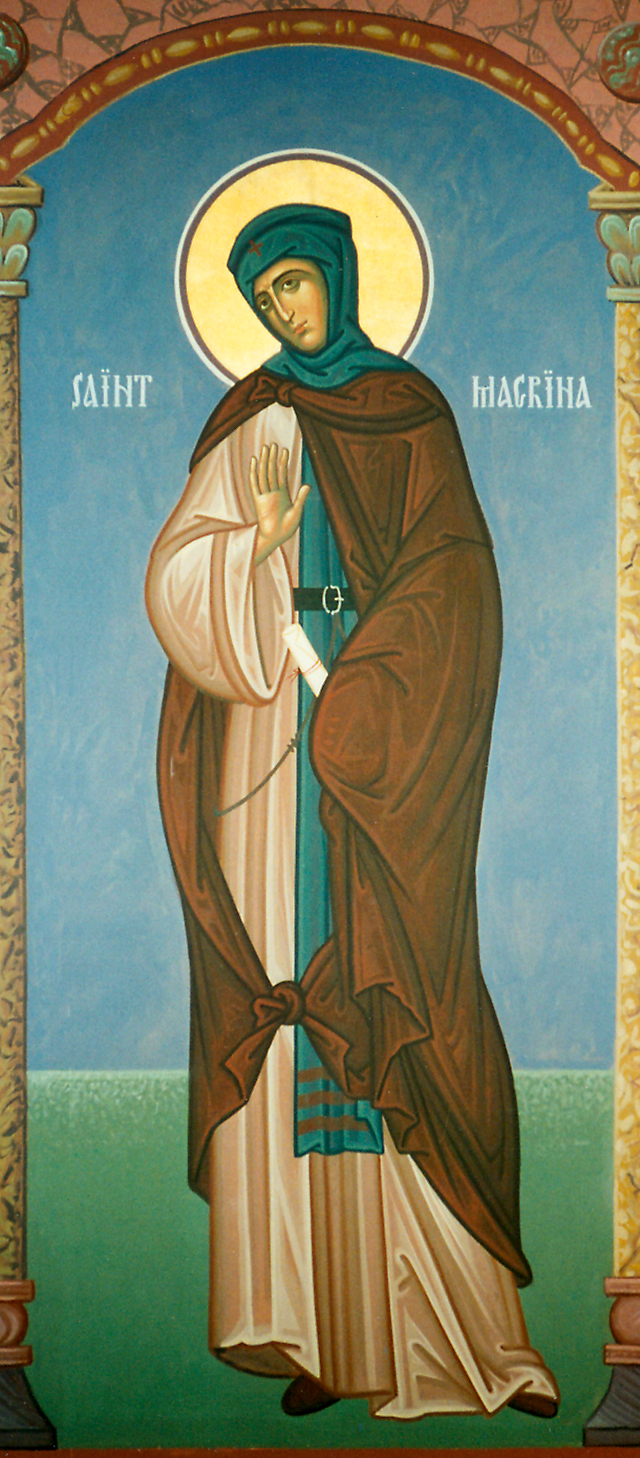
Venerable Macrina, sister of Saint Basil the Great
Saint Macrina was the sister of the holy hierarchs Basil the Great and Gregory of Nyssa, and was born in Cappadocia at the beginning of the fourth century. Her mother, Emilia, saw an angel in a dream, naming her unborn child Thekla, in honor of the holy Protomartyr Thekla. Saint Emilia (January 1) fulfilled the will of God and named her daughter Thekla. Another daughter was named Macrina, in honor of a grandmother, who suffered during the time of persecution under the emperor Maximian Galerius.
Besides Macrina, there were nine other children. Saint Emila herself guided the upbringing and education of her daughter Macrina. She taught her reading and writing in the Scriptural books and Psalms of David, selecting examples from the sacred books which spoke of a pious and God-pleasing life. Saint Emilia taught her daughter to pray and to attend church services. Macrina was also taught the proper knowledge of domestic governance and various handicrafts. She was never left idle and did not participate in childish games or amusements.
When Macrina grew up, her parents betrothed her to a certain pious youth, but the bridegroom soon died. Many young men sought marriage with her, but Macrina refused them all, having chosen the life of a virgin and not wanting to be unfaithful to the memory of her dead fiancé. Saint Macrina lived in the home of her parents, helping them fulfill the household tasks as an overseer together with the servants, and she helped with the upbringing of her younger brothers and sisters. After the death of her father she became the chief support for the family.
When all the children grew up and left the parental home, Saint Macrina convinced her mother, Saint Emilia, to leave the world, to set their slaves free, and to settle in a women’s monastery. Several of their servants followed their example. Having taken monastic vows, they lived together as one family, they prayed together, they worked together, they possessed everything in common, and in this manner of life nothing distinguished one from another.
After the death of her mother, Saint Macrina guided the sisters of the monastery. She enjoyed the deep respect of all who knew her. Strictness towards herself and temperance in everything were characteristic of the saint all her life. She slept on boards and had no possessions. Saint Macrina was granted the gift of wonderworking. There was an instance (told by the sisters of the monastery to Saint Gregory of Nyssa after the death of Saint Macrina), when she healed a girl of an eye-affliction. Through the prayers of the saint, there was no shortage of wheat at her monastery in times of famine.
Saint Macrina died in the year 380, after a final prayer of thanks to the Lord for having received His blessings over all the course of her life. She was buried in the same grave with her parents.
Venerable Dius, Abbot of Antioch
Saint Dius was born in Antioch, Syria towards the end of the fourth century into a pious Christian family. From his youth he was noted for his temperance. He ate food in small quantities, but not every day, and his flesh was humbled by vigil and unceasing prayer. For these deeds the Lord granted Saint Dius dispassion and the gift of wonderworking.
In a vision, the Lord ordered Saint Dius to go to Constantinople and there to serve both Him and the people. Saint Dius settled beyond the city in a solitary place, where people feared to live. Saint Dius bravely contended with the evil spirits which tried to expel him from this place. The Lord heard the prayer of His saint: his staff took root, began to grow and with time was transformed into an immense oak, which stood for a long time even after the death of Saint Dius.
The surrounding inhabitants began to come to the saint for advice and guidance, and they sought healing from illnesses of body and soul. Saint Dius doctored the infirm with prayer, and whatever was offered him he distributed to the poor, the homeless and the sick.
Reports of Saint Dius reached even the emperor Theodosius the Younger. He came to Saint Dius for a blessing together with Patriarch Atticus of Constantinople (406-425). The emperor wanted a monastery to be built on the place of Saint Dius’ efforts, and he provided the means for its construction. The Patriarch ordained the monk as a priest and made him the igumen. Soon numerous monastic brethren gathered to Saint Dius. The monastery was in need of a well, and they dug for a long time without success. Through the prayers of the monk the Lord brought forth a spring of pure water, which soon filled up the entire well. Once, through his prayers, the monk raised up a drowned man. The Lord worked many other miracles through His saint.
In extreme old age Saint Dius became grievously ill. He took his leave of the brethren, received the Holy Mysteries, and lay upon his cot like one dead. At the monastery His Holiness Patriarch Atticus (Comm. on Cheesefare Saturday) came for the funeral service and also Patriarch Alexander of Alexandria, who was then at Constantinople. The holy Elder unexpectedly rose up from his death bed and said, “The Lord has granted me fifteen more years of life.” Great was the joy of the brethren.
Saint Dius did live another fifteen years, helping all with guidance and counsel, healing the sick, and being concerned for the poor and homeless. Shortly before his death, a radiant man in priestly garb appeared to him in the altar of the church and told him of his impending death. Having given thanks to the Lord for this news, Saint Dius quietly died and was buried in his monastery.
Right-believing Prince Roman of Ryazan
The Holy Prince Roman Olegovich of Ryazan was from a line of princes, who during the time of the Tatar (Mongol) Yoke won glory as defenders of the Christian Faith and of their Fatherland. Both his grandfathers perished for the Fatherland in the struggle with Batu.
Raised to love the holy faith (the prince lived in tears and prayers) and his homeland, the prince with all his strength concerned himself about his devastated and oppressed subjects. He defended them from the coercion and plundering of the Khan’s “baskaki” (“tax-collectors”). The “baskaki” hated the saint and they slandered him before the Tatar Khan Mengu-Timur.
Roman Olegovich was summoned to the Horde, where Khan Mengu-Timur declared that he had to choose one of two things: either a martyr’s death or the Tatar faith. The noble prince said that a Christian cannot change from the true Faith to a false one. For his firmness in the confession of faith he was subjected to cruel torments: they cut out his tongue, gouged out his eyes, cut off his ears and lips, chopped off his hands and feet, tore off the skin from his head and, after beheading him, they impaled him upon a spear. This occurred in the year 1270.
The veneration of the royal martyr began immediately with his death. The chronicle says about the saint: “By your suffering, you have gained the Kingdom of Heaven, and a crown from the hand of the Lord, together with your kinsman Michael Vsevolodovich, co-sufferers with Christ for the Orthodox Christian Faith.”
Since 1854, there have been church processions and Moliebens at Ryazan on the Feast day of Saint Roman. A church was consecrated in honor of the holy Prince Roman at Ryazan in 1861.
Venerable Paisius of the Kiev Far Caves
Saint Paisius of the Caves was a monk of the Kiev Caves monastery. From the Canon to the Kiev Caves monks, venerated in the Far Caves, it is known that he was connected by oneness of mind and brotherly love with Saint Mercurius (November 24). Both saints were inseparable, they lived in the same cell, and after death were placed in the same grave. At the present time their relics rest in separate reliquaries.
Blessed Stephen, King of Serbia
Saint Stephen was the son of prince Saint Lazar of Serbia (June 15). In the terrible times of the Turkish Yoke Saint Stephen became the great benefactor of his enslaved countrymen. He built up the city, constructed churches and expended his treasury on the help of the needy. Saint Stephen exceeded many rulers in his wisdom, his charity and his faith. He died peacefully in the year 1427.
Holy Right-believing Princess Militsa of Serbia
Saint Militsa (Milica) was born in 1335, the daughter of Prince Vratko Nemanjić. In Holy Baptism she was named Euphrosynē. Later, she married the Holy Prince Lazarus (Lazar), who was killed during the great Battle of Kosovo (June 15, 1389), which was fought to defend the Holy Church against the Moslems. After her husband's death, she ruled Serbia until her son Stephen the Tall came of age. She also composed several prayers and religious poems, including "A Mother's Prayer" (Молитва матере) and a very touching poem of mourning for her husband, "The Bridegroom of my Widowhood" (Удовству мојему женик).
Saint Militsa founded Ljubostinja monastery around 1390, and there in 1393, she was tonsured as a nun with the name Eugenia. She was concerned about beginning her monastic life as a widow and about being accepted by the other nuns, whose husbands had also fallen on the battlefield. This inspired her to build and support many monasteries and churches.
At the end of her life, Mother Eugenia was tonsured into the Great Schema with the name Euphrosynē.
After her repose on November 11, 1405, Saint Militsa worked many miracles, and her myrrh-streaming relics healed many sick people.
The Russian Orthodox Church commemorates Saint Militsa on July 19, while the Church of Serbia commemorates her on August 30.
Saint Theodore of Edessa, Mesopotamia
The Saint’s father was named Symeon, and his mother’s name was Maria. He received a good education and was distinguished for his philosophical knowledge, as well as for rhetoric.
At the age of ten he was left as an orphan and gave half of his parents’ wealth to his sister, and kept the other half himself. Sharing this with the poor, he departed for Jerusalem. There he venerated the holy places and, when he was nineteen years old, he became a monk in the Lavra of Saint Savva.
Saint Theodore remained there for twenty-four years, leading an ascetic and virtuous life, and became a renowned ascetic. Hearing of his great virtues, the Patriarch of Jerusalem made him Bishop of Edessa in 836. He was an excellent Archpastor, with his vast theological knowledge, his many virtues, and above all, his great love, which he bestowed abundantly upon his flock. At that time Edessa was plagued with many heresies: Arian, Nestorian, Eutychian, etc. The holy hierarch instructed his flock in the Orthodox Faith in order to combat these errors. Saint Theodore also went to see the Persian king in Babylon, asking him to protect the Orthodox Christians of Edessa from the malevolence of the heretics.
The King was very sick, but the Saint healed him and spoke to him about Christ. After many days the King was baptized with the name John. After returning to Edessa, Saint Theodore was informed in a vision that King John and his three bodyguards, who had been baptized with him, proclaimed their faith openly and received the unfading crown of martyrdom.
Sensing the approach of death, Saint Theodore retired to the Lavra of Saint Savva. After calling the clergy and laity of Edessa together and blessing them, he surrendered his holy soul to the Heavenly Father in the year 848.
Bishop Basil of Emessa wrote the Saint’s life in Greek, which is preserved at the Ivḗron Monastery on Mount Athos.