Great and Holy Saturday is the day on which Christ reposed in the tomb. The Church calls this day the Blessed Sabbath.
“The great Moses mystically foreshadowed this day when he said: God blessed the seventh day. This is the blessed Sabbath This is the day of rest, on which the only-begotten Son of God rested from all His works....”
(Vesperal Liturgy of Holy Saturday)
By using this title the Church links Holy Saturday with the creative act of God. In the initial account of creation as found in the Book of Genesis, God made man in His own image and likeness. To be truly himself, man was to live in constant communion with the source and dynamic power of that image: God. Man fell from God. Now Christ, the Son of God through whom all things were created, has come to restore man to communion with God. He thereby completes creation. All things are again as they should be. His mission is consummated. On the Blessed Sabbath He rests from all His works.
THE TRANSITION
Holy Saturday is a neglected day in parish life. Few people attend the Services. Popular piety usually reduces Holy Week to one day—Holy Friday. This day is quickly replaced by another—Easter Sunday. Christ is dead and then suddenly alive. Great sorrow is suddenly replaced by great joy. In such a scheme Holy Saturday is lost.
In the understanding of the Church, sorrow is not replaced by joy; it is transformed into joy. This distinction indicates that it is precisely within death that Christ continues to effect triumph.
TRAMPLING DOWN DEATH BY DEATH
We sing that Christ is “...trampling down death by death” in the troparion of Easter. This phrase gives great meaning to Holy Saturday. Christ’s repose in the tomb is an “active” repose. He comes in search of His fallen friend, Adam, who represents all men. Not finding him on earth, he descends to the realm of death, known as Hades in the Old Testament. There He finds him and brings him life once again. This is the victory: the dead are given life. The tomb is no longer a forsaken, lifeless place. By His death Christ tramples down death by death.
THE ICON OF THE DESCENT INTO HADES
The traditional icon used by the Church on the feast of Easter is an icon of Holy Saturday: the descent of Christ into Hades. It is a painting of theology, for no one has ever seen this event. It depicts Christ, radiant in hues of white and blue, standing on the shattered gates of Hades. With arms outstretched He is joining hands with Adam and all the other Old Testament righteous whom He has found there. He leads them from the kingdom of death. By His death He tramples death.
“Today Hades cries out groaning: I should not have accepted the Man born of Mary. He came and destroyed my power. He shattered the gates of brass. As God, He raised the souls I had held captive. Glory to Thy cross and resurrection, O Lord!” (Vesperal Liturgy of Holy Saturday)
THE VESPERAL LITURGY
The Vespers of Holy Saturday inaugurates the Paschal celebration, for the liturgical cycle of the day always begins in the evening. In the past, this service constituted the first part of the great Paschal vigil during which the catechumens were baptized in the “baptisterion” and led in procession back into the church for participation in their first Divine Liturgy, the Paschal Eucharist. Later, with the number of catechumens increasing, the first baptismal part of the Paschal celebration was disconnected from the liturgy of the Paschal night and formed our pre-paschal service: Vespers and the Liturgy of Saint Basil the Great which follows it. It still keeps the marks of the early celebration of Pascha as baptismal feast and that of Baptism as Paschal sacrament (death and resurrection with Jesus Christ—Romans 6).
On “Lord I Call” the Saturday Resurrectional stichiras of Tone 1 are sung, followed by the the special stichiras of Holy Saturday, which stress the death of Christ as descent into Hades, the region of death, for its destruction. But the pivotal point of the service occurs after the Entrance, when fifteen lessons from the Old Testament are read, all centered on the promise of the Resurrection, all glorifying the ultimate Victory of God, prophesied in the victorious Song of Moses after the crossing of the Red Sea (“Let us sing to the Lord, for gloriously has He been glorified”), the salvation of Jonah, and that of the three youths in the furnace.
Then the epistle is read, the same epistle that is still read at Baptism (Romans 6:3-11), in which Christ’s death and resurrection become the source of the death in us of the “old man,” the resurrection of the new, whose life is in the Risen Lord. During the special verses sung after the epistle, “Arise, O God, and judge the earth,” the dark lenten vestments are put aside and the clergy vest in the bright white ones, so that when the celebrant appears with the Gospel the light of Resurrection is truly made visible in us, the “Rejoice” with which the Risen Christ greeted the women at the grave is experienced as being directed at us.
The Liturgy of Saint Basil continues in this white and joyful light, revealing the Tomb of Christ as the Life-giving Tomb, introducing us into the ultimate reality of Christ’s Resurrection, communicating His life to us, the children of fallen Adam.
One can and must say that of all services of the Church that are inspiring, meaningful, revealing, this one: the Vespers and Liturgy of Saint Basil the Great and Holy Saturday is truly the liturgical climax of the Church. If one opens one’s heart and mind to it and accepts its meaning and its light, the very truth of Orthodoxy is given by it, the taste and the joy of that new life which shines forth from the grave.
Rev. Alexander Schmemann
Afterfeast of the Dormition of the Mother of God
The Church continues to honor the passage of the Most Holy Theotokos from death to life. Just as Christ once dwelt in the virginal womb of His Mother, now He takes Her “to dwell in His courts.”
Martyr Agathonicus of Nicomedia, and those with him, who suffered under Maximian
The Martyrs Agathonicus, Zoticus, Theoprepius, Acindynus, Severian, Zeno and others accepted death for Christ during the reign of the emperor Maximian (284-305).
The Martyr Agathonicus was descended from the illustrious lineage of the Hypasians, and he lived at Nicomedia. Well versed in Holy Scripture, he converted many pagans to Christ, including the most eminent member of the Senate (its “princeps” or leader). Comitus Eutolmius was sent to the Pontine (lower Black Sea) region, where he crucified the followers of the Christian Zoticus, who had refused to offer sacrifice to idols. He took Zoticus with him.
In Nicomedia, Eutolmius arrested the Martyr Agathonicus (together with the princeps), and also Theoprepius, Acindynus and Severian. After tortures, Eutolmius ordered that the martyrs be taken to Thrace for trial by the emperor.
But along the way, in the vicinity of Potama, the Martyrs Zoticus, Theoprepius and Acindynus were unable to proceed further behind the chariot of the governor because of wounds received during torture. Therefore, they were put to death. The Martyr Severian was put to death at Chalcedon, and the Martyr Agathonicus together with others was beheaded with the sword by order of the emperor, in Selymbria.
The relics of the Martyr Agathonicus were in a church named for him at Constantinople, and were seen in the year 1200 by the Russian pilgrim Anthony. And in the fourteenth century Philotheus, the archbishop of Selymbria, devoted an encomium to the Martyr Agathonicus.
Hieromartyr Athanasios, Venerable Anthousa, and others
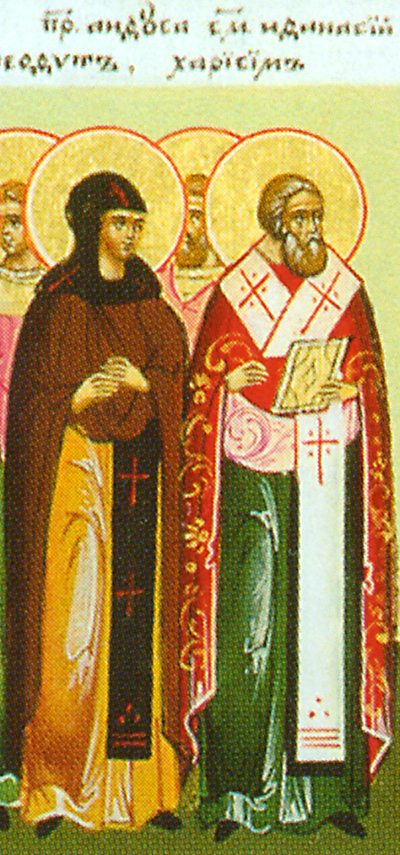
Saint Anthousa lived during the reign of Emperor Valerian (253-259)1 and was from Seleukeίa in Syria. She was the daughter of wealthy pagan parents, Antoninos and Martyria (Maria). Desiring to see her teacher Bishop Athanasios at Tarsus in Cilicia, she persuaded her mother to let her go there with two servants, Kharisimos and Neophytos, under the pretext of visiting her nurse. When she found Bishop Athanasios, he baptized her, then tonsured her as a nun. She withdrew into the desert and after living there for 23 years as an ascetic, she reposed in peace.
Saint Athanasios was brought before Valerian, and since he would not agree to sacrifice to idols, he was beheaded with a sword. Anthousa's servants, Kharisimos and Neophytos, who had been baptized with Saint Anthousa, courageously confessed Christ before the Emperor and were beheaded as well.
1 Some sources say that these Saints died during the reign of Emperor Aurelian (270-275).
Virgin Martyr Eulalia of Barcelona and the Martyr Felix
The Martyr Eulalia lived in Spain, near the city of Barcionum (now Barcelona), and she was raised by her parents in piety and the Christian Faith. Already at fourteen years of age, the maiden spent a solitary life in her parental home with others of her own age, occupied in prayer, the reading of Holy Scripture, and handicrafts.
During the time of a persecution against Christians under the emperors Diocletian (284-305) and Maximian (305-311), the governor Dacian arrived in the city of Barcionum to rid it of Christians. Hearing of this, the maiden secretly left her home at night, and by morning had made her way into the city. Pushing her way through the throng of people, the girl made a bold denunciation of the judge for forcing people to renounce the True God in order to offer sacrifice to devils instead.
Dacian gave orders to strip the girl and beat her with rods, but she steadfastly endured the torment and told the judge that the Lord would deliver her from the pain. They tied the martyr to a tree and tore her skin with iron claws, and they then burned her wounds with torches.
During her torment, Dacian asked the saint, “Where then is your God, Whom you have called upon?” She answered that the Lord was beside her, but that Dacian in his impurity could not see Him. During the saint’s prayer: “Behold, God helps me, and the Lord is the defender of my soul” (Ps. 53/54:4), the flames of the torches turned back upon the torturers, who fell to the ground.
The Martyr Eulalia began to pray that the Lord would take her to Heaven to Himself, and with this prayer she died. People saw a white dove come from her mouth and fly up to Heaven. Then a sudden snowstorm covered the martyr’s naked body like a white garment (the saint’s commemoration is sometimes given as December 10, which may be more correct, in view of the snow).
Three days later, the martyr’s parents came and wept before her hanging body, but they were also glad that their daughter would be numbered among the saints. When they took Saint Eulalia from the tree, one of the Christians, named Felix, said with tears of joy: “Lady Eulalia, you are the first of us to win the martyr’s crown!”
Saint Felix himself soon accepted death for Christ, and is also commemorated on this day.
Icon of the Mother of God of Georgia
In 1622, the Persian Shah Abbas I, after the devastating invasion of Orthodox Georgia, took part of the Robe of the Lord, and some especially revered icons. Three years later, when the Russian clerk Stephen Lazarev was in Persia to do some trading, a certain person from the Shah's retinue offered to let him purchase one of the stolen Georgian icons: an icon of the Most Holy Theotokos. At the same time, at Yaroslavl, the merchant Gregory Lytkin, by whom Stephen was employed, had a revelation of his clerk's imminent arrival with the precious acquisition.
Lytkin had been instructed by a voice from above to take the Icon from Yaroslavl to Arkhangelsk, near the Pinega River. Here, 16 versts from Kholmogorsk, was the Black Mountain monastery (which took its name from the mountain, on which a church was built in 1603.) Later, it was called Krasnogorsk (Beautiful Mountain).
Here the merchant delivered the Georgian Icon of the Most Holy Theotokos in 1629, during the reign of Tsar Michael. On August 22, with a large contingent of the faithful, the Icon was reverently placed in the monastery. At the same time, the miraculous healing of the blind and deaf monk Pitirim took place. The subsequent manifestations of the Icon's miraculous power prompted Metropolitan Nikon of Novgorod (later the Patriarch of Moscow and All Russia) to investigate. Afterward, from 1650, the annual celebration of this Icon took place on August 22, the day of its arrival at Krasnogorsk Monastery.
From that time, the Georgian Icon of the Mother of God was brought to Arkhangelsk each year with honors. The revered Icon was left for a certain time in the main cathedral of the city, for the sanctification of the city and of the Christ-loving people. During the reign of Tsar Alexei (1645-1676), the miraculous Icon was taken to Vologda, Great Ustyug, Pereyaslavl-Zalessky, and Siberia.
In 1654, Hieromonk Makarios of Krasnogorsk Monastery brought the Icon of the Most Holy Theotokos (which had been brought from Persia) to Moscow for restoration, and to be covered with a new riza. It was placed in the newly-built church, dedicated to the Life-giving Trinity, at Nikitnikov Lane near the Saint Barbara Gate, where the Kremlin masters carried on their iconographic work. Gregory Nikitnikov had built the church on his property at his own expense (1628-1651). In the church was a chapel dedicated to Saint Nikḗtas (September 15). Members of the Nikitnikov family were also entombed there.
About that time, a plague or pestilence was raging in Moscow. At the request of the master silversmith Gabriel Evdokimov, whose son was near death, a Moleben was served in his house before the Georgian Icon of the Mother of God from Krasnogorsk Monastery. The patient soon recovered. In gratitude for this miraculous healing, a copy of Georgian Icon was made and placed in Holy Trinity church. From that time, the church was also called Georgian.
The gracious help of the Most Holy Theotokos continued to be conferred by the aforementioned copy of her Icon. During the plague epidemic of 1654, the Moscow merchant Stephanov prayed continuously to the Queen of Heaven. The Most Holy Virgin appeared to him three times in a dream saying: "Pray to the Georgian Theotokos, on the Glinishchi at the mills, and you will be spared." The Holy Trinity church at Nikitniki was also called the church of the Great Martyr Nikḗtas (one of the chapels) on Glinishchi, near the mills. The merchant did not take his family from Moscow as he intended, but began to pray fervently in the Holy Trinity church. The epidemic did not touch him or his family.
The Churchwide celebration of the Georgian Icon of the Mother of God was established with the blessing of Patriarch Nikon in 1654. In 1698, the caretaker of the Moscow printing house Theodore Polikarpov compiled a
second edition of the Service.
After the liberation of Moscow from Napoleon's troops, on December 1, 1812 the wonderworking Georgian Icon of the Mother of God, along with other miraculous Icons of the Most Holy Theotokos (Vladimir, Iveron, and Assuage my Sorrows) were carried in solemn procession around the Kremlin.
In 1904, a chapel was built in Holy Trinity church in honor of the Georgian Icon of the Mother of God. Now this Icon is in the church of the Holy Trinity in Nikitnikov (Razin Street).
Miraculous healings were granted by the Most Holy Theotokos through her wonderworking Icon, which were documented and verified at the end of the XIX century. For example, on June 17, 1887, Lydia Tserkovnitskaya, the wife of a priest in the village of Shuysk, Vologda Province, was critically ill. She recovered after praying before the wonderworking Georgian Icon. There is historical evidence of four more Georgian icons of the Most Holy Theotokos.
Concerning the Georgian Icon of the Mother of God, which was in Moscow's Alekseevsky Convent, church evidence reports that it is not a copy of the Icons from Krasnogorsk Monastery nor from Holy Trinity church at Nikitnikov, which were brought from Georgia. In the same deadly plague epidemic of 1654, one of the nuns at the Alekseev Convent fell ill. While she addressed long prayers to the Heavenly Healer, the sick woman suddenly remembered the miraculous recovery she had heard about from the Icon of the Mother of God, which is in the church of the Life-giving Trinity by Saint Barbara's Gate. However, there was no one to send there. After some time, an unknown monk came to the Convent. Turning to the sick nun, he said: "Do not be sad that the Georgian Icon of the Mother of God cannot be brought here. You have here exactly the same Icon as the one brought from Georgia. You will find it in the cave, and you shall behold God's mercy."
The allegorical meaning of these words became clear afterward in the monastery sacristy, which was laid out like caves, when a hitherto unknown Icon of the Mother of God was discovered. After a Moleben, the miraculous Icon was carried to the cells of the nuns who were suffering from the pestilence. All of them were healed. From that time, the epidemic in Moscow began to abate.
Through the prayerful intercession of the Georgian Icon of the Most Holy Theotokos at the Alekseev Convent, the blind Princess Martha Prozorovskaya received miraculous healing in 1662. She gained her sight by the prayers of her parents, after seven years of serious illness.
To the northwest of Kazan, 18 versts from the city of Sviyazhsk, in the middle of the XVII century was the Raithu communal Hermitage of the Theotokos, which got its name from one of its churches, which was dedicated to the Venerable Fathers slain at Sinai and Raithu (January 14). Tradition states that during the construction of the monastery, Metropolitan Laurence of Kazan, by a revelation from above, sent the best local iconographers to Pinega, to the Krasnogorsk Monastery, which was very far from Kazan, in order to make a faithful copy of the wonderworking Icon of the Most Holy Theotokos, which was brought from Persia.
In 1661, a skillfully executed copy of the Georgian Icon of the Mother of God was delivered from Arkhangelsk. It became highly revered by the local population. Subsequently, this Icon was placed in the cathedral church in honor of the Most Holy Theotokos.
In the XVIII century, the pious peasants of the village of Klyucharev, Korchev county, Tver Province, presented the caretaker of the Moscow Archangel Cathedral with a copy of the Georgian Icon of the Mother of God, which became highly regarded by the locals, when the rye crop was threatened with destruction in the late 1860s. Vast fields of newly-sprouted crops were being eaten by an unknown worm, and nothing they did was of any use. Then the peasants prayed for help to the Most Holy Theotokos, whose Georgian Icon they revered. After a Cross Procession around the fields with the Icon, a sudden, unprecedented torrential rain fell. Streams of water washed the worms out of the ground, which were eaten by a large flock of birds. See also other revered copies of the Georgian Icon of the Mother of God in the Protection church at Vorontsov Field, and in the Holy Cross Church in the city of Tula.
The Icon disappeared after the closure of the monastery (1920-1922), and later it was returned to the monastery. In his 1946 report to the Moscow Patriarchate, Bishop Leonty (Smirnov) of Arkhangelsk states that the Georgian Icon was carried in a procession, which took place at Arkhangelsk in 1946. The further fate of the Georgian Icon is unknown.
Saint Bogolep, disciple of Saint Paisius of Uglich
Saint Bogolep lived during the XV and XVI centuries and was a disciple of Saint Paisios of Uglich (June 6). The Yaroslavl Paterikon (1912) credits Saint Bogolep with finding the wonderworking Icon of the Protection of the Most Holy Theotokos in 1482, which is mentioned in the Life of Saint Paisios. The Life states that "a certain baker" from the Uglich men's Monastery of the Lord's Theophany (later called Protection) went to the Volga early one morning for water. On the shore under the mountain he saw an icon of the Most Holy Theotokos. It is not known how it came to the Monastery. The monk ran to the Monastery and reported the incident to Saint Paisios. That baker was Saint Bogolep, who had worked as a baker when he was still in the world. After entering the Monastery, he carried out the same obedience.
Because of his piety and humility, Saint Bogolep was ordained as a priest before his death, and was tonsured into the Schema.
The date of Saint Basil's local glorification is not known. His Feast Day is celebrated on August 22, perhaps because the martyr Theoprepios (Феопрепий in Russian), who suffered martyrdom in the IV century with Saint Agathonikos of Nikomedia, is commemorated on that date.
The local canonization of Saint Bogolep was confirmed with the inclusion of his name in the Synaxis of the Rostov-Yaroslavl Saints, by the decision of His Holiness Patriarch Alexei I of Moscow and the Holy Synod on March 10, 1964.
The Synaxis of the Rostov-Yaroslavl Saints is celebrated on May 23/June 5.
Venerable Isaac I of Optina
Saint Isaac (Antimonov) fell asleep in the Lord on August 22, 1894.
The Moscow Patriarchate authorized local veneration of the Optina Elders on June 13,1996, glorifying them for universal veneration on August 7, 2000.