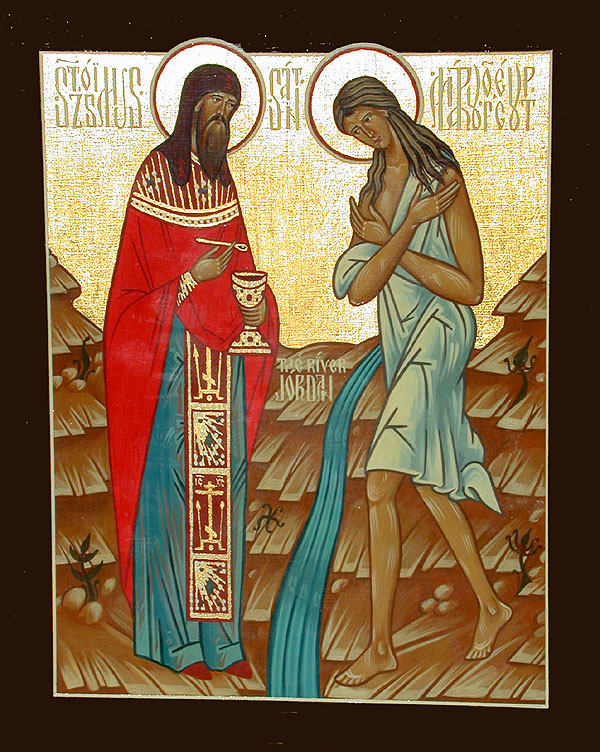
Saint Zosimas (April 4) was a monk at a certain Palestinian monastery on the outskirts of Caesarea. Having dwelt at the monastery since his childhood, he lived there in asceticism until he reached the age of fifty-three. Then he was disturbed by the thought that he had attained perfection, and needed no one to instruct him. “Is there a monk anywhere who can show me some form of asceticism that I have not attained? Is there anyone who has surpassed me in spiritual sobriety and deeds?”
Suddenly, an angel of the Lord appeared to him and said, “Zosimas, you have struggled valiantly, as far as this is in the power of man. However, there is no one who is righteous (Rom 3:10). So that you may know how many other ways lead to salvation, leave your native land, like Abraham from the house of his father (Gen 12:1), and go to the monastery by the Jordan.”
Abba Zosimas immediately left the monastery, and following the angel, he went to the Jordan monastery and settled in it.
Here he met Elders who were adept in contemplation, and also in their struggles. Never did anyone utter an idle word. Instead, they sang constantly, and prayed all night long. Abba Zosimas began to imitate the spiritual activity of the holy monks.
Thus much time passed, and the holy Forty Day Fast approached. There was a certain custom at the monastery, which was why God had led Saint Zosimas there. On the First Sunday of Great Lent the igumen served the Divine Liturgy, everyone received the All-Pure Body and Blood of Christ. Afterwards, they went to the trapeza for a small repast, and then assembled once more in church.
The monks prayed and made prostrations, asking forgiveness one of another. Then they made a prostration before the igumen and asked his blessing for the struggle that lay before them. During the Psalm “The Lord is my Light and my Savior, whom shall I fear? The Lord is defender of my life, of whom shall I be afraid?” (Ps 26/27:1), they opened the monastery gate and went off into the wilderness.
Each took with him as much food as he needed, and went into the desert. When their food ran out, they ate roots and desert plants. The monks crossed the Jordan and scattered in various directions, so that no one might see how another fasted or how they spent their time.
The monks returned to the monastery on Palm Sunday, each having his own conscience as a witness of his ascetic struggles. It was a rule of the monastery that no one asked how anyone else had toiled in the desert.
Abba Zosimas, according to the custom of the monastery, went deep into the desert hoping to find someone living there who could benefit him.
He walked into the wilderness for twenty days and then, when he sang the Psalms of the Sixth Hour and made the usual prayers. Suddenly, to the right of the hill where he stood, he saw a human form. He was afraid, thinking that it might be a demonic apparition. Then he guarded himself with the Sign of the Cross, which removed his fear. He turned to the right and saw a form walking southward. The body was black from the blazing sunlight, and the faded short hair was white like a sheep’s fleece. Abba Zosimas rejoiced, since he had not seen any living thing for many days.
The desert-dweller saw Zosimas approaching, and attempted to flee from him. Abba Zosimas, forgetting his age and fatigue, quickened his pace. When he was close enough to be heard, he called out, “Why do you flee from me, a sinful old man? Wait for me, for the love of God.”
The stranger said to him, “Forgive me, Abba Zosimas, but I cannot turn and show my face to you. I am a woman, and as you see, I am naked. If you would grant the request of a sinful woman, throw me your cloak so I might cover my body, and then I can ask for your blessing.”
Then Abba Zosimas was terrified, realizing that she could not have called him by name unless she possessed spiritual insight.
Covered by the cloak, the ascetic turned to Zosimas: “Why do you want to speak with me, a sinful woman? What did you wish to learn from me, you who have not shrunk from such great labors?”
Abba Zosimas fell to the ground and asked for her blessing. She also bowed down before him, and for a long time they remained on the ground each asking the other to bless. Finally, the woman ascetic said: “Abba Zosimas, you must bless and pray, since you are honored with the grace of the priesthood. For many years you have stood before the holy altar, offering the Holy Gifts to the Lord.”
These words frightened Saint Zosimas even more. With tears he said to her, “O Mother! It is clear that you live with God and are dead to this world. You have called me by name and recognized me as a priest, though you have never seen me before. The grace granted you is apparent, therefore bless me, for the Lord’s sake.”
Yielding finally to his entreaties, she said, “Blessed is God, Who cares for the salvation of men.” Abba Zosimas replied, “Amen.” Then they rose to their feet. The woman ascetic again said to the Elder, “Why have you come, Father, to me who am a sinner, bereft of every virtue? Apparently, the grace of the Holy Spirit has brought you to do me a service. But tell me first, Abba, how do the Christians live, how is the Church guided?”
Abba Zosimas answered her, “By your holy prayers God has granted the Church and us all a lasting peace. But fulfill my unworthy request, Mother, and pray for the whole world and for me a sinner, that my wanderings in the desert may not be useless.”
The holy ascetic replied, “You, Abba Zosimas, as a priest, ought to pray for me and for all, for you are called to do this. However, since we must be obedient, I will do as you ask.
The saint turned toward the East, and raising her eyes to heaven and stretching out her hands, she began to pray in a whisper. She prayed so softly that Abba Zosimas could not hear her words. After a long time, the Elder looked up and saw her standing in the air more than a foot above the ground. Seeing this, Zosimas threw himself down on the ground, weeping and repeating, “Lord, have mercy!”
Then he was tempted by a thought. He wondered if she might not be a spirit, and if her prayer could be insincere. At that moment she turned around, lifted him from the ground and said, “Why do your thoughts confuse you, Abba Zosimas? I am not an apparition. I am a sinful and unworthy woman, though I am guarded by holy Baptism.”
Then she made the Sign of the Cross and said, “May God protect us from the Evil One and his schemes, for fierce is his struggle against us.” Seeing and hearing this, the Elder fell at her feet with tears saying, “I beseech you by Christ our God, do not conceal from me who you are and how you came into this desert. Tell me everything, so that the wondrous works of God may be revealed.”
She replied, “It distresses me, Father, to speak to you about my shameless life. When you hear my story, you might flee from me, as if from a poisonous snake. But I shall tell you everything, Father, concealing nothing. However, I exhort you, cease not to pray for me a sinner, that I may find mercy on the Day of Judgment.
“I was born in Egypt and when I was twelve years old, I left my parents and went to Alexandria. There I lost my chastity and gave myself to unrestrained and insatiable sensuality. For more than seventeen years I lived like that and I did it all for free. Do not think that I refused the money because I was rich. I lived in poverty and worked at spinning flax. To me, life consisted in the satisfaction of my fleshly lust.
“One summer I saw a crowd of people from Libya and Egypt heading toward the sea. They were on their way to Jerusalem for the Feast of the Exaltation of the Holy Cross. I also wanted to sail with them. Since I had no food or money, I offered my body in payment for my passage. And so I embarked on the ship.
“Now, Father, believe me, I am very amazed, that the sea tolerated my wantonness and fornication, that the earth did not open up its mouth and take me down alive into hell, because I had ensnared so many souls. I think that God was seeking my repentance. He did not desire the death of a sinner, but awaited my conversion.
“So I arrived in Jerusalem and spent all the days before the Feast living the same sort of life, and maybe even worse.
“When the holy Feast of the Exaltation of the Venerable Cross of the Lord arrived, I went about as before, looking for young men. At daybreak I saw that everyone was heading to the church, so I went along with the rest. When the hour of the Holy Elevation drew nigh, I was trying to enter into the church with all the people. With great effort I came almost to the doors, and attempted to squeeze inside. Although I stepped up to the threshold, it was as though some force held me back, preventing me from entering. I was brushed aside by the crowd, and found myself standing alone on the porch. I thought that perhaps this happened because of my womanly weakness. I worked my way into the crowd, and again I attempted to elbow people aside. However hard I tried, I could not enter. Just as my feet touched the church threshold, I was stopped. Others entered the church without difficulty, while I alone was not allowed in. This happened three or four times. Finally my strength was exhausted. I went off and stood in a corner of the church portico.
“Then I realized that it was my sins that prevented me from seeing the Life-Creating Wood. The grace of the Lord then touched my heart. I wept and lamented, and I began to beat my breast. Sighing from the depths of my heart, I saw above me an icon of the Most Holy Theotokos. Turning to Her, I prayed: “O Lady Virgin, who gave birth in the flesh to God the Word! I know that I am unworthy to look upon your icon. I rightly inspire hatred and disgust before your purity, but I know also that God became Man in order to call sinners to repentance. Help me, O All-Pure One. Let me enter the church. Allow me to behold the Wood upon which the Lord was crucified in the flesh, shedding His Blood for the redemption of sinners, and also for me. Be my witness before Your Son that I will never defile my body again with the impurity of fornication. As soon as I have seen the Cross of your Son, I will renounce the world, and go wherever you lead me.”
“After I had spoken, I felt confidence in the compassion of the Mother of God, and left the spot where I had been praying. I joined those entering the church, and no one pushed me back or prevented me from entering. I went on in fear and trembling, and entered the holy place.
“Thus I also saw the Mysteries of God, and how God accepts the penitant. I fell to the holy ground and kissed it. Then I hastened again to stand before the icon of the Mother of God, where I had given my vow. Bending my knees before the Virgin Theotokos, I prayed:
“‘O Lady, you have not rejected my prayer as unworthy. Glory be to God, Who accepts the repentance of sinners. It is time for me to fulfill my vow, which you witnessed. Therefore, O Lady, guide me on the path of repentance.’”
“Then I heard a voice from on high: ‘If you cross the Jordan, you will find glorious rest.’
“I immediately believed that this voice was meant for me, and I cried out to the Mother of God: ‘O Lady, do not forsake me!’
“Then I left the church portico and started on my journey. A certain man gave me three coins as I was leaving the church. With them I bought three loaves of bread, and asked the bread merchant the way to the Jordan.
“It was nine o’clock when I saw the Cross. At sunset I reached the church of Saint John the Baptist on the banks of the Jordan. After praying in the church, I went down to the Jordan and washed my face and hands in its water. Then in this same temple of Saint John the Forerunner I received the Life-Creating Mysteries of Christ. Then I ate half of one of my loaves of bread, drank water from the holy Jordan, and slept there that night on the ground. In the morning I found a small boat and crossed the river to the opposite shore. Again I prayed that the Mother of God would lead me where She wished. Then I found myself in this desert.”
Abba Zosimas asked her, “How many years have passed since you began to live in the desert?”
“‘I think,” she replied, “it is forty-seven years since I came from the Holy City.”
Abba Zosimas again asked, “What food do you find here, Mother?”
And she said, “I had with me two and a half loaves of bread when I crossed the Jordan. Soon they dried out and hardened Eating a little at a time, I finished them after a few years.”
Again Abba Zosimas asked, “Is it possible you have survived for so many years without sickness, and without suffering in any way from such a complete change?”
“Believe me, Abba Zosimas,” the woman said, “I spent seventeen years in this wilderness (after she had spent seventeen years in immorality), fighting wild beasts: mad desires and passions. When I began to eat bread, I thought of the meat and fish which I had in abundance in Egypt. I also missed the wine that I loved so much when I was in the world, while here I did not even have water. I suffered from thirst and hunger. I also had a mad desire for lewd songs. I seemed to hear them, disturbing my heart and my hearing. Weeping and striking myself on the breast, I remembered the vow I had made. At last I beheld a radiant Light shining on me from everywhere. After a violent tempest, a lasting calm ensued.
“Abba, how shall I tell you of the thoughts that urged me on to fornication? A fire seemed to burn within me, awakening in me the desire for embraces. Then I would throw myself to the ground and water it with my tears. I seemed to see the Most Holy Virgin before me, and She seemed to threaten me for not keeping my vow. I lay face downward day and night upon the ground, and would not get up until that blessed Light encircled me, dispelling the evil thoughts that troubled me.
“Thus I lived in this wilderness for the first seventeen years. Darkness after darkness, misery after misery stood about me, a sinner. But from that time until now the Mother of God helps me in everything.”
Abba Zosimas again inquired, “How is it that you require neither food, nor clothing?”
She answered, “After finishing my bread, I lived on herbs and the things one finds in the desert. The clothes I had when I crossed over the Jordan became torn and fell apart. I suffered both from the summer heat, when the blazing heat fell upon me, and from the winter cold, when I shivered from the frost. Many times I fell down upon the earth, as though dead. I struggled with various afflictions and temptations. But from that time until the present day, the power of God has guarded my sinful soul and humble body. I was fed and clothed by the all-powerful word of God, since man does not live by bread alone, but by every word proceeding from the mouth of God (Dt 8:3, Mt.4:4, Luke 4:4), and those who have put off the old man (Col 3:9) have no refuge, hiding themselves in the clefts of the rocks (Job 24:8, Heb 11:38). When I remember from what evil and from what sins the Lord delivered me, I have imperishible food for salvation.”
When Abba Zosimas heard that the holy ascetic quoted the Holy Scripture from memory, from the Books of Moses and Job and from the Psalms of David, he then asked the woman, “Mother, have you read the Psalms and other books?”
She smiled at hearing this question, and answered, “Believe me, I have seen no human face but yours from the time that I crossed over the Jordan. I never learned from books. I have never heard anyone read or sing from them. Perhaps the Word of God, which is alive and acting, teaches man knowledge by itself (Col 3:16, 1 Thess 2:13). This is the end of my story. As I asked when I began, I beg you for the sake of the Incarnate Word of God, holy Abba, pray for me, a sinner.
“Furthermore, I beg you, for the sake of Jesus Christ our Lord and Savior, tell no one what you have heard from me, until God takes me from this earth. Next year, during Great Lent, do not cross the Jordan, as is the custom of your monastery.”
Again Abba Zosimas was amazed, that the practice of his monastery was known to the holy woman ascetic, although he had not said anything to her about this.
“Remain at the monastery,” the woman continued. “Even if you try to leave the monastery, you will not be able to do so. On Great and Holy Thursday, the day of the Lord’s Last Supper, place the Life-Creating Body and Blood of Christ our God in a holy vessel, and bring it to me. Await me on this side of the Jordan, at the edge of the desert, so that I may receive the Holy Mysteries. And say to Abba John, the igumen of your community, ‘Look to yourself and your brothers’ (1 Tim 4:16), for there is much that needs correction. Do not say this to him now, but when the Lord shall indicate.”
Asking for his prayers, the woman turned and vanished into the depths of the desert.
For a whole year Elder Zosimas remained silent, not daring to reveal to anyone what he had seen, and he prayed that the Lord would grant him to see the holy ascetic once more.
When the first week of Great Lent came again, Saint Zosimas was obliged to remain at the monastery because of sickness. Then he remembered the woman’s prophetic words that he would not be able to leave the monastery. After several days went by, Saint Zosimas was healed of his infirmity, but he remained at the monastery until Holy Week.
On Holy Thursday, Abba Zosimas did what he had been ordered to do. He placed some of the Body and Blood of Christ into a chalice, and some food in a small basket. Then he left the monastery and went to the Jordan and waited for the ascetic. The saint seemed tardy, and Abba Zosimas prayed that God would permit him to see the holy woman.
Finally, he saw her standing on the far side of the river. Rejoicing, Saint Zosimas got up and glorified God. Then he wondered how she could cross the Jordan without a boat. She made the Sign of the Cross over the water, then she walked on the water and crossed the Jordan. Abba Zosimas saw her in the moonlight, walking toward him. When the Elder wanted to make prostration before her, she forbade him, crying out, “What are you doing, Abba? You are a priest and you carry the Holy Mysteries of God.”
Reaching the shore, she said to Abba Zosimas, “Bless me, Father.” He answered her with trembling, astonished at what he had seen. “Truly God did not lie when he promised that those who purify themselves will be like Him. Glory to You, O Christ our God, for showing me through your holy servant, how far I am from perfection.”
The woman asked him to recite both the Creed and the “Our Father.” When the prayers were finished, she partook of the Holy Mysteries of Christ. Then she raised her hands to the heavens and said, “Lord, now let Your servant depart in peace, for my eyes have seen Your salvation.”
The saint turned to the Elder and said, “Please, Abba, fulfill another request. Go now to your monastery, and in a year’s time come to the place where we first time spoke.”
He said, “If only it were possible for me to follow you and always see your holy face!”
She replied, “For the Lord’s sake, pray for me and remember my wrechedness.”
Again she made the Sign of the Cross over the Jordan, and walked over the water as before, and disappeared into the desert. Zosimas returned to the monastery with joy and terror, reproaching himself because he had not asked the saint’s name. He hoped to do so the following year.
A year passed, and Abba Zosimas went into the desert. He reached the place where he first saw the holy woman ascetic. She lay dead, with arms folded on her bosom, and her face was turned to the east. Abba Zosimas washed her feet with his tears and kissed them, not daring to touch anything else. For a long while he wept over her and sang the customary Psalms, and said the funeral prayers. He began to wonder whether the saint would want him to bury her or not. Hardly had he thought this, when he saw something written on the ground near her head: “Abba Zosimas, bury on this spot the body of humble Mary. Return to dust what is dust. Pray to the Lord for me. I reposed on the first day of April, on the very night of the saving Passion of Christ, after partaking of the Mystical Supper.”
Reading this note, Abba Zosimas was glad to learn her name. He then realized that Saint Mary, after receiving the Holy Mysteries from his hand, was transported instantaneously to the place where she died, though it had taken him twenty days to travel that distance.
Glorifying God, Abba Zosimas said to himself, “It is time to do what she asks. But how can I dig a grave, with nothing in my hands?” Then he saw a small piece of wood left by some traveler. He picked it up and began to dig. The ground was hard and dry, and he could not dig it. Looking up, Abba Zosimas saw an enormous lion standing by the saint’s body and licking her feet. Fear gripped the Elder, but he guarded himself with the Sign of the Cross, believing that he would remain unharmed through the prayers of the holy woman ascetic. Then the lion came close to the Elder, showing its friendliness with every movement. Abba Zosimas commanded the lion to dig the grave, in order to bury Saint Mary’s body. At his words, the lion dug a hole deep enough to bury the body. Then each went his own way. The lion went into the desert, and Abba Zosimas returned to the monastery, blessing and praising Christ our God.
Arriving at the monastery, Abba Zosimas related to the monks and the igumen, what he had seen and heard from Saint Mary. All were astonished, hearing about the miracles of God. They always remembered Saint Mary with faith and love on the day of her repose.
Abba John, the igumen of the monastery, heeded the words of Saint Mary, and with the help of God corrected the things that were wrong at the monastery. Abba Zosimas lived a God-pleasing life at the monastery, reaching nearly a hundred years of age. There he finished his temporal life, and passed into life eternal.
The monks passed on the life of Saint Mary of Egypt by word of mouth without writing it down.
“I however,” says Saint Sophronius of Jerusalem (March 11), “wrote down the Life of Saint Mary of Egypt as I heard it from the holy Fathers. I have recorded everything, putting the truth above all else.”
“May God, Who works great miracles and bestows gifts on all who turn to Him in faith, reward those who hear or read this account, and those who copy it. May he grant them a blessed portion together with Saint Mary of Egypt and with all the saints who have pleased God by their pious thoughts and works. Let us give glory to God, the Eternal King, that we may find mercy on the Day of Judgment through our Lord Jesus Christ, to Whom is due all glory, honor, majesty and worship together with the Unoriginate Father, and the Most Holy and Life-Creating Spirit, now and ever and unto ages of ages. Amen.”
Afterfeast of the Dormition of the Mother of God
The Church continues to honor the passage of the Most Holy Theotokos from death to life. Just as Christ once dwelt in the virginal womb of His Mother, now He takes Her “to dwell in His courts.”
Apostle Thaddeus of the Seventy
Saint Thaddeus, Apostle of the Seventy, was by descent a Hebrew, and he was born in the Syrian city of Edessa. The holy Apostle Thaddeus of the Seventy must be distinguished from Saint Jude, also called Thaddeus or Levi (June 19), who was one of the Twelve Apostles.
When he came to Jerusalem for a feastday, he heard the preaching of John the Forerunner. After being baptized by him in the Jordan, he remained in Palestine. He saw the Savior, and became His follower. He was chosen by the Lord to be one of the Seventy Disciples, whom He sent by twos to preach in the cities and places where He intended to visit (Luke. 10: 1).
After the Ascension of the Savior to Heaven, Saint Thaddeus preached the good news in Syria and Mesopotamia. He came preaching the Gospel to Edessa and he converted King Abgar, the people and the pagan priests to Christ. He backed up his preaching with many miracles (about which Abgar wrote to the Assyrian emperor Nerses). He established priests there and built up the Edessa Church.
Prince Abgar wanted to reward Saint Thaddeus with rich gifts, but he refused and went preaching to other cities, converting many pagans to the Christian Faith. He went to the city of Beirut to preach, and he founded a church there. It was in this city that he peacefully died in the year 44. (The place of his death is indicated as Beirut in the Slavonic MENAION, but according to other sources he died in Edessa. According to an ancient Armenian tradition, Saint Thaddeus, after various tortures, was beheaded by the sword on December 21 in the Artaz region in the year 50).
Martyr Bassa of Edessa and her sons Theogonius, Agapius, and Pistus
The Martyr Bassa with her sons Theognis, Agapius and Pistus, lived in the city of Macedonian Edessa and she was married to a pagan priest. From childhood she had been raised in the Christian Faith, which she passed on to her sons.
During the reign of the emperor Maximian Galerius (305-311), the husband denounced his wife and children to the governor. In spite of threats, the boys refused to offer sacrifice to idols, so they were tortured and put to death. The eldest son, Theognis, was raked with iron claws, then he was beheaded. The skin of the young Agapius was flayed from head to chest, but the martyr did not utter a sound. The youngest son Pistus was tortured and beheaded, just as his brothers had been. One account says that the three brothers suffered at Edessa in Macedonia. Another account says they died at Larissa in Thessaly, their homeland.
Saint Bassa was thrown into prison and was weakened by hunger, but an angel strengthened her with heavenly food. Under successive tortures she remained unharmed by fire, water and beasts. When they brought her to a pagan temple, she shattered the statue of Zeus. Then they threw the martyr into a whirlpool in the sea. But to everyone’s surprise a ship sailed up, and three radiant men pulled her up (Saint Νikόdēmos of the Holy Mountain (July 14) suggests that these were her children, martyred earlier). After eight days Saint Bassa came by ship to the governor of the island of Alona, not far from Cyzicus, in the Propontis or Sea of Marmora. After beating her with rods, they beheaded her.
By the year 450 there was already a church in honor of the holy martyr Bassa at Chalcedon.
Venerable Abramius the Wonderworker, Archimandrite of Smolensk
Saint Abramius of Smolensk, a preacher of repentance and the Dread Last Judgment, was born in the mid-twelfth century at Smolensk of rich parents, who had twelve daughters before him, and they begged God for a son.
From childhood he grew up in the fear of God, he was often in church and had the opportunity to read books. The parents hoped that their only son would enter into marriage and continue their illustrious lineage, but he sought a different life. After the death of his parents, having given away all his wealth to monasteries, to churches and to the destitute, the saint walked through the city in rags, asking God to show him the way to salvation.
He was tonsured in the monastery of the Most Holy Theotokos, five versts from Smolensk, at Selischa. Having passed through various obediences there, the monk fervently occupied himself with copying books, culling spiritual riches from them. The Smolensk prince Roman Rostislavich (+ 1170) started a school in the city, in which they taught not only in Slavonic, but also from Greek and Latin books. The Prince himself had a large collection of books, which Saint Abramius used. He had struggled for more than 30 years at the monastery, when in the year 1198 the igumen persuaded him to accept the dignity of presbyter. Every day he served the Divine Liturgy and fulfilled the obedience of clergy not only for the brethren, but also for the laity.
Soon the monk became widely known. This aroused the envy of the brethren, and then of the igumen also, and five years later, the monk was compelled to transfer to the Exaltation of the Cross monastery in Smolensk itself. With offerings from the devout, he embellished the cathedral church of the poor monastery with icons, and with curtains and candle-stands. He himself painted two icons on themes which most concerned him. On one he depicted the Dread Last judgment, and on the other the suffering of the trials of life. Lean and pale from extreme toil, in priestly garb the ascetic resembled Saint Basil the Great in appearance. The saint was strict both towards himself, and towards his spiritual children. He preached constantly in church and to those coming to him in his cell, conversing with rich and poor alike.
The city notables and the clergy demanded that Bishop Ignatius bring the monk to trial, accusing him of seducing women and tempting his spiritual children. But even more terrible were the accusations of heresy and the reading of forbidden books. For this they proposed to drown or burn the ascetic. At the trial by the Prince and the Bishop, the saint answered all the false accusations. Despite this, they forbade him to serve as a priest and returned him to his former monastery of the Most Holy Theotokos . A terrible drought occurred in consequence of God’s wrath over the unjust sentence, and only when Saint Ignatius pardoned Saint Abramius, permitting him to serve and preach, did the rain again fall on Smolensk.
The bishop Saint Ignatius built a new monastery, in honor of the Placing of the Robe of the Most Holy Theotokos, and he entrusted the guidance of it to Saint Abramius, and he himself settled into it, retiring from the diocese because of age. Many wished to enter under the guidance of Saint Abramius, but he examined them very intensely and only after great investigation, so at his monastery there were only seventeen brethren. Saint Abramius, after the death of Saint Ignatius, having become his spiritual friend, urged the brethren, more than before, to think about death and to pray day and night, that they be not condemned in the Judgment by God.
Saint Abramius died after the year 1224, having spent 50 years in monasticism. Already at the end of the thirteenth century a service had been compiled to him, together with his disciple Saint Ephraim. The terrible Mongol-Tatar invasion, seen as the wrath of God for the nation’s sins, not only did not stifle the memory of Saint Abramius of Smolensk, but rather was a reminder to people of his calling to repentance and recollection of the dread Last Judgment.
Venerable Ephraim the Wonderworker, disciple of Abramius, and Archimandrite of Smolensk
Saint Ephraim was the disciple of Saint Abramius of Smolensk. He compiled the Life of Saint Abramius, which provides many details about education in the remote northwestern part of Russia in those days.
Venerable Abramius the lover-of-labor of the Kiev Near Caves
It is hard to determine precisely when Saint Abraham and the other saints of the Caves lived because of the scarcity of written records. It is likely, though not certain, that they lived during the Mongol-Tatar invasions in the XIII century.
In the Teraturgim of Hieromonk Athanasius (Kalophoisky), dating back to the XVII century, Saint Abraham is called “Venerable Elder Abraham, the Lover of Labor.” Archbishop Philaret (Gumilevsky) said that “toward the end of his life, he toiled in a cave. After praying here he worked to prepare everything necessary for the Brotherhood of the Caves, which earned him the title ‘Lover of Labor.’”
Archbishop Sergius (Spassky) suggests that Saint Abraham lived during the XII-XIII centuries. On the other hand, the Orthodox Encyclopedia places his life between the second half of the XIII century and the beginning of the XIV century. His holy relics rest in the Near Caves of Saint Anthony.
On an ancient icon of the wonderworkers of the Near Caves Saint Anthony is called an Igoumen. He is described in the same way in a manuscript list of saints. If that is so, then he buried Prince Skirigail (John), who was killed by his own servants in Vyshgorod in 1396, near the tomb of Saint Theodosios (May 3).
Saint Abraham the Lover of Labor has long been commemorated on August 21, the same day as Saint Abraham of Smolensk.
Saint Abraham the Lover of Labor is also commemorated on September 28, the Synaxis of all the Venerable Fathers of the Kiev Caves Monastery, whose relics lie in the Near Caves of Saint Anthony. We also remember Saint Abraham on the Second Sunday of Great Lent, the Synaxis of all the Venerable Fathers of the Kiev Caves (which is a movable Feast).
Saint Sarmean, Catholicos of Kartli, Georgia
The chronicles listing the generations of chief shepherds of Georgia reveal that Saint Sarmean was leader of the Georgian Apostolic Church from the year 767 (or 760, according to some sources) until the year 774. These were years of Arab-Muslim rule in Georgia. The Arabs persecuted the Christians, oppressed those who served in the Church, and tried in every way to convert the country to Islam. Despite the frightful abuses that the faithful endured and the transformation of the city into a residence for the emir, many Tbilisi churches continued to function.
Sarmean was a firm defender of Orthodoxy. Once, however, on Cheese-fare Thursday at Shio-MgvimeMonastery, a group of strangers bearing gifts arrived at the monastery. He served Holy Communion to them without ever inquiring into their faith. Later he learned that they were Jacobites (members of one of the Monophysite churches).
His carelessness was revealed to him in a dream that same night.
When he awoke the next morning, Catholicos Sarmean summoned the bishops, confessed his mistake, burned the gifts that the Jacobites had given him before their eyes, and departed for an isolated cave, where he wept over his sin with bitter tears.
But the All-merciful Lord sent a sign to Saint Sarmean to inform him that his transgression had been forgiven. The bishops sent him a message from Mtskheta: “O Great Sovereign Patriarch Sarmean! Rejoice! We, your spiritual children, believers in your holiness, the entire council of bishops, wish to inform you that Saint Shio has appeared and told each of the five of us that the Lord has remitted your sin. Make haste and summon us to the monastery, that we may give thanks together to our Holy Father Shio!”
Holy Catholicos Sarmean, divinely endowed with humility, faith, love, and the fear of God, led his flock wisely to the end of his days and reposed peacefully in the year 774.
New Martyr Simeon of Samokov
No information available at this time.
Hieromartyr Raphael of Serbia
No information available at this time.
Venerable Cornelius of Paleostrov, Olonets
Saint Cornelius, the Igoumen of Paleostrov, Olonets was born in Pskov. He entered a monastery and was tonsured as an adult, and at first he began his monastic struggles at Valaam Monastery. Later he passed through Finland to the White Sea and enlightened the pagans there, and more than once he was subjected to mortal danger. For some time Saint Cornelius visited several monasteries and hermitages, gathering invaluable experience for living among the humble hermits and ascetics of the wilderness.
At the end of the XIV century, and the conclusion of his many profitable pilgrimages, he went to Lake Onega in search of a secluded place to live in silence and prayer. The beauty of the location and the isolation of the Onega island of Paleh (Vspalye) attracted the hermit, and he settled here, building a small cell for himself. This godly-minded and prayerful feat became the basis of his solitary life.
Soon news of the devout life of Saint Cornelius spread throughout the region, and despite the island's seclusion, numerous visitors began to come to him, seeking his spiritual help and guidance. Some of them asked the holy ascetic to allow them to settle on the island to live an eremitic life. Saint Cornelius accepted them gladly, and helped them to build cells; and then they built a church in honor of the Nativity of the Most Holy Theotokos and a trapeza church in honor of the Holy Prophet Elijah. This was the beginning of Paleostrov Monastery.
Not neglecting his duties to manage the Monastery he established, the God-pleaser often withdrew to pray in a secluded cave located on the same island at the foot of a mountain. The prayerful struggle (podvig) of Saint Cornelius was exacerbated by wearing heavy iron chains, and by his severe fasting. Once, during evening prayers, the holy Igoumen had a vision of the Lord Jesus Christ, Who appeared to him with a cross in His hands and blessed both him and the Monastery. Comforted by such a sweet vision, Saint Cornelius left his beloved disciple Saint Abraham (August 21) as Igoumen of the Monastery, while he retired to his hermitage in the cave, where he remained until his death.
Saint Cornelius reposed around 1420 at an advanced age and was buried in the place of his solitary ascetical contests. During the lifetime of the holy Igoumen Abraham (who reposed in the second half of the XV century), the Lord glorified the body of the Monastery's first founder, Saint Cornelius, with incorruption. Saint Abraham and the brethren solemnly transferred the revered relics of their teacher from the cave and placed them under the floor of the cathedral church dedicated to the Nativity of the Most Holy Theotokos. Saint Abraham was also glorified by his ascetical life, and was buried in the Paleostrov Monastery beside his Elder.
Hieromartyr Raphael of Sisatovac
No information available at this time.
Venerable Schema-nun Martha of Diveyevo
Our Venerable Mother Martha (in the world Maria Semenovna Milyukova) was born on February 10, 1810 into a peasant family of the Nizhny Novgorod governorate, Ardatovsky district, in the village of Pozhidovo (now Malinovka). The Milyukov family, who led a righteous and God-pleasing life, was close to Elder Seraphim of Sarov. In addition to Maria, there were two older children - her sister Praskovya Semenovna and her brother Ivan Semenovich.
This village, along with those adjacent to it, were appanages - they did not belong to the lord-landowner, but to the treasury. Its land was divided separately, but it was infertile, because the black earth plots were seized by neighboring landlords. The peasants lived very poorly, from childhood they had to work a great deal in the fields, and to take care of the livestock.
With Saint Seraphim's blessing, Praskovya Semenovna entered the community of Mother Alexandra (in the world Agathia Semenovna Belokopytova), the first founder of Diveyevo Monastery, and a nun of exalted spiritual life.
When Maria was thirteen years old, she and her sister Praskovya came to Father Seraphim for the first time. This occurred on November 21, 1823, the Feast of the Entry of the Most Holy Theotokos into the Temple. As Praskovya Semenovna told it, Maria "was attached to me," and so both of them came to Sarov. The great Elder, seeing that the girl Maria was a chosen vessel of God's grace, he did not allow her to return home, but ordered her to remain in the community. Thus, thirteen-year-old Maria Semenovna was numbered with Father Seraphim's chosen orphans, in the community of Matushka Alexandra, of which the Eldress Xenia Mikhailovna Kocheulova was the Superior, whom Father Seraphim called "a pillar of fire from earth to heaven" and a "spiritual rasp" because of her righteous life. The extraordinary, hitherto inconspicuous girl Maria cannot be compared with anyone: she was angelic, a child of God, and from an early age she began to lead an ascetical life. In the severity of her ascetical contest (podvig) she surpassed even the sisters of the community, who were distinguished for the severity of their life, and even surpassed the Superior Xenia Mikhailovna herself. Unceasing prayer was her food, and she would reply only to necessary questions with heavenly meekness. She was almost completely silent, and Father Seraphim loved her with exceptional tenderness, disclosing to her all his heavenly revelations concerning the Monastery's future glory, and other great spiritual mysteries. He ordered her not to speak of these things until that time. She obeyed his instructions, despite the requests and entreaties of the sisters and her relatives. Whenever she returned after seeing Saint Seraphim, she was radiant with inexpressible joy.
Soon afterward, Maria entered the community of the Kazan church. The Queen of Heaven had blessed the creation of a new community next to that one, which is how the construction of the Monastery, which the Mother of God had promised to Mother Alexandra, began.
From 1825, Father Seraphim began going to bless first the sisters, and then the virtuous Superior of the Diveyevo community, Xenia Mikhailovna, who, of course, deeply respected and highly revered Father Seraphim, but she would not agree to change the Rule of her community, which seemed to be too severe, both to Father Seraphim and all the sisters who had been rescued in the community. The number of sisters had increased so much in the community that they needed to enlarge their property, but it was impossible to expand in any direction. Batiushka Seraphim summoned Xenia Mikhailovna and tried to persuade her that it would be easier to replace the severe Sarov Rule, but she wouldn't hear of it.
"Obey me, my joy," Father Seraphim said.
But the uncompromising Eldress finally replied: "No, Batiushka, let it be the old way. We have been content with the Rule which our founder, Father Pakhomios († 1794) has already established for us!"
Then Father Seraphim dismissed the Superior of the Diveyevo community, reassured that what the great Eldress Mother Alexandra had asked him to do no longer weighed on his conscience, or that the time for God's will to be done had not yet come. But on November 25 of that year, on the Feast Day of the holy God-pleasers Clement, the Pope of Rome, and Saint Peter of Alexandria, while he was making his way through the thickets of the forest along the bank of the Sarovka River, and going to his Far Hermitage as usual, Saint Seraphim saw the Mother of God and two Apostles standing behind her: Saint Peter and Saint John the Evangelist. The Queen of Heaven, struck the earth with her staff, so that a spring issued from the ground, a fountain of clear water. She said to him, "Why do you wish to disregard what my servant Agathia, the nun Alexandra, has asked you to do, and to forsake Xenia and her sisters, for this commandment to my servants must not be broken, but strictly observed; for it is by my will that she gave it to you. I will show you another place, also in the village of Diveyevo, and there I will establish this, my promised abode. In remembrance of the promise I gave her, take eight sisters from Xenia’s community, the place of my servant’s repose."
She also told him the names of which girls to take. Two weeks after this vision of the Queen of Heaven, on December 9, 1825, Maria and another sister, came to Saint Seraphim, and Batiushka told them that they should accompany him to his Far Hermitage. Arriving there and going into the dwelling, Father Seraphim gave the sisters two lit wax candles, which they brought with them at his orders, together with oil and breadcrumbs. He told Maria to stand on the right side of the cross hanging on the wall, and Praskovia Stepanovna (that was the name of the other sister) on the left. So they stood for more than an hour with lit candles, and Father Seraphim stood between them, praying all the while. After praying, he stood before the cross and told them to pray as well. Thus, before beginning to establish a new community he prayed mystically with the sisters, who had been designated by the Mother of God for special service to her and to the Monastery.
For four years, Maria struggled, helping Saint Seraphim and the sisters to establish the new community, she stored poles and timbers for the mill which the Mother of God blessed them to build on the site where the new community would be built. She carried bricks for construction of the church of the Nativity of the Most Holy Theotokos; she ground flour and fulfilled other obediences, during which she never neglected her heartfelt prayers, "silently lifting up her ardent soul to the Lord."
This wondrous girl was endowed by the Lord with a very rare gift of pure and unceasing prayer. In all things she was always guided by Saint Seraphim himself. As an example of her unconditional obedience, it was said that when her sister Praskovia Semenovna had a question about a certain Sarov monk, Maria was surprised and like an innocent child she asked: "What kind of monks, Parasha, look like a priest?"
Surprised in turn by her sister's question, Praskovya Semenovna replied to her: "After all, you go to Sarov, didn't you see what you were asking about?" – "No, Parashenka," Maria Semenovna said humbly, "because I don't see or know anything; Father Seraphim ordered me never to look at them, and I tie a handkerchief over my face like this, so I can see the road beneath my feet."
That is how the child-ascetic was. She lived in the Monastery for just six years, and then she went peacefully and quietly to the Lord at the age of nineteen.
On August 21,1829, Diveyevo Monastery lost its wondrous young girl of holy life, Maria Semenovna Milyukova, Schema-nun Martha. Having foreseen the hour of her death in the spirit, Saint Seraphim suddenly wept with great sorrow and told Father Paul in the neighboring cell, “Paul! Maria has departed, and it grieves me that, as you see, everyone is crying!”
Batiushka Seraphim wished to make her an oak coffin, rounded and hollowed out. Praskovya Semenovna went after him with another sister of Diveyevo, Aquilina Vasilyevna. Praskovya Semenovna was very upset, and Batiushka embraced her in a paternal way, caressing and encouraging her. Then he joined the hands of Praskovya Semenovna and Aquilina Vasilyevna and told them: "Now you shall be sisters, and I am your father, for I have begotten you in the Spirit! Maria is the Schema-nun Martha, I tonsured her into the Schema. She has everything: the Schema, the mantiya, and my kamilavka, all this is hers. Put it down! Don't be discouraged, Matushka." Father Seraphim turned to Praskovya Semenovna and said, "Her soul is in the Kingdom of Heaven, near the Holy Trinity, at God's Throne, and your entire family shall be saved by her."
In addition, Batiushka Seraphim donated 25 rubles for the funeral expenses and 25 copper rubles to give to all the sisters and laymen, whoever was at her burial, three kopecks each. He also donated two towels for the altar, a bunch of yellow candles for her to be commemorated for forty days after her repose, so that they would burn in the church day and night for forty days, and at her coffin a yellow one ruble candle, and at the funeral, half a pound of white twenty-kopeck candles.
Thus, with the blessing of Saint Seraphim, Maria Semenovna, Schema-nun Martha, was laid in a coffin: in two scrolls (shirts), in a paper cassock, belted with a woolen black edge, over this was in a black and white cross-stitched Schema and a long robe. On her head was placed a green velvet embroidered gold cap, and on top of it Batiushka Seraphim's kamilavka, and finally, still tied with a large dradedam a dark blue handkerchief with tassels. In her hands - leather prayer ropes. All these things were given to her by Father Seraphim with his own hands, ordering them always to commune of the Holy Mysteries, which was exactly what Maria did on each of the Twelve Major Feasts, and during the four fasts.
The righteous Seraphim sent all those who had just come to him in these days to Diveyevo for the funeral of Maria Semenovna. So, to the sisters who knew nothing about it, those who worked on Satis (a forest area on the banks of the Satis River), to Barbara Ilyinishna and others, the Elder said: "You are my joys! Come soon to Diveyevo where the great servant of God Maria has departed to the Lord!" The sisters could not understand how Maria could die, and they were surprised to find Maria Semenovna in her coffin.
Then Maria Semenovna's brother Ivan, who had also attended his sister's funeral, went to speak to Batiushka Seraphim. Suddenly the Elder said: "Are you really Maria's brother?" – "Yes, Batiushka," he replied. Batiushka looked at him a second time and asked: "Are you Maria's brother?" – "Yes, Batiushka," he said again.
Then the Elder thought for a long, long time, still staring intently at Ivan, who stood before him. Suddenly he became so joyful and luminous that the sun's rays seemed to shine from his face, and Ivan had to turn away from Father Seraphim, unable to look at him. Then Batiushka exclaimed: "Behold, my joy! What mercy she has received from the Lord! She is in the Kingdom of Heaven at the Throne of God, near the Queen of Heaven, with the holy virgins! She is an intercessor for your entire family! She is the Schema-nun Martha, I tonsured her. Whenever you are at Diveyevo, never pass by her grave without kneeling down and saying: "Our lady and Mother Martha, remember us before God's Throne in the Kingdom of Heaven!"
Then Saint Seraphim repeated this to Ivan Semenovich three times.
After that, Father Seraphim summoned Sister Xenia Vasilyevna Putkova (later the Nun Capitolina) whom he always assigned to write down various names for commemoration, and said to her, "Behold, Matushka, list her as the Nun Maria, but because by her deeds and by the prayers of the wretched Seraphim, she has received the Schema! Pray to her as Schema-nun Martha, you and everyone around her."
According to the testimony of the sisters and those close to Diveyeo, Maria Semenovna was tall and attractive in appearance; with an oblong, pale, bright face, blue eyes, thick light blonde eyebrows, and hair of the same color. She was buried with her hair loose. She rests on the left side of Mother Alexandra, the first founder of the Kazan community. Few of the stories told by the older nuns about Maria Semenovna have been preserved. Maria Ilarionovna (later the nun Melitina) related the following: "Living in the world and hearing about Father Seraphim from everyone," she said: "I wished to be at Sarov and to receive his blessing. First of all, when I arrived at Sarov, I went to Batiushka in his wilderness; he came out to meet me, blessed me, and said with a smile, 'Matushka, do you know Maria Semenovna?' I said 'I do know her, Batiushka; she lives three yards away from us.'
'Behold, Matushka," the Saint continued, 'I will tell you about her, how zealous she was about her work. When a church was being built at Diveyevo in honor of the Nativity of the Most Holy Theotokos, the girls themselves carried small bricks, one took two, another took three, and she, Matushka, could carry five or six bricks, and silently, with a prayer on her lips, she lifted up her ardent soul to the Lord. Soon she developed a stomach ailment and surrendered her soul to God.'
According to Saint Seraphim, the nineteen-year-old ascetic Schema-nun Martha, who departed to the Lord, was appointed, as the Superior of the Diveyevo "orphans" in the Kingdom of Heaven, in the abode of the Mother of God, concerning which he said to the Eldress Eudokia Ephraimna: "The Lord has twelve Apostles, the Queen of Heaven has twelve virgins, so you twelve are mine. Just as the Lord chose the Great Martyr Katherine as His bride, so from you twelve virgins, I selected Maria as His future bride. There she is above you, she will be the eldest!"
Their brother, Ivan Semenovich, also ended his life as a monk at Sarov Hermitage. Having the obedience as the gatekeeper at Sarov, he said: "As a layman and a peasant, I often worked for Father Seraphim, and he foretold many, many wonderful things to me concerning Diveyevo, and he always said: "If anyone offends my orphan girls, he shall be punished severely by the Lord; but whoever stands up for them, and defends and helps them when in need, God's great mercy will poured forth on that person from on high. Whoever even sighs and pities them in his heart will be rewarded by the Lord. And I will tell you, Batiushka, remember this: happy is everyone who stays with the wretched Seraphim at Diveyevo for a day, from morning to morning, for the Mother of God, the Queen of Heaven, visits Diveyevo every twenty-four hours!"
Remembering his commandment to Batiushka he added: "Gatekeeper, I have always said that, and I tell everyone."
Three of his daughters later entered the Diveyevo community. One of them, Elena Ivanovna, married a spiritual man, Saint Seraphim's friend Nicholas Alexandrovich Motovilov, who was the Monastery's benefactor. She was a "great lady," as Batiushka Seraphim called her when she was just a child, ordering her sister to fall down at the young girl's feet. Elena Ivanovna was the only one present at Father Seraphim's burial in 1833, and the survived until his glorification in 1903. Widowed in the last years of her life she lived at Diveyevo. Elena Ivanovna reposed at an advanced age in 1910. Before her death, she was secretly tonsured as a nun.
Praskovya Stepanovna, an old sister in the community by the mill related how terrible it was to disobey Father Seraphim, she recalled that once Batiushka ordered her to come with the young woman Maria Semenovnaya with two horses pulling logs behind them. They were to go straight to Batiushka in the woods, where he would be waiting for them. They prepared two thin logs for each horse. Then, lthinking that all four logs could be carried by one horse. The sisters attached the logs to one horse, and to the second horse they attached a large, thick log. But as soon as they tried to move from their places, this horse fell, wheezed, and almost died. Knowing that they were guilty of acting contrary to what Batiushka had blessed, they immediately fell to their knees in tears and asked for forgiveness, and then removed the thick log and attached the other logs as before. The horse jumped up and ran so fast that they could hardly catch up with it. The words of Schema-nun Martha have come down to us through generations of Diveyevo sisters, recorded by an old woman, Justinia Ivanovna (later the nun Hilaria), from a manuscript page found in the cells of Schema-nun Margarita Lakhtionova.
After the Monastery was restored, the Lord wondrously celebrated the Feast Day of the Venerable Schema-nun Martha by consecrating the Transfiguration Cathedral. It was built in 1917 but was not consecrated. It lay in ruins during the Soviet years and the authorities transferred the cathedral to the restored Monastery in 1991, The restoration work went on until 1998, and the Cathedral's consecration just happened to coincide with the day of the Saint's blessed repose.
According to the memoirs of the nun Seraphima Bulgakova of Diveyevo Monastery, before the Monastery's closure in 1927, there was a portrait of Schema-nun Martha, painted by the sisters immediately after her death. According to the testimony of Archpriest Stephen Lyashevsky, in addition to this portrait, another one was painted by his mother (Capitolina Zakharovna Lyashevskaya, later the nun Maria). It is a hagiographic image of the Schema-nun Martha with the following scenes around the borders: Schema-nun Martha carrying bricks to the top of the Nativity Church under construction; Father Seraphim tonsuring her into the schema; Father Seraphim, Maria, and Praskovya Semenovna pray with lit candles for Diveyevo; the soul of Schema-nun Martha ascending to God's Throne; the Queen of Heaven and Schema-nun Martha in a vision in the church; and three holy graves. The present location of Schema-nun Martha's portrait is unknown, but the hagiographic image is believed to have been taken abroad.
In 2000, Schema-nun Martha was canonized for local veneration as a Saint in the Nizhny Novgorod diocese, and now her relics rest in the church of the Nativity of the Theotokos in the Seraphim-Diveyevo Monastery. Saint Martha of Diveyevo is commemorated on August 21 (the day of her repose), June 14 (the Synaxis of the Diveyevo Saints), and on the Synaxis of the Nizhny Novgorod Saints (Movable Feast on the Sunday after August 26).