On Great and Holy Friday, Christ died on the Cross. He gave up His spirit with the words: “It is finished” (John 19:30). These words are better understood when rendered: “It is consummated.” He had accomplished the work for which His heavenly Father had sent Him into the world. He became a man in the fullest sense of the word. He accepted the baptism of repentance from John in the Jordan River. He assumed the whole human condition, experiencing all its alienation, agony, and suffering, concluding with the lowly death on the Cross. He perfectly fulfilled the prophecy of Isaiah:
“Therefore I will divide him a portion with the great, and he shall divide the spoil with the strong; because he has poured out his soul to death, and was numbered with the transgressors; yet he bore the sins of many, and made intercession for the transgressors.”
(Isaiah 53:12)
The Man of Sorrows
On the Cross Jesus thus became “the man of sorrows; acquainted with grief” whom the prophet Isaiah had foretold. He was “despised and forsaken by men” and “smitten by God, and afflicted” (Isaiah 53:3-4). He became the one with “no form or comeliness that we should look at him, and no beauty that we should desire him” (Isaiah 53:2). His appearance was “marred beyond human semblance, and his form beyond that of the sons of men” (Isaiah 52:14). All these Messianic prophecies were fulfilled in Jesus as he hung from the Cross.
As the end approached, He cried: “My God, my God, why hast Thou forsaken me?” (Matthew 27:46). This cry indicated His complete identification with the human condition. He had totally embraced the despised, forsaken and smitten condition of suffering and death—alienation from God. He was truly the man of sorrows.
Yet, it is important to note that Jesus’ cry of anguish from the Cross was not a sign of His loss of faith in His Father. The words which He exclaimed are the first verse of Psalm 22, a messianic Psalm. The first part of the Psalm foretells the anguish, suffering and death of the Messiah. The second part is a song of praise to God. It predicts the final victory of the Messiah.
The Formal Charges
The death of Christ had been sought by the religious leaders in Jerusalem from the earliest days of His public ministry. The formal charges made against Him usually fell into the following two categories:
1) violation of the Law of the Old Testament, e.g., breaking the Sabbath rest; 2) blasphemy: making Himself equal with God.
Matters were hastened (consummated) by the moment of truth which followed His entrance into Jerusalem on Palm Sunday. He had the people behind Him. He spoke plainly. He said that the Sabbath was made for man, and not man for the Sabbath. He chastised the scribes and Pharisees for reducing religion to a purely external affair;
“You are like whitewashed tombs, which outwardly appear beautiful, but within are full of dead men’s bones and all uncleanness. So you also outwardly appear righteous to men, but within you are full of hypocrisy and iniquity” (Matthew 23:27-28).
It was the second formal charge; however, that became the basis for His conviction.
The Religious Trial
Christ’s conviction and death sentence required two trials: religious and political. The religious trial was first and took place during the night immediately after His arrest. After considerable difficulty in finding witnesses for the prosecution who actually agreed in their testimony, Caiaphas, the high priest, asked Jesus the essential question: “Are you Christ, the Son of the Blessed?” Jesus, who had remained silent to this point, now responded directly:
“I am; and you will see the Son of man sitting at the right hand of power, and coming with the clouds of heaven” (Mark 14:61-62).
Jesus’ reply recalled the many other statements He had made beginning with the words, “I am.” “I am the bread of life . . . I am the light of the world. . . I am the way, the truth, and the life. . . before Abraham was, I am.” (John 6 through 15). The use of these words themselves was considered blasphemous by the religious leaders. The words were the Name of God. By using them as His own Name, Jesus positively identified Himself with God. From the burning bush the voice of God had disclosed these words to Moses as the Divine Name:
“Say this to the people of Israel, ‘I AM has sent me to you’” (Exodus 3:13-14).
Now Jesus, as He had done on many other occasions, used them as His own Name. The high priest immediately tore his mantle and “they all condemned Him as deserving death” (Mark 14:64). In their view He had violated the Law of the Old Testament:
“He who blasphemes the name of the Lord shall be put to death” (Leviticus 24:16).
The Political Trial
The Jewish religious leaders lacked the actual authority to carry out the above law: to put a man to death. Such authority belonged to the Roman civil administration. Jesus had carefully kept His activity free of political implications. He refused the temptation of Satan to rule the kingdoms of the world by the sword (Luke 4: 1-12). He often charged His disciples and others to tell no one that He was , the Christ, because of the political overtones that this title carried for many (Matthew 16: 13-20). He rebuked Peter, calling him Satan, when the disciple hinted at His swerving from the true nature of His mission (Matthew 16:23). To Pilate, the spineless and indifferent Roman Governor, He said plainly: “My kingdom is not of this world” (John 18:36). Jesus was not a political revolutionary who came to free the people from Roman control and establish a new kingdom based on worldly power.
Nevertheless, the religious leaders, acting in agreement with the masses, devised political charges against Him in order to get their way. They presented Christ to the Romans as a political , leader, the “King of the Jews” in a worldly sense, a threat to Roman rule and a challenge to Caesar. Pilate became fearful of his own position as he heard the charges and saw the seething mobs. Therefore, despite his avowed testimony to Jesus’ innocence, he passed formal sentence, “washed his hands” of the matter, and turned Jesus over to be crucified (John 19:16).
Crucifixion—The Triumph of Evil
Before succumbing to this cruel Roman method of executing political criminals, Jesus suffered still other injustices. He was stripped, mocked and beaten. He wore a “kingly” crown of thorns on His head. He carried His own cross. He was finally nailed to the cross between two thieves at a place called Golgotha (the place of the skull) outside Jerusalem. An inscription was placed above His head on the Cross to indicate the nature of His crime: “Jesus of Nazareth, the King of the Jews.” He yielded up His spirit at about the ninth hour (3 p.m.), after hanging on the Cross for about six hours.
On Holy Friday evil triumphed. “It was night” (John 13:30) when Judas departed from the Last Supper to complete his act of betrayal, and “there was darkness over all the land” (Matthew 27:45) when Jesus was hanging on the Cross. The evil forces of this world had been massed against Christ. Unjust trials convicted Him. A criminal was released to the people instead of Him. Nails and a spear pierced His body. Bitter vinegar was given to Him to quench His thirst. Only one disciple remained faithful to Him. Finally, the tomb of another man became His place of repose after death.
The innocent Jesus was put to death on the basis of both religious and political charges. Both Jews and Gentile Romans participated in His death sentence.
“The rulers of the people have assembled against the Lord and His Christ.” (Psalm 2—the Prokeimenon of the Holy Thursday Vesperal Liturgy)
We, also, in many ways continue to participate in the death sentence given to Christ. The formal charges outlined above do not exhaust the reasons for the crucifixion. Behind the formal charges lay a host of injustices brought, on by hidden and personal motivations. Jesus openly spoke the truth about God and man. He thereby exposed the false character of the righteousness and smug security, both religious and material, claimed by many especially those in high places. The constantly occurring expositions of such smugness in our own day teach us the truly illusory nature of much so-called righteousness and security. In the deepest sense, the death of Christ was brought about by hardened, personal sin—the refusal of people to change themselves in the light of reality, which is Christ.
“He came to His very own, and His own received Him not” (John 1:11).
Especially we, the Christian people, are Christ’s very own. He continues to come to us in His Church. Each time we attempt to make the Church into something other than the eternal coming of Christ into our midst, each time we refuse to repent for our wrongs; we, too, reject Christ and participate in His death sentence.
The Vespers
The Vespers, celebrated in the Church on Holy Friday afternoon, brings to mind all of the final events of the life of Christ as mentioned above: the trial, the sentence, the scourging and mocking, the crucifixion, the death, the taking down of His body from the Cross, and the burial. As the hymnography indicates, these events remain ever-present in the Church; they constitute the today of its life.
The service is replete with readings from Scripture: three from the Old Testament and two from the New. The first of the Old Testament readings, from Exodus, speaks of Moses beholding the “back” of the glory of God—for no man can see the glory of God face to face and live. The Church uses this reading to emphasize that now, in the crucifixion and death of Christ, God is making the ultimate condescension to reveal His glory to man—from within man himself.
The death of Christ was of a wholly voluntary character. He dies not because of some necessity in His being: as the Son of God He has life in Himself! Yet, He voluntarily gave up His life as the greatest sign of God’s love for man, as the ultimate revelation of the Divine glory:
“Greater love has no man than this, that a man lay down his life for his friends” (John 15:13).
The vesperal hymnography further develops the fact that God reveals His glory to us in this condescending love. The Crucifixion is the heart of such love, for the One being crucified is none other than He through whom all things have been created:
Today the Master of creation stands before Pilate. Today the Creator of all is condemned to die on the cross. . . The Redeemer of the world is slapped on the face. The Maker of all is mocked by His own servants. Glory to Thy condescension, 0 Lover of man! (Verse on “Lord I call”, and the Apostikha)
The verses also underscore the cosmic dimensions of the event taking place on the Cross. Just as God who revealed Himself to Moses is not a god, but the God of “heaven and earth, and of all things visible and invisible,” so the death of Jesus is not the culmination of a petty struggle in the domestic life of Palestine. Rather, it is the very center of the epic struggle between God and the Evil One, involving the whole universe:
All creation was changed by fear when it saw Thee hanging on the cross, 0 Christ! The sun was darkened, and the foundations of the earth were shaken. All things suffered with the Creator of all. 0 Lord, who didst willingly endure this for us, glory to Thee! (Verse I on “Lord, I Call”)
The second Reading from the Old Testament (Job 42:12 to the end) manifests Job as a prophetic figure of the Messiah Himself. The plight of Job is followed in the services throughout Holy Week, and is concluded with this reading. Job is the righteous servant who remains faithful to God despite trial, humiliation, and the loss of all his possessions and family. Because of his faithfulness, however, “The Lord blessed the latter days of Job more than his beginning” (Job 42: 12)
The third of the Old Testamental readings is by far the most substantial (Isaiah 52:13 to 54:1). It is a prototype of the Gospel itself. Read at this moment, it positively identifies Jesus of Nazareth as the Suffering Servant, the Man of Sorrows; the Messiah of Israel.
The Epistle Reading (I Corinthians 1:18 to 2:2) speaks of Jesus crucified, a folly for the world, as the real center of our Faith. The Gospel reading, a lengthy composite taken from Matthew, Luke and John, simply narrates all the events associated with the crucifixion and burial of Christ.
All the readings obviously focus on the theme of hope. As the Lord of Glory, the fulfillment of the righteous Job, and the Messiah Himself, humiliation and death will have no final hold over Jesus. Even the parental mourning of Mary is transformed in the light of this hope:
When she who bore Thee without seed saw Thee suspended upon the Tree, 0 Christ, the Creator and God of all, she cried bitterly: “Where is the beauty of Thy countenance, my Son? I cannot bear to see Thee unjustly crucified. Hasten and arise, that I too may see Thy resurrection from the dead on the third day! (Verse IV on “Lord I call.”)
Near the end of the Vespers, the priest vests fully in dark vestments. At the appointed time he lifts the Holy Shroud, a large icon depicting Christ lying in the tomb, from the altar table. Together with selected laymen and servers, a procession is formed and the Holy Shroud is carried to a specially prepared tomb in the center of the church. As the procession moves, the troparion is sung:
The Noble Joseph, when he had taken down Thy most pure body from the tree, wrapped it in fine linen and anointed it with spices, and placed it in a new tomb.
At this ultimate solemn moment of Vespers, the theme of hope once again occurs—this time more strongly and clearly than ever. As knees are bent and heads are bowed, and often tears are shed, another troparion is sung which penetrates through this triumph of evil, to the new day which is contained in its very midst:
The Angel came to the myrrh-bearing women at the tomb and said: “Myrrh is fitting for the dead, but Christ has shown Himself a stranger to corruption.
A new Age is dawning. Our salvation is taking place. The One who died is the same One who will rise on the third day, to “trample down death by death,” and to free us from corruption.
Therefore, at the conclusion of Holy Friday Vespers, at the end of this long day of darkness, when all things are apparently ended, our eternal hope for salvation springs forth. For Christ is indeed a stranger to corruption:
“As by a man came death, by a man has come also the resurrection of the dead. For as in Adam all die, so also in Christ shall all be made alive. But each in his own order: Christ the first fruits, then at his coming those who belong to Christ.” (I Cor. 15:21-32)
“If any man would come after me, let him deny himself and take up his cross and follow me. For whoever would save his life will lose it, and whoever loses his life for my sake and the gospel’s will save it.” (Mark 8:35)
- Father Paul Lazor
Venerable Anthony of the Kiev Far Caves
Saint Anthony of the Kiev Caves was born in the year 983 at Liubech, not far from Chernigov, and was named Antipas in Baptism. Possessing the fear of God from his youth, he desired to be clothed in the monastic schema. When he reached a mature age, he wandered until he arrived on Mt. Athos, burning with the desire to emulate the deeds of its holy inhabitants. Here he received monastic tonsure, and the young monk pleased God in every aspect of his spiritual struggles on the path of virtue. He particularly excelled in humility and obedience, so that all the monks rejoiced to see his holy life.
The igumen saw in Saint Anthony the great future ascetic, and inspired by God, he sent him back to his native land, saying, “Anthony, it is time for you to guide others in holiness. Return to your own Russian land, and be an example for others. May the blessing of the Holy Mountain be with you.”
Returning to the land of Rus, Anthony began to make the rounds of the monasteries about Kiev, but nowhere did he find that strict life which had drawn him to Mt. Athos.
Through the Providence of God, Anthony came to the hills of Kiev by the banks of the River Dnieper. The forested area near the village of Berestovo reminded him of his beloved Athos. There he found a cave which had been dug out by the Priest Hilarion, who later became Metropolitan of Kiev (October 21). Since he liked the spot, Anthony prayed with tears, “Lord, let the blessing of Mt. Athos be upon this spot, and strengthen me to remain here.” He began to struggle in prayer, fasting, vigil and physical labor. Every other day, or every third day, he would eat only dry bread and a little water. Sometimes he did not eat for a week. People began to come to the ascetic for his blessing and counsel, and some decided to remain with the saint.
Among Anthony’s first disciples was Saint Nikon (March 23), who tonsured Saint Theodosius of the Caves (May 3) at the monastery in the year 1032.
The virtuous life of Saint Anthony illumined the Russian land with the beauty of monasticism. Saint Anthony lovingly received those who yearned for the monastic life. After instructing them how to follow Christ, he asked Saint Nikon to tonsure them. When twelve disciples had gathered about Saint Anthony, the brethren dug a large cave and built a church and cells for the monks within it.
After he appointed Abbot Barlaam to guide the brethren, Saint Anthony withdrew from the monastery. He dug a new cave for himself, then hid himself within it. There too, monks began to settle around him. Afterwards, the saint built a small wooden church in honor of the Dormition of the Mother of God over the Far Caves.
At the insistence of Prince Izyaslav, the igumen Barlaam withdrew to the Dimitriev monastery. With the blessing of Saint Anthony and with the general agreement of the brethren, the meek and humble Theodosius was chosen as igumen. By this time, the number of brethren had already reached a hundred men. The Kiev Great Prince Izyaslav (+ 1078) gave the monks the hill on which the large church and cells were built, with a palisade all around. Thus, the renowned monastery over the caves was established. Describing this, the chronicler remarks that while many monasteries were built by emperors and nobles, they could not compare with those which are built with holy prayers and tears, and by fasting and vigil. Although Saint Anthony had no gold, he built a monastery which became the first spiritual center of Rus.
For his holiness of life, God glorified Saint Anthony with the gift of clairvoyance and wonderworking. One example of this occurred during the construction of the Great Caves church. The Most Holy Theotokos Herself stood before him and Saint Theodosius in the Blachernae church in Constantinople, where they had been miraculously transported without leaving their own monastery. Actually, two angels appeared in Constantinople in their forms (See May 3, the account of the Kiev Caves Icon of the Most Holy Theotokos). Having received gold from the Mother of God, the saints commissioned master architects, who came from Constantinople to the Russian land on the command of the Queen of Heaven to build the church at the Monastery of the Caves. During this appearance, the Mother of God foretold the impending death of Saint Anthony, which occurred on July 10, 1073.
Through Divine Providence, the relics of Saint Anthony remain hidden.
Venerable Theodosius of the Kiev Far Caves
Saint Theodosius of the Caves, was the Father of monasticism in Russia. He was born at Vasilevo, not far from Kiev. From his youth he felt an irresistible attraction for the ascetic life, and led an ascetic lifestyle while still in his parental home. He disdained childish games and attractions, and constantly went to church. He asked his parents to let him study the holy books, and through his ability and rare zeal, he quickly learned to read the books, so that everyone was amazed at his intellect.
When he was fourteen, he lost his father and remained under the supervision of his mother, a strict and domineering woman who loved her son very much. Many times she chastised her son for his yearning for asceticism, but he remained firmly committed to his path.
At the age of twenty-four, he secretly left his parents’ home and Saint Anthony at the Kiev Caves monastery blessed him to receive monastic tonsure with the name Theodosius. After four years his mother found him and with tearfully begged him to return home, but the saint persuaded her to remain in Kiev and to become a nun in the monastery of Saint Nicholas at the Askold cemetery.
Saint Theodosius toiled at the monastery more than others, and he often took upon himself some of the work of the other brethren. He carried water, chopped wood, ground up the grain, and carried the flour to each monk. On cold nights he uncovered his body and let it serve as food for gnats and mosquitoes. His blood flowed, but the saint occupied himself with handicrafts, and sang Psalms. He came to church before anyone else and, standing in one place, he did not leave it until the end of services. He also listened to the readings with particular attention.
In 1054 Saint Theodosius was ordained a hieromonk, and in 1057 he was chosen igumen. The fame of his deeds attracted a number of monks to the monastery, at which he built a new church and cells, and he introduced cenobitic rule of the Studion monastery, a copy of which he commissioned at Constantinople.
As igumen, Saint Theodosius continued his arduous duties at the monastery. He usually ate only dry bread and cooked greens without oil, and spent his nights in prayer without sleep. The brethren often noticed this, although the saint tried to conceal his efforts from others.
No one saw when Saint Theodosius dozed lightly, and usually he rested while sitting. During Great Lent the saint withdrew into a cave near the monastery, where he struggled unseen by anyone. His attire was a coarse hairshirt worn next to his body. He looked so much like a beggar that it was impossible to recognize in this old man the renowned igumen, deeply respected by all who knew him.
Once, Saint Theodosius was returning from visiting the Great Prince Izyaslav. The coachman, not recognizing him, said gruffly, “You, monk, are always on holiday, but I am constantly at work. Take my place, and let me ride in the carriage.” The holy Elder meekly complied and drove the servant. Seeing how nobles along the way bowed to the monk driving the horses, the servant took fright, but the holy ascetic calmed him, and gave him a meal at the monastery. Trusting in God’s help, the saint did not keep a large supply of food at the monastery, and therefore the brethren were in want of their daily bread. Through his prayers, however, unknown benefactors appeared at the monastery and furnished the necessities for the brethren.
The Great Princes, especially Izyaslav, loved to listen to the spiritual discourses of Saint Theodosius. The saint was not afraid to denounce the mighty of this world. Those unjustly condemned always found a defender in him, and judges would review matters at the request of the igumen. He was particularly concerned for the destitute. He built a special courtyard for them at the monastery where anyone in need could receive food and drink. Sensing the approach of death, Saint Theodosius peacefully fell asleep in the Lord in the year 1074. He was buried in a cave which he dug, where he had secluded himself during fasting periods.
The relics of the ascetic were found incorrupt in the year 1091, and Saint Theodosius was glorified as a saint in 1108. Of the written works of Saint Theodosius six discourses, two letters to Great Prince Izyaslav, and a prayer for all Christians have survived to our time.
The Life of Saint Theodosius was written by Saint Nestor the Chronicler (October 27), a disciple of the great Abba, only thirty years after his repose, and it was always one of the favorite readings of the Russian nation. Saint Theodosius is also commemorated on September 28 and May 3.
Martyr Mamas of Caesarea in Cappadocia
The Holy Great Martyr Mamas was born in Paphlagonia, Asia Minor in the third century of pious and illustrious parents, the Christians Theodotus and Rufina. The parents of the saint were arrested by the pagans for their open confession of their faith and locked up in prison in Caesarea in Cappadocia.
Knowing his own bodily weakness, Theodotus prayed that the Lord would take him before being subjected to tortures. The Lord heard his prayer and he died in prison. Saint Rufina died also after him, after giving birth to a premature son. She entrusted him to God, beseeching Him to be the Protector and Defender of the orphaned infant.
God heard the dying prayer of Saint Rufina: a rich Christian widow named Ammia reverently buried the bodies of Saints Theodotus and Rufina, and she took the boy into her own home and raised him as her own son. Saint Mamas grew up in the Christian Faith. His foster mother concerned herself with the developing of his natural abilities, and early on she sent him off to study his grammar.
The boy learned easily and willingly. He was not of an age of mature judgment but distinguished himself by maturity of mind and of heart. By means of prudent conversations and personal example young Mamas converted many of his own peers to Christianity.
The governor, Democritus, was informed of this, and the fifteen-year-old Mamas was arrested and brought to trial. In deference to his illustrious parentage, Democritus decided not to subject him to torture, but instead sent him off to the emperor Aurelian (270-275). The emperor tried at first kindly, but then with threats to turn Saint Mamas back to the pagan faith, but all in vain. The saint bravely confessed himself a Christian and pointed out the madness of the pagans in their worship of lifeless idols.
Infuriated, the emperor subjected the youth to cruel tortures. They tried to drown the saint, but an angel of the Lord saved Saint Mamas and bade him live on a high mountain in the wilderness, not far from Caesarea. Bowing to the will of God, the saint built a small church there and began to lead a life of strict temperance, in exploits of fasting and prayer.
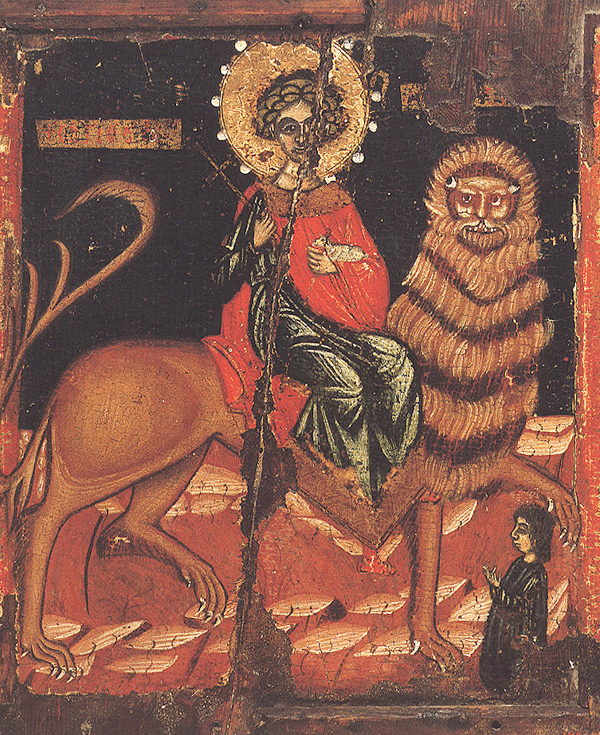
Soon he received a remarkable power over the forces of nature: wild beasts inhabiting the surrounding wilderness gathered at his abode and listened to the reading of the Holy Gospel. Saint Mamas nourished himself on the milk of wild goats and deer.
The saint did not ignore the needs of his neighbors. Preparing cheese from this milk, he gave it away freely to the poor. Soon the fame of Saint Mamas’s life spread throughout all of Caesarea.
The governor sent a detachment of soldiers to arrest him. When they encountered Saint Mamas on the mountain, the soldiers did not recognize him, and mistook him for a simple shepherd. The saint then invited them to his dwelling, gave them a drink of milk and then told them his name, knowing that death for Christ awaited him. The servant of God told the servant of the Emperor to go on ahead of him into Caesaria, promising that he would soon follow. The soldiers waited for him at the gates of the city, and Saint Mamas, accompanied by a lion, met them there.
Surrendering himself into the hands of the torturers, Saint Mamas was brought to trial under a deputy governor named Alexander, who subjected him to intense and prolonged tortures. They did not break the saint’s will, however. He was strengthened by the words addressed to him from above: “Be strong and take courage, Mamas.”
When they threw Saint Mamas to the wild beasts, these creatures would not touch him. Finally, one of the pagan priests struck him with a trident. Mortally wounded, Saint Mamas went out beyond the city limits. There, in a small stone cave, he gave up his spirit to God, Who in the hearing of all summoned the holy Martyr Mamas into His heavenly habitation. He was buried by believers at the place of his death.
Christians soon began to receive help from him in their afflictions and sorrows. Saint Basil the Great speaks thus about the holy Martyr Mamas in a sermon to the people: “Remember the holy martyr, you who live here and have him as a helper. You who call on his name have been helped by him. Those in error he has guided into life. Those whom he has healed of infirmity, those whose dead children he has restored to life, those whose life he has prolonged: let us all come together as one, and praise the martyr!”
Martyrs Theodotus and Rufina of Caesarea, in Cappadocia
The holy martyrs Theodotus and Rufina were the parents of Saint Mamas. They came from patrician families, and were honored by all for their Christian piety. Alexander, the magistrate of the city of Gangra, summoned them because they refused to obey the imperial decree requiring all citizens to worship the pagan gods. Those who disobeyed would be tortured and put to death.
Since Theodotus refused to comply with this order, Alexander sent him to the governor Faustus in Caesarea of Cappadocia. Alexander could not torture or kill Theodotus because of his noble rank. Faustus, however, had no such scruples. He threw Theodotus into prison as soon as he arrived.
Even though she was pregnant at the time, Rufina followed her husband. She stayed in the prison with Theodotus, where they both suffered for Christ. Fearing that he would not be able to withstand the cruel tortures, Theodotus asked God to take his soul. The Lord heard his prayer and sent him a blessed repose, establishing his soul in the heavenly mansions.
Saint Rufina endured privations and sufferings in prison, and experienced great sorrow at the death of her husband. Because of these things, she gave birth to her child before the proper time. She prayed that God would permit her to follow her husband in death, and that He would also protect her child. Her prayer was also granted, and she gave her virtuous soul into God’s hands.
Saint Mamas was raised by a pious woman named Ammia, or Matrona, who became a second mother to him.
Saint John the Faster, Patriarch of Constantinople
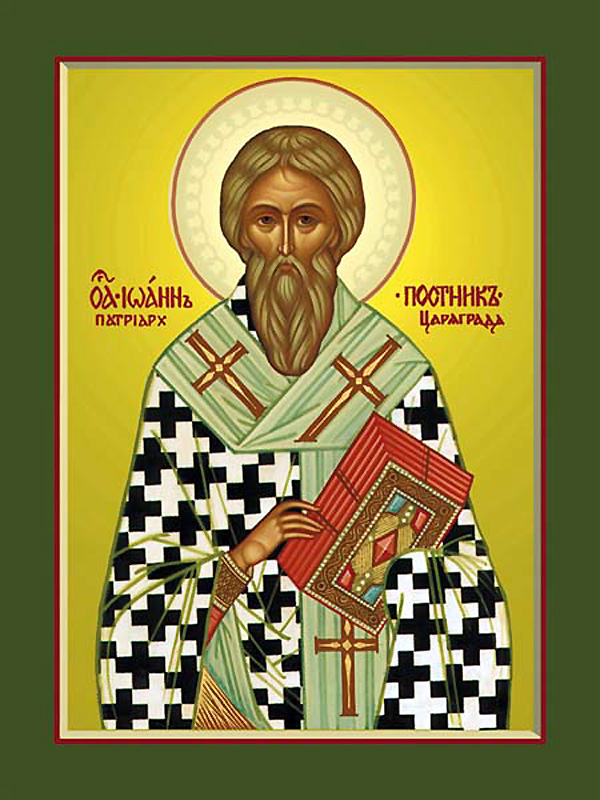
Our Holy Father John was born in Constantinople, the Queen of Cities. At first he worked as a goldsmith, and everyone expected him to continue in that occupation. From his youth, however, he was inclined toward the monastic life. He also possessed a rare gift for continence and a natural love for fasting, and thus he was known as “the Faster.” Because of his reputation for virtue, he was ordained as a deacon by Patriarch John III, and later he received the grace of the priesthood. Saint John was found worthy to behold a vision which showed that he would become be a worthy recipient of God’s grace, for the spiritual enlightenment of his flock. He read the Holy Scriptures and other ecclesiastical books every day, thereby enriching his knowledge.
Once, when he was a young man, John was walking with Eusebius, an old monk from Palestine. Suddenly, a bodiless voice spoke to Eusebius: “Abba, do not walk to the right of the great John.” It was the voice of God, foretelling the great service to which John would shortly be called.
After the death of Patriarch Eutychius, Saint John was chosen to succeed him. He did not want to accept the office, but he was frightened by a heavenly vision, and so he consented. By the example of his own life he taught all believers to restrain their capricious desires and to control themselves. The hierarch was unable to abide his flock’s blatant disregard for the institutions of the Church. When the citizens of Constantinople decided to give in to their passions by attending a horse show in the Hippodrome on eve of the Feast of Pentecost, the hierarch fell on his knees before God and fervently prayed that the Lord would thwart their impious intention. As soon as the people began to make their way to the Hippodrome, a terrible storm arose with thunder, rain and hailstones so that everyone dispersed in fear and came to realize the inappropriateness of such entertainment.
St John was Patriarch of Constantinople from 582 - 595, and was the first to use the title “Ecumenical Patriarch.”
He was a great faster, intercessor and wonderworker right up to the time of his death. Distinguished for his abstinence and prayer, Saint John had such a love for the poor that he refused them nothing from his estate. After his death, his only personal possessions were found to be a wooden spoon, a linen shirt and an old garment. His writings on repentance and Confession are well known.
After a virtuous life of piety, during which he performed many miracles, Saint John reposed on September 2, 595. His grace-filled relics were entombed in the Church of the Holy Apostles.
Saint John is also commemorated on August 30.
3,628 Martyrs who suffered at Nicomedia
The 3,628 Martyrs in Nicomedia suffered under the emperors Diocletian (284-305) and Maximian (305-311). These were Christians who had come from Alexandria. They had come to believe in Christ following the martyrdom of Saint Peter, Archbishop of Alexandria (November 25).
Taking their wives and children with them, they arrived in Nicomedia and voluntarily presented themselves for martyrdom, exclaiming, “We are Christians.” At first, Diocletian tried to persuade them to renounce Christ, but seeing their resolve, he ordered them all to be beheaded, and for their bodies to be thrown into a fiery pit.
Many years later, the relics of the holy martyrs were discovered through various manifestations of grace.
Icon of the Mother of God of Kaluga
The Kaluga Icon of the Mother of God appeared in 1748 in the village of Tinkova, near Kaluga, at the home of the landowner Basil Kondratevich Khitrov. Two servants of Khitrov were cleaning out junk from the attic of his home. One of them, Eudokia, noted for her temper, was given to rough and even indecorous language. Her companion was modest and serious.
They discovered a large package covered in a linen cloth. Undoing it, the girl saw the picture of a woman in dark garments with a book in her hands. Considering it to be the portrait of a woman monastic and wanting to bring Eudokia to her senses, she accused her of being disrespectful to the abbess.
Eudokia jeered at the scolding words of her companion, and becoming increasingly angry, she spit on the picture. Immediately, she became convulsed and fell down senseless. She also became blind and mute. Her frightened companion reported what had happened to the household.
The next night, the Queen of Heaven appeared to Eudokia’s parents and told them that their daughter had behaved impertinently toward Her and She ordered them to serve a Molieben before the insulted icon, then sprinkle the invalid with holy water at the Molieben.
After the Molieben Eudokia recovered, and Khitrov took the wonderworking icon into his own home, where it granted healing to those approaching it with faith. Later, the icon was placed in the parish temple of the Nativity of the Most Holy Theotokos in the village of Kaluga. At the present time it is located in the cathedral church of Kaluga.
Through this icon the Mother of God has repeatedly manifest Her protection of the Russian land during difficult times. The celebration of the Kaluga Icon on September 2 was established in remembrance of the deliverance from a plague in 1771. A second celebration was established October 12, in memory of the preservation of Kaluga from the French invasion of 1812. In 1898, a celebration was established on July 18 in gratitude to the Mother of God for protection against cholera. The icon is also commemorated on the first Sunday of the Apostles’ Fast.