The Holy Martyr Photina (Svetlana) the Samaritan Woman, her sons Victor (named Photinus) and Joses; and her sisters Anatola, Phota, Photis, Paraskevḗ, Kyriake; Nero’s daughter Domnina; and the Martyr Sebastian: The holy Martyr Photina was the Samaritan Woman, with whom the Savior conversed at Jacob’s Well (John. 4:5-42).
During the time of the emperor Nero (54-68), who displayed excessive cruelty against Christians, Saint Photina lived in Carthage with her younger son Joses and fearlessly preached the Gospel there. Her eldest son Victor fought bravely in the Roman army against barbarians, and was appointed military commander in the city of Attalia (Asia Minor). Later, Nero called him to Italy to arrest and punish Christians.
Sebastian, an official in Italy, said to Saint Victor, “I know that you, your mother and your brother, are followers of Christ. As a friend I advise you to submit to the will of the emperor. If you inform on any Christians, you will receive their wealth. I shall write to your mother and brother, asking them not to preach Christ in public. Let them practice their faith in secret.”
Saint Victor replied, “I want to be a preacher of Christianity like my mother and brother.” Sebastian said, “O Victor, we all know what woes await you, your mother and brother.” Then Sebastian suddenly felt a sharp pain in his eyes. He was dumbfounded, and his face was somber.
For three days he lay there blind, without uttering a word. On the fourth day he declared, “The God of the Christians is the only true God.” Saint Victor asked why Sebastian had suddenly changed his mind. Sebastian replied, “Because Christ is calling me.” Soon he was baptized, and immediately regained his sight. Saint Sebastian’s servants, after witnessing the miracle, were also baptized.
Reports of this reached Nero, and he commanded that the Christians be brought to him at Rome. Then the Lord Himself appeared to the confessors and said, “Fear not, for I am with you. Nero, and all who serve him, will be vanquished.” The Lord said to Saint Victor, “From this day forward, your name will be Photinus, because through you, many will be enlightened and will believe in Me.” The Lord then told the Christians to strengthen and encourage Saint Sebastian to peresevere until the end.
All these things, and even future events, were revealed to Saint Photina. She left Carthage in the company of several Christians and joined the confessors in Rome.
At Rome the emperor ordered the saints to be brought before him and he asked them whether they truly believed in Christ. All the confessors refused to renounce the Savior. Then the emperor gave orders to smash the martyrs’ finger joints. During the torments, the confessors felt no pain, and their hands remained unharmed.
Nero ordered that Saints Sebastian, Photinus and Joses be blinded and locked up in prison, and Saint Photina and her five sisters Anatola, Phota, Photis, Paraskevḗ and Kyriake were sent to the imperial court under the supervision of Nero’s daughter Domnina. Saint Photina converted both Domnina and all her servants to Christ. She also converted a sorcerer, who had brought her poisoned food to kill her.
Three years passed, and Nero sent to the prison for one of his servants, who had been locked up. The messengers reported to him that Saints Sebastian, Photinus and Joses, who had been blinded, had completely recovered, and that people were visiting them to hear their preaching, and indeed the whole prison had been transformed into a bright and fragrant place where God was glorified.
Nero then gave orders to crucify the saints, and to beat their naked bodies with straps. On the fourth day the emperor sent servants to see whether the martyrs were still alive. But, approaching the place of the tortures, the servants fell blind. An angel of the Lord freed the martyrs from their crosses and healed them. The saints took pity on the blinded servants, and restored their sight by their prayers to the Lord. Those who were healed came to believe in Christ and were soon baptized.
In an impotent rage Nero gave orders to flay the skin from Saint Photina and to throw the martyr down a well. Sebastian, Photinus and Joses had their legs cut off, and they were thrown to dogs, and then had their skin flayed off. The sisters of Saint Photina also suffered terrible torments. Nero gave orders to cut off their breasts and then to flay their skin. An expert in cruelty, the emperor readied the fiercest execution for Saint Photis: they tied her by the feet to the tops of two bent-over trees. When the ropes were cut the trees sprang upright and tore the martyr apart. The emperor ordered the others beheaded. Saint Photina was removed from the well and locked up in prison for twenty days.
After this Nero had her brought to him and asked if she would now relent and offer sacrifice to the idols. Saint Photina spit in the face of the emperor, and laughing at him, said, “O most impious of the blind, you profligate and stupid man! Do you think me so deluded that I would consent to renounce my Lord Christ and instead offer sacrifice to idols as blind as you?”
Hearing such words, Nero gave orders to again throw the martyr down the well, where she surrendered her soul to God (ca. 66).
On the Greek Calendar, Saint Photina is commemorated on February 26.
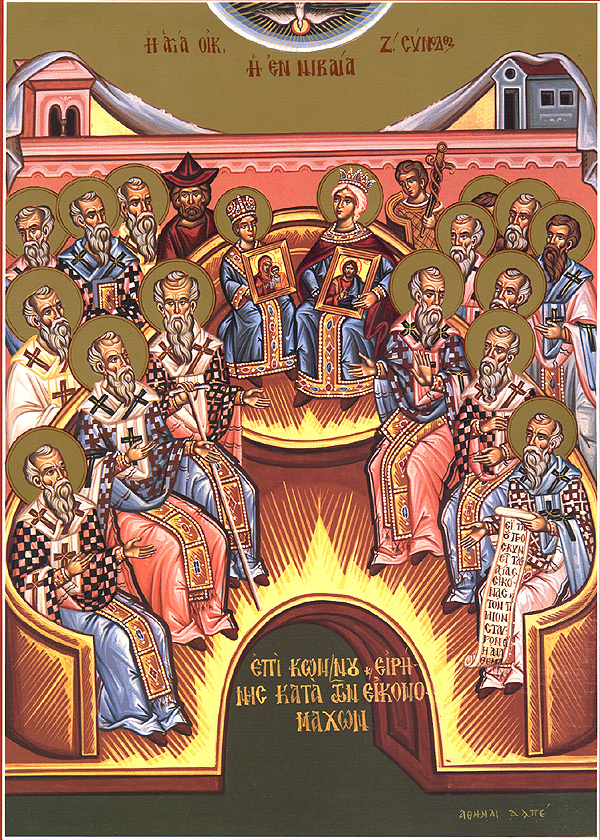
Commemoration of the Holy Fathers of the Seventh Ecumenical Council
Today the Church remembers the 350 holy Fathers of the Seventh Ecumenical Council under the holy Patriarch Tarasius (February 25).
The Synod of 787, the second to meet at Nicea, refuted the Iconoclast heresy during the reign of Empress Irene and her son Constantine VI.
The Council decreed that the veneration of icons was not idolatry (Exodus 20:4-5), because the honor shown to them is not directed to the wood or paint, but passes to the prototype (the person depicted). It also upheld the possibility of depicting Christ, Who became man and took flesh at His Incarnation. The Father, on the other hand, cannot be represented in His eternal nature, because “no man has seen God at any time” (John 1:18).
In Greek practice, the holy God-bearing Fathers of the Seventh Ecumenical Council are commemorated on October 11 (if it is a Sunday), or on the Sunday which follows October 11. According to the Slavic menaion, however, if the eleventh falls on Monday, Tuesday, or Wednesday, the service is moved to the preceding Sunday.
Martyrs Gervasius, Nazarius, Protasius, and Celsus of Milan
The Holy Martyrs Nazarius, Gervasius, Protasius and Celsus of Milan suffered during the reign of the emperor Nero (54-68). Saint Nazarius (son of the Christian Perpetua and the Jew Africanus) was born at Rome and was baptized by Bishop Linus. From his youth Nazarius decided to devote his life to preaching Christ and to aid wandering Christians. With this intent he left Rome and arrived in Mediolanum (Milan).
Saints Protasius and Gervasius were twin brothers from Mediolanum (Milan), the sons of wealthy Roman citizens, Vitalius and Valeria. When they received their inheritance from their parents, they distributed the money to the poor, freed their slaves, and occupied themselves with fasting and prayer. The pagans locked them up in prison because they were Christians. Saint Nazarius met Protasius and Gervasius when he was visiting Christians in the Mediolanum prison. He so loved the twins that he wanted to suffer and die with them. The ruler heard that he was visiting the prisoners, so he had Saint Nazarius beaten with rods, then driven from the city.
Saint Nazarius proceeded to Gaul (modern France), and there he successfully preached Christianity and converted many pagans. In the city of Kimel he baptized Celsus, the son of a Christian woman who entrusted her child to the saint. Nazarius raised the boy in piety, and acquired a faithful disciple and coworker in his missionary labors.
The pagans threw the saints to wild animals to be eaten, but the beasts would not touch them. Afterwards, they tried to drown the martyrs in the sea, but they walked upon the water as if on dry land. The soldiers who carried out the orders were so amazed that they themselves accepted Christianity and released the holy martyrs.
Saints Nazarius and Celsus went to Milan and visited Gervasius and Protasius in prison. For this, they were brought before Nero, who ordered that Saints Nazarius and Celsus be beheaded. Soon after this the holy brothers Gervasius and Protasius were also executed. The relics of all four martyrs were stolen by a Christian named Philip, and were buried in his house.
Many years later, during the reign of the holy Emperor Theodosius (408-450), Saint Ambrose, Bishop of Milan (December 7), discovered the relics of Saints Gervasius and Protasius through a revelation from God.
In the reign of Arcadius and Honorius, Saint Ambrose also discovered the relics of Saints Nazarius and Celsus. The holy relics, glorified by many healings, were solemnly transferred to the Milan cathedral.
Venerable Paraskevi (Petka) of Serbia
Saint Paraskevi (Paraskevḗ) the New was born into a pious family, living during the eleventh century in the village of Epivato, between Silistra and Constantinople. Her older brother Euthymius became a monk, and later he was consecrated as Bishop of Matidia. One day, while attending the divine services, the words of the Lord pierced her heart like an arrow, “If any man will come after Me, let him deny himself” (Mt. 16:24). From that time she began to distribute her clothing to the needy, for which reason she endured much grief from her family.
Upon the death of her parents, the saint was tonsured into monasticism at the age of fifteen. She withdrew to the Jordanian desert where she lived the ascetic life until she reached the age of twenty-five. An angel of the Lord ordered her to return to her homeland, so she stayed at Epivato for two years.
Saint Paraskevi departed to the Lord at the age of twenty-seven, and was buried near the sea. Because of the many miracles which took place at her grave, her relics were uncovered and found to be incorrupt. They were placed in the church of the Holy Apostles at Epivato, where they remained for about 175 years.
Saint Paraskevi’s relics were moved to Trnovo, Bulgaria in 1223 and placed in the cathedral. Patriarch Euthymius wrote her Life and established the day of her commemoration as October 14. The Turks occupied Bulgaria in 1391, and her relics were given to Mircea the Elder, Prince of the Romanian Land (one of the districts of Romania). In 1394 the relics were given to Princess Angelina of Serbia (July 30), who brought them to Belgrade. For 120 years Saint Paraskevi’s relics rested in Constantinople in the patriarchal cathedral.
On June 13, 1641, her incorrupt relics were transferred to the monastery of the Three Hierarchs at Jassy in Rumania, where many healings took place. On December 26, 1888, after being rescued from a fire, Saint Paraskevi’s relics were moved again. This time they were placed in the new cathedral at Jassy, where they remain until the present day.
Venerable Nicholas Sviatosha Prince of Chernigov, and Wonderworker of the Kiev Near Caves
Saint Nicholas Sviatosha, Prince of Chernigov, and Wonderworker of the Kiev Caves, Near Caves, was a great-grandson of Great Prince Yaroslav the Wise and son of Prince David Svyatoslavich of Chernigov (+ 1123). Nicholas was the Prince of Lutsk, and he had a wife and children (his daughter was later married to the Novgorod prince Saint Vsevolod-Gabriel (February 11).
On February 17, 1106 the holy prince left his family and was tonsured at the Kiev Caves monastery. Nicholas Sviatosha carried out his obediences with great humility. For three years he worked in the kitchen, for which he chopped wood and carried water. For the next three years, he was gatekeeper at the monastery. The saint had a garden around his cell. Out of his own means he built at the monastery the temple of the Holy Trinity and the infirmary church in the name of Saint Nicholas, his patron saint.
Saint Nicholas was the first of the Russian princes to accept monasticism, patiently enduring the reproaches of his brothers for his decision to lead a life of humble obedience. The saint’s doctor, Peter, pointed out to the royal ascetic that such exploits of obedience had injured his health. But suddenly the doctor himself fell sick, and was healed only by the prayer of Saint Nicholas. Then Peter himself was tonsured.
After he had progressed through various obediences, Saint Nicholas took upon himself the vow of silence. When the saint received money, he used it to beautify the church and to procure books (because he loved reading), or he distributed it to the poor. Saint Nicholas was a zealous peacemaker; in 1142 he reconciled the Prince of Chernigov with the Great Prince Vsevolod.
Soon after the death of the saint, his brother Prince Izyaslav fell grievously ill. The igumen of the monastery sent the sick man the saint’s hairshirt. Izyaslav put it on and was healed.
Hieromartyr Silvanus of Gaza
The Holy Hieromartyr Silvanus of Gaza was a native of the city of Gaza. He was first a soldier, then a priest. He was falsely accused of a crime and sentenced to labor in the copper mines. In spite of many tribulations, the saint did not renounce Christ. In his old age, he was beheaded together with forty other Christians.
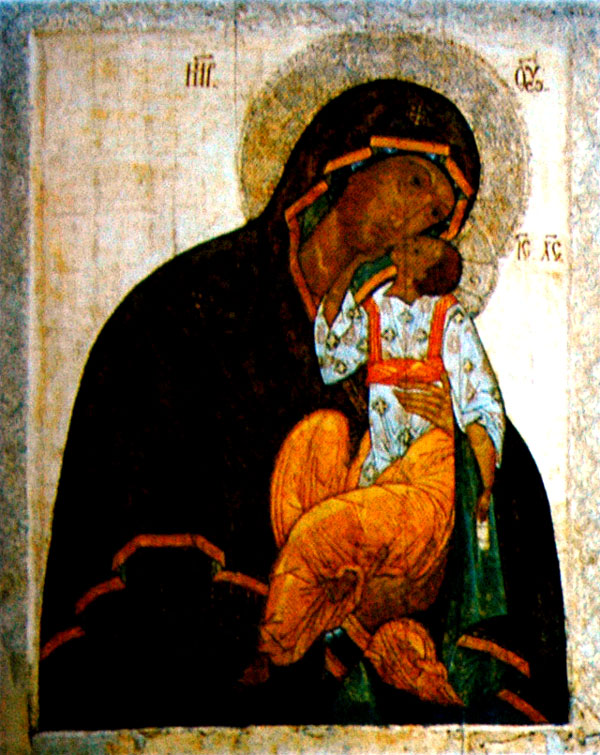
Icon of the Mother of God of Yakhrom
The Yakhrom Icon of the Mother of God appeared to the holy youth Cosmas (February 18), while he was accompanying his master, a sick landowner. Cosmas had stopped at the bank of the Yakhrom River, not far from Vladimir, and the sick man fell asleep. Cosmas suddenly saw a bright light coming from a nearby tree, and heard a voice, “Attend and understand the words of life. Live a God-pleasing life and seek the joy of the righteous, and then you will delight in eternal blessings.” The light had come from an icon of the Dormition of the Most Holy Theotokos.
Saint Cosmas (February 18) took the icon and placed it on his master, who was immediately healed. After this, Cosmas’s term of servitude expired, so he went to the Kiev Caves monastery. After he was tonsured, he amazed even the experienced monks by his own spiritual efforts.
Years later, Saint Cosmas was told by an angel to return to the place where he had found the icon. He took the wonderworking icon with him to the bank of the Yakhrom River where he had found the icon. At once, the place was again filled with light. Saint Cosmas built a monastery in honor of the Dormition of the Mother of God, and placed the Yakhrom Icon within it.