On the day after every Great Feast, the Orthodox Church honors the one through whom the Feast is made possible. On the day following the Nativity of the Lord, for example, we celebrate the Synaxis of the Most Holy Theotokos (December 26). On the day after Theophany, we commemorate Saint John the Baptist (January 7), and so on.
Today we honor the all-Holy, good, and life-creating Spirit, Who descended upon the Apostles at Pentecost in the form of fiery tongues in fulfillment of the Lord’s promise to send the Comforter to His disciples (JN 14:16). That same Holy Spirit remains within the Church throughout the ages, guiding it “into all truth” (JN 16:13).
One of the hymns at Vespers on Saturday evening tells us that the Holy Spirit “provides all things. He gushes forth prophecy, He perfects the priesthood, ... He holds together the whole institution of the Church.”
At Vespers on the day of Pentecost, we hear that the Holy Spirit is “the Fountain of goodness, through Whom the Father is known, and the Son is glorified.” He is “the living Fountain of spiritual gifts” Who “purifies us from our sins.” It is by the Holy Spirit that “the prophets, divine Apostles, and martyrs are crowned.” He is the source of life and of sanctification.
In the services of this day, we sing the same hymns as on Pentecost, except the Canon of the Holy Spirit, which is sung at Compline. The Vigil is not prescribed for the eve of today’s feast. We sing the Great Doxology at Matins, but not the Polyeleos. The Irmos of the Ninth Ode (“Hail, O Queen, glory of mothers and virgins...”) is sung in place of the Song of the Theotokos (“My soul magnifies the Lord...”).
At the Liturgy, the priest or deacon chants the Entrance Verse (“Be exalted in Thy strength, O Lord. We will sing and praise Thy power.”) as on the day of Pentecost. “Holy God” replaces “As many as have been baptized....” The dismissal of Pentecost is also used.
This whole week is fast-free, and the Leave-taking of Pentecost occurs on Saturday.
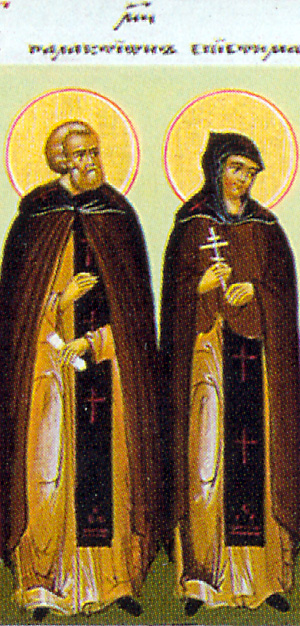
Martyrs Galaction and his wife, Epistemis, at Emesa
There was a rich and distinguished couple named Kletophon and Leukippe, who lived in the Syrian city of Emesa, and for a long time they were childless. They gave much gold to the pagan priests, but still they remained childless.
The city of Emesa was governed by a Syrian named Secundus, put there by the Roman Caesars. He was a merciless and zealous persecutor of Christians, and to intimidate them he ordered that the instruments of torture be displayed on the streets. The slightest suspicion of belonging to “the sect of the Galilean” (as thus Christians were called by the pagans), was enough to get a man arrested and handed over for torture. In spite of this, many Christians voluntarily surrendered themselves into the hands of the executioners, in their desire to suffer for Christ.
A certain old man by the name of Onuphrius concealed his monastic and priestly dignity beneath his beggar’s rags. He walked from house to house in Emesa, begging alms. At the same time, whenever he saw the possibility of turning people away from the pagan error, he preached about Christ.
Once, he came to the magnificent house of Leukippe. Accepting alms from her, he sensed that the woman was in sorrow, and he asked what was the cause of this sadness. She told the Elder about her familial misfortune. In consoling her, Onuphrius began to tell her about the one true God, about His omnipotence and mercy, and how He always grants the prayer of those turning to Him with faith. Hope filled the soul of Leukippe. She believed and accepted Holy Baptism. Soon after this it was revealed to her in a dream that she would give birth to a son, who would be a true follower of Christ. At first, Leukippe concealed her delight from her husband, but after the infant was born, she revealed the secret to her husband and also persuaded him to be baptized.
They named the baby Galaction and his parents raised him in the Christian Faith and provided him a fine education. He could make an illustrious career for himself, but Galaction sought rather an unsullied monastic life in solitude and prayer.
When Galaction turned twenty-four, his father resolved to marry him off and they found him a bride, a beautiful and illustrious girl by the name of Episteme. The son did not oppose the will of his father, but by the will of God, the wedding was postponed for a time. Visiting his betrothed, Galaction gradually revealed his faith to her. Eventually, he converted her to Christ and he secretly baptized her himself.
Besides Episteme he baptized also one of her servants, Eutolmius. The newly-illumined decided on the initiative of Galaction, to devote themselves to the monastic life. Leaving the city, they hid themselves away on Mount Publion, where there were two monasteries, one for men and the other for women. The new monastics had to take with them all the necessities for physical toil, since the inhabitants of both monasteries were both old and infirm.
For several years the monastics struggled in work, fasting and prayer. Once, Episteme had a vision in her sleep: she and Galaction stood in a wondrous palace before a radiant King, and the King bestowed golden crowns on them. This was a prefiguring of their impending martyrdom.
The pagans became aware of the existence of the monasteries, and a military detachment was sent to apprehend their inhabitants. But the monks and the nuns succeeded in hiding themselves in the hills. Galaction, however, had no desire to flee and so he remained in his cell, reading Holy Scripture. When Episteme saw that the soldiers were leading Galaction away in chains, she began to implore the Abbess to permit her to go also, since she wanted to accept torture for Christ together with her fiancé and teacher. The Abbess tearfully blessed Episteme to do so.
The saints endured terrible torments, while supplicating and glorifying Christ. Their hands and legs were cut off, their tongues were cut out, and then they were beheaded.
Eutolmius, the former servant of Episteme, and who had become her brother in Christ and fellow ascetic in monastic struggles, secretly buried the bodies of the holy martyrs. He later wrote an account of their virtuous life and their glorious martyrdom, for his contemporaries and for posterity.
Repose of Saint Jonah, Archbishop of Novgorod
Saint Jonah, Archbishop of Novgorod, in the world named John, was left orphaned early in life and was adopted by a certain pious widow living in Novgorod. She raised the child and sent him to school. Blessed Michael of Klops Monastery (January 11), who chanced to meet John on the street, foretold that he would become Archbishop of Novgorod. John received tonsure at the Otnya wilderness-monastery, 50 versts from the city, and he became igumen of this monastery. It was from here that the people of Novgorod chose him as their archbishop in 1458, after the death of Saint Euthymius (March 11).
Saint Jonah enjoyed great influence at Moscow, and during his time as hierarch, the Moscow princes did not infringe upon the independence of Novgorod. Saint Jonah, Metropolitan of Moscow (1449-1461), was a friend of the Novgorod Archbishop Saint Jonah, and wanted him to become his successor.
In 1463, Archbishop Jonah built the first church dedicated to Saint Sergius of Radonezh in the Novgorod region. Concerning himself over reviving traditions of the old days in the Novgorod Church, he summoned to Novgorod the renowned compiler of Saints’ Lives, Pachomius the Logothete, who wrote both the services and history of the best known Novgorod Saints, based on local sources.
And to this time period belongs also the founding of the Solovki monastery. Saint Jonah rendered much help and assistance in the organizing of the monastery. To Saint Zosimas he gave a special land-grant (in conjunction with the secular authorities of Novgorod), by which the whole of Solovki Island was granted to the new monastery.
The saint, after his many toils, and sensing the approach of his end, wrote a spiritual testament to bury his body at the Otnya monastery. On November 5, 1470, after he received the Holy Mysteries, the saint fell asleep in the Lord.
There has survived to the present day a Letter of Saint Jonah to Metropolitan Theodosius, written in 1464. The Life of the saint was written in the form of a short account in the year 1472 (included in the work, Memorials of Old Russian Literature, and also in the Great Reading Menaion of Metropolitan Macarius, under November 5). In 1553, after the uncovering of the relics of Archbishop Jonah, an account of this event was written by Saint Zenobius of Otnya (October 30). A special work relating the miracles of the saint is found in manuscripts of the seventeenth century.
Apostles Patrobus, Hermes, Linus, Gaius, and Philologus, of the Seventy
Saints Patrobus, Hermes, Linus, Gaius, and Philologus, Apostles of the Seventy, preached the Gospel in various cities, each enduring various hardships in their service as bishops.
Saint Patrobus (Rom 16:14) was Bishop of Neopolis (now Naples) and Puteoli in Italy.
Saint Hermes was bishop in the city of Philippoplis where he died a martyr.
Saint Linus (2 Tim 4:21) was a successor to the Apostle Peter at Rome.
Saint Gaius (Rom 16:23), was Bishop of Ephesus after Saint Timothy.
The Apostle Andrew consecrated Saint Philologus (Rom 16:15) as bishop of the city of Sinope (in the Black Sea region).
Saint Gregory, Archbishop of Alexandria
Saint Gregory the Archbishop of Alexandria lived in the ninth century. He was flogged and thrown into prison in the reign of Leo the iconoclast. He was left in prison without food until he died.